The House of Salusbury

– 3 min read


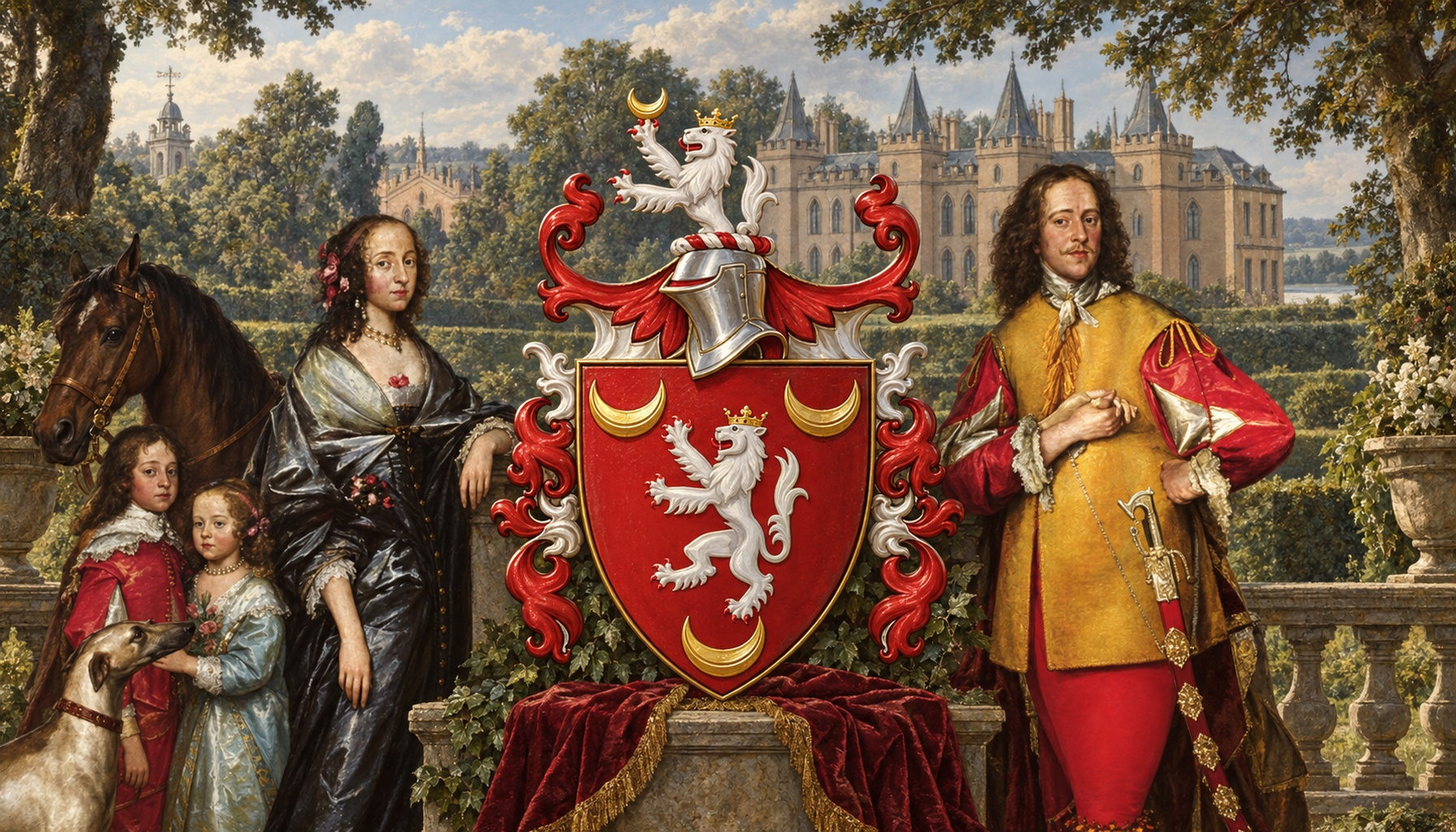
The House of Salusbury was one of the great historic families of north Wales, rooted above all in Denbighshire and closely bound to the estate of Lleweni. Their story belongs to that particularly Tudor and early modern Welsh world in which landed power, royal service, local influence, military ambition, and learning all met in the same household. The family is associated here with the Y-DNA haplogroup R1b1a1b1a1a2a1b, presented as the primary family haplogroup tag. In plain terms, this places the Salusburys within a broad paternal line that appears again and again across Atlantic and western European history, especially in regions touched by later Celtic and post-Roman populations.
The family emerged from the social and political fabric of north-east Wales, where old Welsh lineage, marcher politics, and the expanding authority of the English crown constantly rubbed against one another. By the 16th century the Salusburys had become one of the leading gentry houses of Denbighshire, not merely because they held land, but because they knew how to use it: through office, patronage, marriage, scholarship, and carefully cultivated standing at court. John Salusbury of Lleweni (1520-1578) helped anchor the family in regional authority; William Salusbury (1520-1584) became one of the most important figures in Welsh literary and religious history through his scholarship and translation work; and Sir Thomas Salusbury (1564-1586) showed the more dangerous side of noble politics, his career ending in execution after involvement in conspiracy against Elizabeth I. It is a family history with all the right ingredients: books and bloodlines, estate power and royal suspicion, local pride and national consequence.
If one place captures the Salusbury story, it is Lleweni Hall near Denbigh. Historically this was the principal seat of the family and the visible expression of their rank in the Vale of Clwyd. The estate became famous as one of the grand houses of Denbighshire, built up over generations and associated with political hospitality, cultured life, and the sort of landed self-confidence that made a family seem almost part of the landscape itself. The house known from later centuries was altered significantly, and much of the earlier great hall has been lost, so what survives today is only part of the long story. Even so, Lleweni remains the essential location anchor for the House of Salusbury: not just a building, but a statement of how north Welsh gentry power worked, with land, tenants, kinship, and reputation all flowing outward from one estate center. The hall and its grounds are tied to private property and changing preservation circumstances, so while the area and historic setting can still be appreciated, visits should be checked against current local access arrangements rather than assumed as open-house tourism.
From an ancient DNA perspective, the Salusbury haplogroup tag R1b1a1b1a1a2a1b sits within a very wide and well-traveled paternal landscape. Related or linked samples under this branch appear across Iron Age, Roman, medieval, and later contexts from Britain and Iberia to Gaul, the Low Countries, Germany, Italy, and beyond. Particularly suggestive parallels for a Welsh noble family with deep western British roots include Celtic and Romano-British linked finds such as Durotriges England Duropolis Winterborne Kingston (WBK36), Roman Era Fenstanton Cambridgeshire (FEN008), Medieval England Cherry Hinton (ATP_PSN_920), Late Medieval England Clopton Cambridgeshire (ATP_PSN_1217), High Status Parisi Nunburnholme Wold Yorkshire England (I5502), Elite Celtic Chariot Burial Iron Age England West Yorkshire Ferry Fryston (I50137), and Late Bronze Age Great Orme Wales (I1775). Iberian-linked examples such as Medieval Northern Spain Las Gobas (ldo066), Las Gobas (ldo037), Las Gobas (ldo048), and Dark Ages Las Gobas (ldo062) also show how this broader paternal lineage turns up repeatedly along the Atlantic-facing world. None of this proves direct descent from any one ancient individual, of course; what it does show is that the Salusbury-linked haplogroup belongs to an old and widespread western European paternal network, entirely at home in the long genetic backdrop of Britain, Wales, and the Celtic fringe.
Read more about the House of Wynne
If you are researching the House of Salusbury, the wider history of Denbighshire, or the deeper genetic landscape behind Welsh gentry families, this is exactly the sort of case where documents and DNA become much more interesting together. Upload your DNA to MyTrueAncestry to see whether you match the House of Salusbury, or related ancient DNA samples connected to the same broader R1b1a1b1a1a2a1b lineage across Britain and Europe.
Comments