Haplogroup T1a1a1b2b

– 4 min read


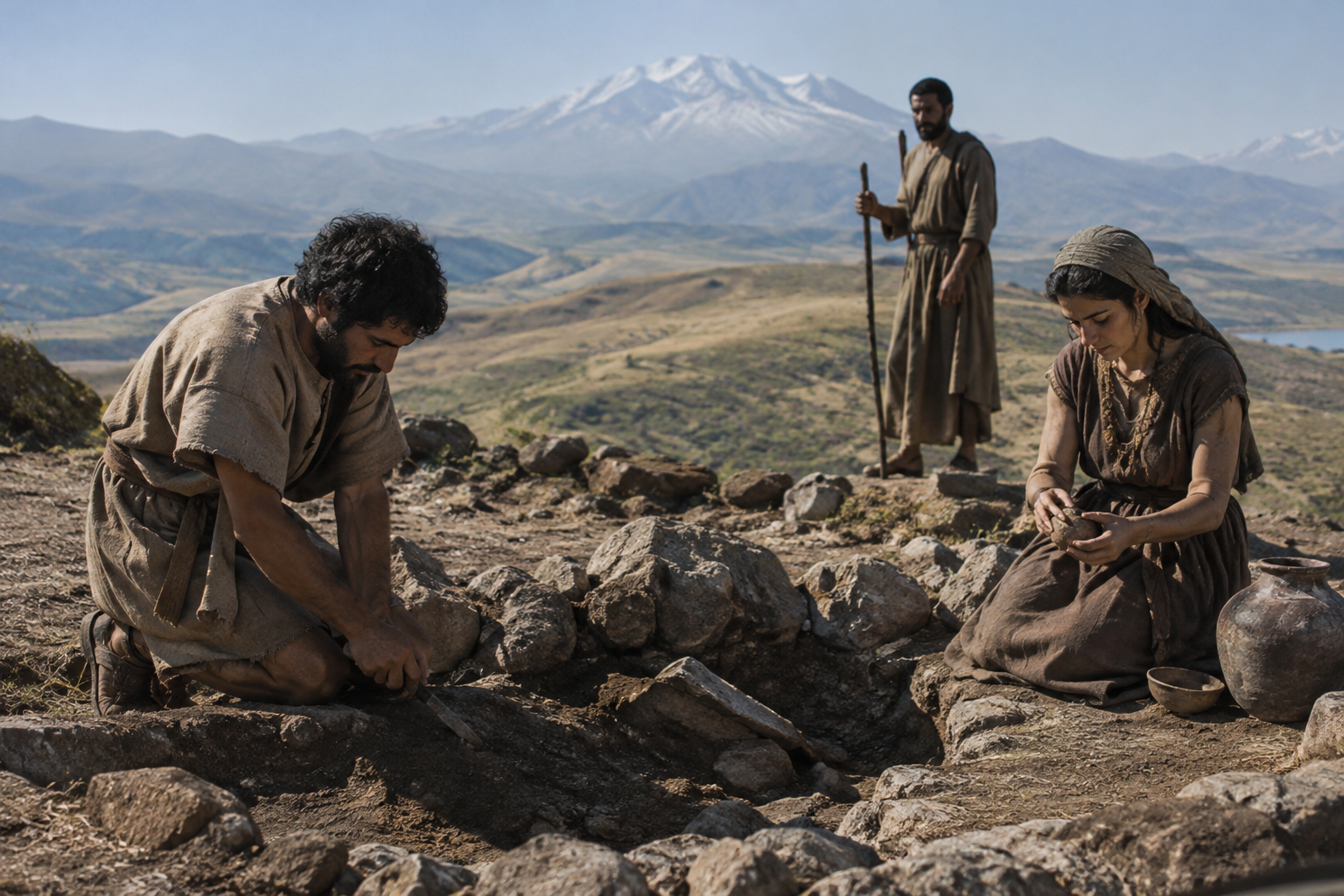
At Karashamb in Armenia, a Late Bronze Age burial identified as I19345 offers a rare fixed point for thinking about Y-DNA haplogroup T1a1a1b2b. The date given for this individual, around 1175 BC, places him in a South Caucasus world that was anything but isolated: mountain routes, river valleys, and political frontiers all met here, and so did people.
That matters because haplogroup T is one of those paternal lines that tends to appear in archaeology not as a blunt sign of one empire or one ethnicity, but as part of older and more intricate human movement around the Near East and neighboring regions. In this case, the MyTrueAncestry assignment points to the narrower branch T1a1a1b2b, while the ancient burial itself anchors the discussion in a real landscape and period. As ever with Y-DNA, we are looking at one direct paternal line, not the whole ancestry of the man in the grave.
Karashamb is one of the best-known archaeological locations in Armenia for exploring the Bronze Age and its aftermath. By the 12th century BC, the South Caucasus was living through the stresses and rearrangements that marked the wider Late Bronze Age world. This was not Mesopotamia, not the Aegean, and not the Eurasian steppe, yet it was in conversation with all of them through trade, migration, warfare, and local adaptation.
So when a paternal lineage such as T1a1a1b2b appears here, the interest lies less in any fantasy of a single "tribe" on the move and more in the region's role as a hinge between worlds. Armenia sat at the meeting point of Anatolian, Iranian, and Caucasian spheres. A man buried at Karashamb around 1175 BC belonged to that local historical reality first and foremost, even if his paternal line also hints at older connections spreading well beyond one valley or one kingdom.
A major ancient DNA study of the South Caucasus and neighboring regions has helped clarify just how dynamic this area was over several millennia, showing both continuity and change rather than a simple replacement story. For the broader regional picture, see this genetic study of the South Caucasus and its long population history.
The first thing to say is that T1a1a1b2b is a very specific branch name, much narrower than haplogroup T as a whole. That distinction is important. The wider T family has a broad and rather complicated history across parts of Southwest Asia, Northeast Africa, and the Mediterranean, but those deep patterns should not simply be copied onto one subclade as if nothing changed along the way.
In practical terms, Karashamb gives us evidence that a paternal line associated with this branch was present in Late Bronze Age Armenia. That is already useful. It places the lineage in an archaeologically rich setting at a time when the South Caucasus was connected to neighboring cultural zones but maintained its own local trajectories.
What it does not do is magically identify the language this man spoke, the polity he served, or a neat ethnic label for his descendants. Ancient DNA is often at its most valuable when it makes the old historical map look less tidy. One paternal line can pass through communities that change language, culture, and political allegiance many times over.
There is a lingering habit in popular history of treating upland regions as remote sidelines to "real" civilization. Karashamb makes that view look rather thin. Bronze Age and Late Bronze Age Armenia was not sitting passively on the edge of events. It was part of a corridor linking the Iranian plateau, eastern Anatolia, Mesopotamia, and the steppe to the north.
That is exactly the kind of setting where a lineage like T1a1a1b2b becomes historically interesting. Not because it proves one dramatic migration all by itself, but because it belongs to a zone where movement accumulated over centuries. Caravans, marriage alliances, local mobility, pastoral routes, and political disruptions all left traces in the human landscape. A Y-chromosome lineage can survive those changes even while everything around it shifts.
In other words, the South Caucasus often preserves the history of contact in miniature. One burial at Karashamb cannot stand for all Armenia, but it can remind us that paternal ancestry in this region was shaped by deep local roots and repeated external connections at the same time.
The date around 1175 BC is especially evocative because it falls in the centuries when many societies across the eastern Mediterranean and Near East were under strain. States rose, contracted, and sometimes disappeared; exchange systems were disrupted; regional centers were reconfigured. Yet archaeology increasingly shows that local communities did not simply vanish whenever the great powers stumbled.
That is one of the reasons a Karashamb individual matters. He stands at the level of lived history rather than imperial slogan. His paternal lineage survived in a landscape experiencing wider instability, which is a useful corrective to those sweeping collapse narratives that can flatten whole regions into background noise.
For family historians, this is worth lingering over. A haplogroup is not a royal badge or a civilization label. It is, rather, a thread running through ordinary and extraordinary history alike. T1a1a1b2b in this case appears not in a palace genealogy but in the archaeology of a real Late Bronze Age cemetery in Armenia, and that is often the more revealing sort of evidence.
If your paternal line falls under T1a1a1b2b, Karashamb provides a historically grounded point of comparison in the ancient South Caucasus. That does not mean your line "comes from" this one man in any simple sense, nor that every carrier of the branch must have Armenian ancestry in the recent genealogical period. It means that this branch, or a lineage closely tied to it, was present in a region that long served as a bridge between Anatolia, Iran, and the Caucasus.
That makes T1a1a1b2b particularly interesting for anyone whose family history touches the eastern Mediterranean, the Near East, or the Caucasus. The branch's significance lies in connection and persistence: a paternal line present in a crossroads region, surviving through centuries when local societies were changing but not disappearing.
The most responsible reading of haplogroup T1a1a1b2b is also the most interesting one. At Karashamb, sample I19345 shows this paternal line in Late Bronze Age Armenia, in a region shaped by long-distance contact and strong local continuity alike. For someone tracing this haplogroup today, that is a valuable clue: not a ready-made identity, but a well-placed ancestral signpost pointing toward the ancient South Caucasus and its wider Near Eastern connections.






Comments