Haplogroup T1a1a1a1

– 5 min read


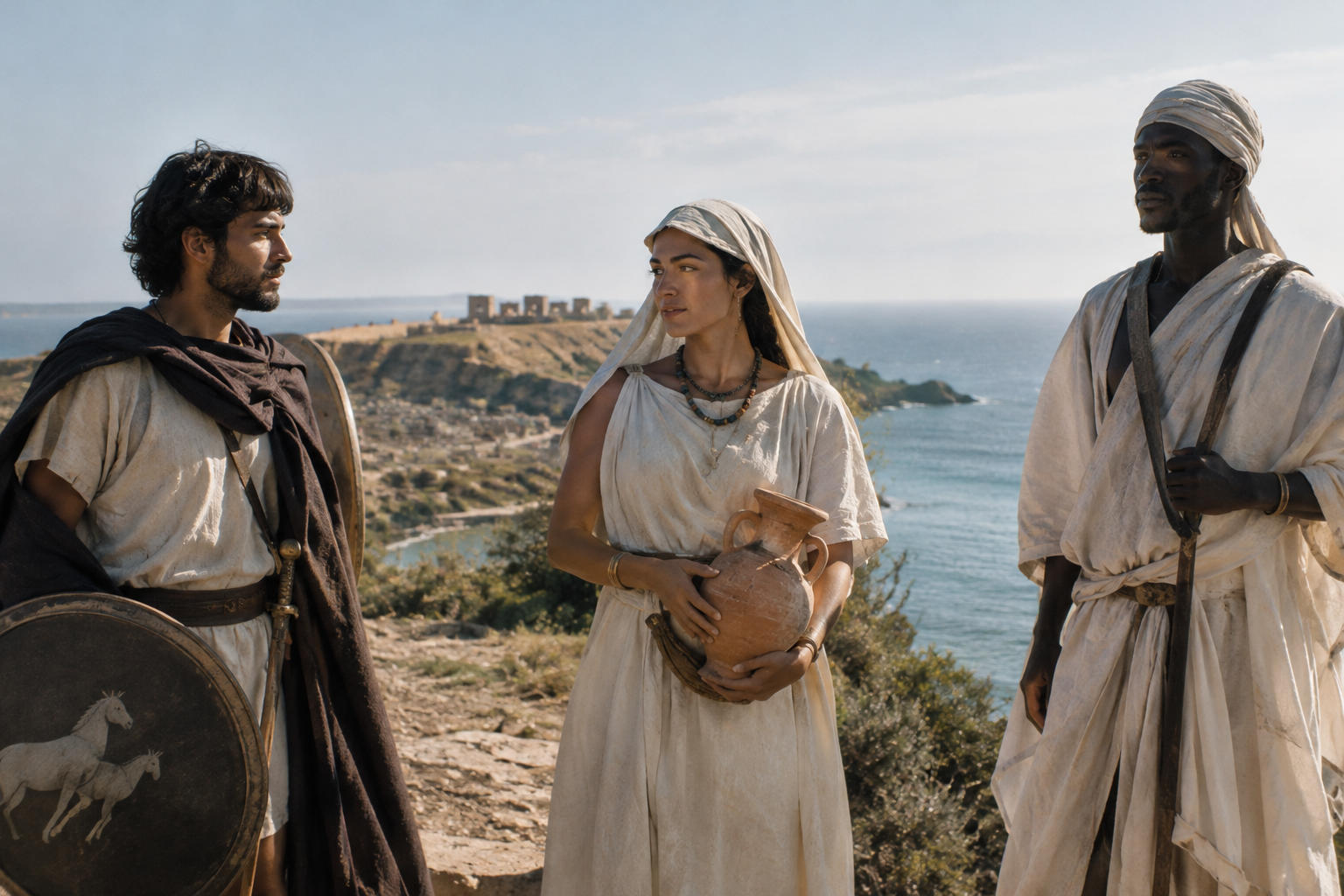
At Kerkouane on the Cap Bon peninsula of Tunisia, one ancient man stands out not because he confirms a stereotype about the Punic world, but because he complicates it. Sample I24205, dated to around 492 BC and described as a Punic Era outlier, belongs in the story of Y-DNA haplogroup T1a1a1a1. That matters because Kerkouane was one of the best-known Punic towns in the central Mediterranean, yet its people were never likely to have been a simple, single-origin population. Ancient DNA keeps forcing us back to that basic historical truth: port cities were messy, connected, and human.
T1a1a1a1 is a very specific paternal branch, nested within the wider haplogroup T. Y-DNA traces one direct male line only, so it does not define a person's whole ancestry, language, or identity. But when the same branch appears in widely separated settings - Punic Tunisia, Iron Age southeastern Spain, and medieval Nubia - it becomes historically interesting precisely because it hints at long-lived male-line continuity moving through old corridors of trade, settlement, and contact around the Mediterranean and into northeast Africa.
Kerkouane is a splendid place to begin because it belongs to a world that is often flattened into a simple Carthaginian map. In reality, Punic communities were part of a maritime network linking North Africa, Sicily, Sardinia, Iberia, and beyond. A man carrying T1a1a1a1 at Kerkouane does not prove that this lineage was "the Punic haplogroup" - that would be far too much to claim from one individual - but it does place the branch securely inside a Phoenician-Punic setting in the first millennium BC.
That makes historical sense. Punic settlements were commercial and colonial enterprises, yet also local communities built over generations, with marriages, mobility, and regional absorption. A branch like T1a1a1a1 appearing here fits the broader picture of a Mediterranean population assembled not by a single migration, but by repeated movement and mixture. One useful MyTrueAncestry companion piece on this wider context is the article on Punic genetic diversity.
A research preprint examining ancient individuals from Punic contexts, including material from North Africa and Mediterranean-connected sites, helped sharpen this emerging picture of diversity rather than uniformity: https://www.biorxiv.org/content/10.1101/2021.02.17.431423v1. Even without leaning too heavily on one paper, the broad lesson is clear enough: Punic archaeology and genetics alike resist tidy ethnic boxes.
The second key appearance is sample I18193, dated to around 268 BC, from Almera Cuevas del Almazora Villaricos in Iron Age Spain, described as a North African individual. Villaricos, ancient Baria, sits on the southeastern Iberian coast - exactly the sort of place where one would expect dense contact with Punic and North African networks. If Kerkouane gives us one side of the sea, Villaricos gives us the other.
This is where T1a1a1a1 becomes more than a curiosity. The same paternal branch is not just present in a Punic North African context; it also appears in Iberia in an individual explicitly identified as North African in ancestry terms. That does not mean a direct father-to-son chain can be drawn between Tunisia and Spain. But it does suggest that the branch moved within the same connected western Mediterranean world shaped by shipping routes, colonial enclaves, military ventures, and ordinary family life.
Southeastern Iberia in the later Iron Age was no backwater. It was entangled with Phoenician and Punic commerce for centuries, and later with Roman expansion. The genetic evidence for movement into and across Iberia has been building steadily, and readers who want the longer background may find a useful parallel in MyTrueAncestry's piece on Roman Hispania's lasting genetic legacy, which shows how layered the peninsula's population history became.
What makes I18193 especially valuable is that he stops us from treating Mediterranean connections as abstractions. Here is an actual man in Iberia whose ancestry was read as North African, and whose paternal line falls within T1a1a1a1. In other words, the seaways between Africa and Iberia were not just carrying amphorae and ideas. They were carrying people, and some of those people left descendants.
The third sample, I6340, comes from Kulubnarti in Makurian Nubia, dated to around AD 850. On the face of it, this seems a very different world: Christian medieval Nubia on the Nile rather than Punic ports on the Mediterranean. Yet this is exactly why the sample matters. T1a1a1a1 was not confined to one political culture or one coastline. By the early medieval period it also appears deep in the Nile corridor, in a region with its own long history of connections northward into Egypt and outward across northeast Africa.
Kulubnarti has become an important site for understanding medieval Nubian society, health, and ancestry. A recent ancient DNA study on the region, published in https://www.nature.com/articles/s41586-025-08913-3, has brought that community into much sharper focus. For the purposes of T1a1a1a1, the crucial point is not to force a romantic tale of one wandering clan from Carthage to the Nile, but to notice that this paternal branch belongs to a much older Afro-Mediterranean zone of contact than modern borders suggest.
That is worth pausing over. Historians often divide the ancient world into neat blocks - Mediterranean, North African, Nile Valley, Iberian - because our textbooks do. Real populations did not always oblige. Male lines could persist through conquest, conversion, language change, and the rise and fall of states. The man at Kulubnarti was not a "Punic survivor" in any simple sense; he was a medieval Nubian individual whose paternal ancestry happened to sit on a branch also seen centuries earlier in western Mediterranean contexts.
With only three ancient examples, caution is essential. We are not looking at a royal dynasty, a tribal badge, or a neatly mapped migration arrow. We are looking at a small but suggestive pattern: T1a1a1a1 turns up in places that were tied together by sustained movement of men, goods, and communities over many centuries.
The western Mediterranean examples are the strongest pair because they sit within a historically documented zone of Punic and North African interaction. Kerkouane and Villaricos are not random dots on a map. They are sites embedded in the same marine world, and the pairing of I24205 with I18193 gives this haplogroup a plausible archaeological setting in those networks. Kulubnarti then widens the frame, showing that the branch also existed in a later Nile Valley population rather than dying out or remaining regionally trapped.
That is often how ancient Y-DNA becomes historically useful. A branch does not need dozens of elite burials to tell us something. Sometimes a sparse distribution is enough to reveal where older corridors of contact ran, especially when the sites themselves are so well placed historically.
For another example of how ancient DNA is revealing unexpected diversity in Iberian settings, see the MyTrueAncestry article on diverse origins at a 7th-century Madrid burial site. It belongs to a later period, but the broader lesson is similar: Iberia repeatedly absorbed people from different directions, and the genetic record shows it.
If your paternal line falls under T1a1a1a1, these ancient cases suggest an intriguing but disciplined conclusion. This branch is attested in a Punic-era North African context, in Iron Age Iberia with a North African-associated individual, and in medieval Nubia. That does not tell you a single homeland story or guarantee descent from any named ancient people. What it does suggest is that your direct male line belongs to an old networked world spanning North Africa, the Mediterranean, and the Nile corridor - a world in which movement was normal, and continuity could survive enormous historical change.






Comments