Haplogroup T1a1a1a
– 5 min read


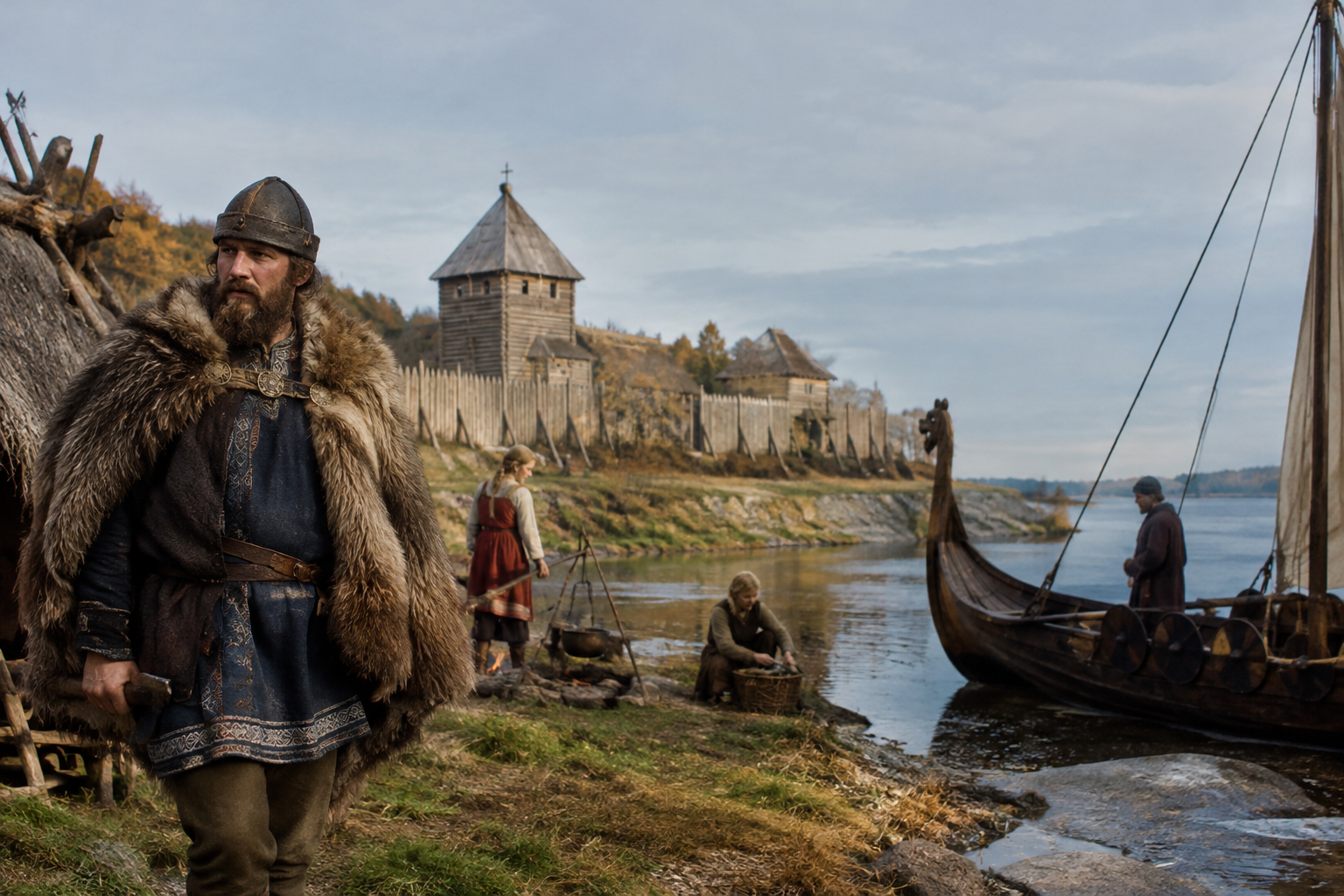
At Staraya Ladoga, on the Volkhov River in northwestern Russia, archaeologists are looking at one of the most famous threshold places of the Viking Age: a river-port town tied to trade, travel, and the making of early Rus'. Among the ancient individuals recovered there is sample VK17, dated to around AD 1000 and associated here with the Y-DNA haplogroup T1a1a1a. That is immediately interesting, because Staraya Ladoga is exactly the sort of place where paternal lineages from very different worlds might turn up side by side.
One ancient man does not stand for an entire people, of course. Y-DNA follows only one direct paternal line out of many ancestral lines. But a find like VK17 matters because it places this branch in a real medieval setting: not an abstract map, but a busy northern crossroads where Scandinavians, Slavs, Finnic groups, and long-distance merchants all moved through the same landscape.
Staraya Ladoga has long held a special place in early medieval history. It sat on a key route linking the Baltic to the river systems of eastern Europe, and from there onward toward Byzantium and the Islamic world. By about the 8th to 10th centuries, it was already a settlement with an unmistakably international character, shaped by exchange as much as by conquest or kingship.
That makes sample VK17 especially valuable. A paternal lineage reported as T1a1a1a in a Viking Age context reminds us that "Viking Age" is an archaeological and historical label, not a genetic one. The people found in Viking Age towns were not all cut from a single biological pattern. Some were locally rooted, some had mixed ancestry, and some likely came from far beyond the North itself.
A genetic study of Viking Age populations, available as research on ancient genomes from the Viking world, helped drive home precisely this broader point: Viking Age communities were often more diverse than older nationalist stories allowed. Even without overclaiming for one individual sample, VK17 fits that larger archaeological picture rather well.
Haplogroup T is a relatively uncommon Y-chromosome lineage in much of Europe today, especially when compared with better-known branches such as R1a, R1b, or I1 in northern and eastern European histories. That is one reason a T1a1a1a result at a Viking Age site catches the eye. It is not the expected headline lineage for the popular image of a Norse-age river town.
But rare does not mean inexplicable. Medieval trading ports are precisely where unusual paternal lines can appear, because ports collect people. A branch such as T1a1a1a may have arrived through merchant mobility, marriage, military service, small-scale migration, or generations of movement before the man represented by VK17 ever lived. The crucial thing is not to turn a single Y-line into a complete ethnic label.
And there is another point worth making carefully. The article haplogroup is T1a1a1a, a narrow branch. The wider parent haplogroup T has a broader and older distribution across parts of western Eurasia, but that does not allow us to assign the exact history of every T subclade automatically. In cases like VK17, the ancient context is firmer than any grand migration story we might be tempted to hang on it.
Staraya Ladoga was not a lonely Scandinavian colony dropped into the forest zone. It was part of a connected riverine system, with contacts running west into the Baltic and east and south into the great political and commercial networks of Eurasia. This is why Ladoga matters so much in both archaeology and early medieval history: it shows how movement worked before modern states drew hard borders.
A lineage like T1a1a1a in that setting may point less to a single dramatic migration than to the ordinary untidiness of medieval life. Men with different paternal origins could end up in the same town, under the same rulers, speaking different languages, trading in the same market, or buried in the same broad community. That, in a way, is the real historical force of the evidence.
Readers interested in the wider genetic background to language spread in northern Europe may also want to compare this with work on Germanic-speaking populations, where archaeology and genomics together show just how complex the relationship can be between language, identity, and ancestry.
Ancient DNA has been steadily dismantling the old habit of imagining past peoples as neat biological blocs. In the Viking world especially, the evidence increasingly points to mobility, mixing, and regional variation. Some burial grounds and settlements look fairly local in character; others show clear signs of people or ancestry arriving from farther afield. The significance of VK17 lies in adding one more concrete case to that pattern.
This is not just about Scandinavia either. The eastern Viking sphere, including places such as Staraya Ladoga, Novgorod, and the river networks leading toward the Black Sea and Caspian worlds, was especially open to contact. If one were designing the perfect place to find an unexpected Y-chromosome branch in around AD 1000, a trading centre like Ladoga would be high on the list.
That wider eastern setting has become increasingly important in MyTrueAncestry's own coverage of the medieval north and northeast. The story is not simply one of "Vikings moving out," but of frontier towns, river traffic, and mixed communities forming along the seams between cultural zones.
By around AD 1000, Staraya Ladoga belonged to a political and cultural environment often discussed in relation to the rise of the Rus'. Historians have argued for generations about the balance between Scandinavian initiative, Slavic development, and local Finnic participation in this process. Genetics does not settle those debates on its own, but it does provide a useful corrective: the human communities involved were evidently not simple or uniform.
In that sense, T1a1a1a at Ladoga is a small but eloquent detail. It suggests that the paternal landscape of the eastern Viking Age could include lineages that fall outside popular expectations. Rather than weakening the history, this makes it more believable. Real port towns are messy. Real state formation is messy. Real ancestry is messy too.
There is a useful parallel here with other early medieval populations around the Baltic, where burial evidence and DNA often reveal local continuity mixed with outside contacts. The old picture of sealed-off peoples gives way to something more recognisable: communities made by trade, kinship, opportunism, and repeated movement.
For someone exploring a present-day Y-DNA result of T1a1a1a, the most responsible lesson from VK17 is not a grand claim of Viking identity, but a more interesting historical possibility. This lineage could be present in medieval northern Europe within a genuinely cosmopolitan setting, in a town that connected the Baltic to wider Eurasia. In other words, your direct paternal line may belong to one of those smaller, less stereotyped threads that still ran through major historical centres.
That is often how ancient DNA is most useful: not by handing out simplistic labels, but by placing a paternal line inside a real human landscape. In the case of T1a1a1a, Staraya Ladoga offers exactly that sort of glimpse.






Comments