Haplogroup T1a1a1

– 5 min read


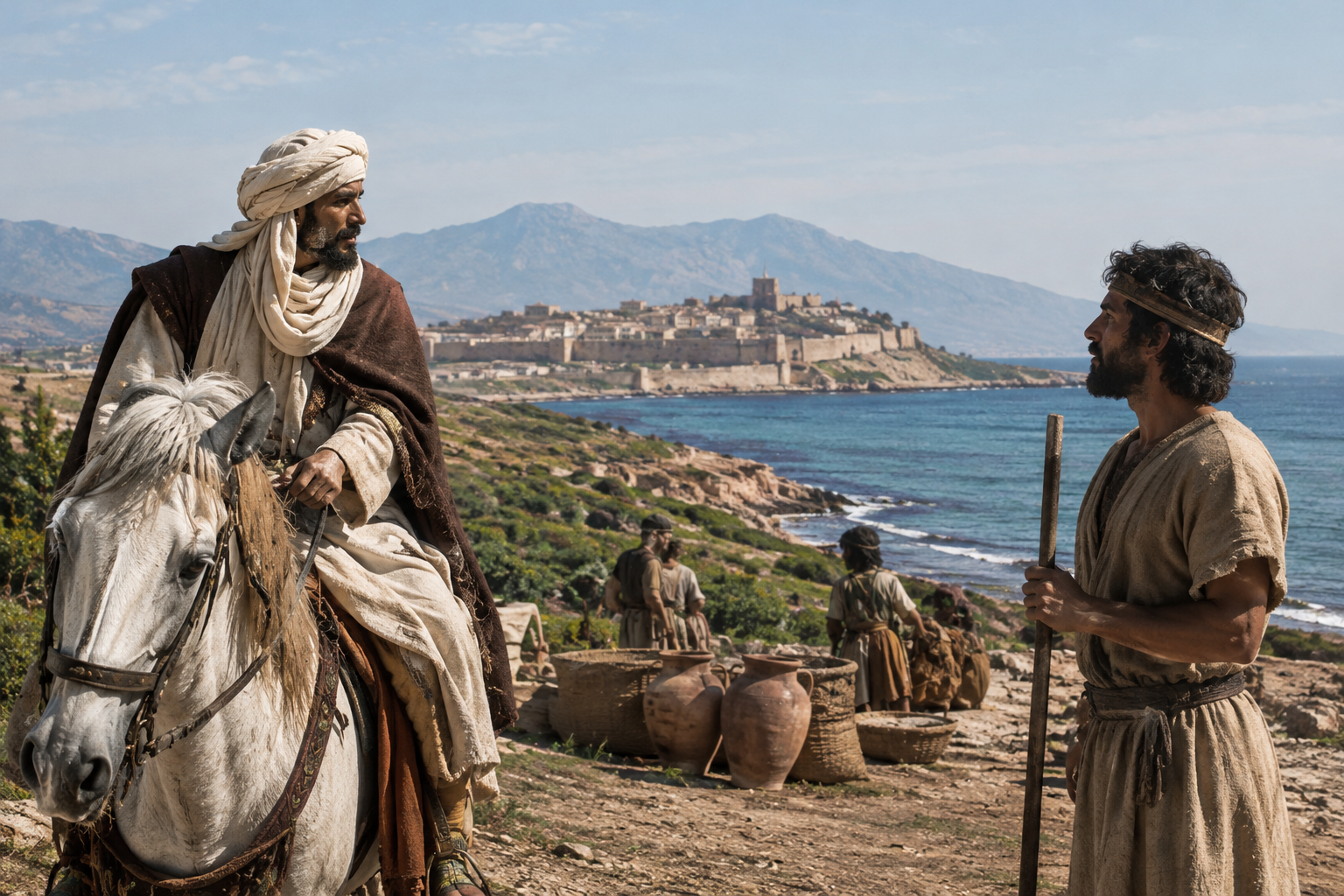
In the ancient kingdom of Yamhad, in what is now Kilis in southeast Anatolia, one Bronze Age male sample stands out for anyone interested in Y-DNA haplogroup T1a1a1: I14788, dated to around 1600 BC. That is a useful place to begin, because it anchors this paternal line not in myth or modern map-shading, but in a real person from a real political landscape - a world of fortified cities, cuneiform diplomacy, and long-distance exchange linking northern Syria, Anatolia, and Mesopotamia.
The second anchor comes much later and much farther west: I23165, dated to about 558 AD, from Arroyo Vaquero near Estepona, Malaga in early medieval Spain. Taken together, these two men do not tell us everything about T1a1a1. Y-DNA follows only one direct paternal line, after all. But they do show something historically interesting: this branch appears in two very different settings connected by the wider Mediterranean world, from Bronze Age southwest Asia to post-Roman Iberia.
T1a1a1 is a sub-branch within the broader haplogroup T, a paternal lineage found across parts of western Asia, northeast Africa, the Mediterranean, and beyond. That broader geography matters, but it should not be lazily collapsed into a single migration story. A narrow subclade such as T1a1a1 has its own history, and ancient DNA only reveals that history in fragments, one excavated individual at a time.
So the point is not to claim that every man with T1a1a1 descends from Bronze Age Yamhad, or that an early medieval individual in Malaga must represent one simple route from east to west. The value of the evidence is subtler and, in some ways, more interesting: it places this paternal branch inside well-documented historical contact zones where movement, marriage, trade, military service, and religious change all helped reshape populations.
Sample I14788 comes from the orbit of the Yamhad Kingdom, a major Bronze Age power centered on Aleppo but deeply entangled with neighboring regions. By around 1600 BC, this was no backwater. It was a political crossroads where Amorite dynasts, Anatolian interests, and Mesopotamian traditions met in a landscape of courts, caravans, and shifting alliances.
That setting matters for a lineage like T1a1a1. A Y-chromosome result from a kingdom such as Yamhad tells us that this paternal branch was present within an interconnected urban world of the northern Levant and adjacent Anatolia during the Middle to Late Bronze Age transition. It does not by itself identify the language, ethnicity, or social status of I14788, but it does place the lineage in one of the great exchange zones of the ancient Near East.
An ancient DNA study on populations from this broad historical sphere has helped sharpen how archaeologists think about mobility and mixture in Bronze Age southwest Asia, even when individual lineages must be handled cautiously. For the wider regional context, see this research on ancient populations of the Near East and neighboring regions.
There is also a useful historical caution here. Because Bronze Age states were so interconnected, a single paternal lineage can appear in settings that look culturally different in the archaeological record. That is exactly why Y-DNA results are valuable: they cut across later historical labels and remind us that people, not tidy categories, moved through these worlds.
The later sample, I23165, comes from Arroyo Vaquero near Estepona in Malaga, dated to around 558 AD. This was a period when southern Iberia was anything but isolated. Roman rule had fractured, Visigothic power was developing, Byzantine influence touched parts of the south, and the old Mediterranean networks of the peninsula had by no means vanished.
A T1a1a1-linked male in this context is revealing because early medieval Iberia was genetically and culturally diverse in ways older nationalist histories often flattened out. Southern Spain in particular had long absorbed people from across the Mediterranean - through empire, commerce, enslavement, military movement, and local continuity from earlier Roman centuries. A lineage like this fits that broader pattern of complexity rather well.
Research on ancient individuals from Iberia's late antique and early medieval transition has increasingly shown that burial communities could include people with quite varied ancestry backgrounds. One useful comparison is the growing picture of diverse origins in central Iberian cemeteries, explored in MyTrueAncestry's discussion of Madrid-area burials.
For southern Spain, the historical backdrop is especially rich. Malaga and its coast had been tied for centuries to Phoenician, Punic, Roman, and later post-Roman worlds. So while one should not force a direct line from eastern Mediterranean Bronze Age kingdoms to a sixth-century man in Andalusia, the appearance of T1a1a1 in both regions makes excellent sense within the long, messy history of Mediterranean connectivity.
If there is one temptation to resist with T1a1a1, it is the urge to turn two ancient samples into a neat arrow on a map. History rarely behaves so politely. What these samples more responsibly suggest is that this paternal branch participated in populations living around the eastern and western Mediterranean over a very long period, and in places where identities were layered rather than simple.
In Bronze Age Yamhad, that meant palace societies shaped by diplomacy and trade. In early medieval Malaga, it meant communities living in the aftermath of Rome, when older provincial populations mixed with newcomers and when local life was still linked to wider sea routes. The repeated theme is not one conquering tribe or one heroic migration, but circulation.
This is also where Iberian context matters. MyTrueAncestry readers who want the bigger backdrop for how outside influences entered the peninsula across Roman and later centuries may find these broader Iberian studies useful.
And southern Iberia was not only shaped by events within Europe. It stood close to North Africa, and across late antiquity and the Middle Ages that strait was less a barrier than a corridor. That becomes especially relevant here because I23165 is explicitly identified as a North African Early Medieval Spain individual from the Malaga region. That description should not be overextended into a complete biography, but it does underline that paternal lines associated with T1a1a1 could sit inside the human traffic between Iberia and North Africa.
The phrase "North African Early Medieval Spain" attached to I23165 is perhaps the most intriguing detail in the whole set. Not because it solves the history of T1a1a1, but because it places this lineage in one of the most important frontier-zones of the early medieval west: the meeting ground between the Iberian Peninsula and the Maghreb.
Archaeology and genetics increasingly agree that these regions cannot be studied in isolation. Long before the better-known Islamic-period movements, there were already deep connections in trade, seafaring, and population contact around the western Mediterranean. A genetic study examining historical population change in Iberia and adjoining regions helps frame that larger background, though a single Y-line must still be interpreted cautiously: this ancient DNA research on Iberian population history.
For readers interested in that specific cross-strait dimension, there is a useful parallel in MyTrueAncestry's coverage of later North African-linked communities in Iberian and Atlantic contexts.
Iberian-North African Connection
What makes T1a1a1 distinctive, then, is not merely that it is "old" or "rare," but that the ancient evidence presently points toward historically mobile regions where Africa, Asia, and Europe met. That is a far more illuminating story than any attempt to reduce the lineage to one modern nationality.
With only two ancient samples here - I14788 in Bronze Age Yamhad and I23165 in early medieval Malaga - the evidence is still modest. Yet it is unusually evocative. T1a1a1 appears in a Bronze Age Near Eastern kingdom and later in a western Mediterranean setting with North African ties, which is exactly the sort of pattern one would expect from a paternal line shaped by long-range contact rather than isolation.
For someone researching T1a1a1 today, that does not provide a ready-made family saga. What it does offer is something better grounded: a glimpse of your direct paternal line in some of the ancient world's most connected regions, where political frontiers shifted but human movement never really stopped.






Comments