Haplogroup S1d

– 5 min read


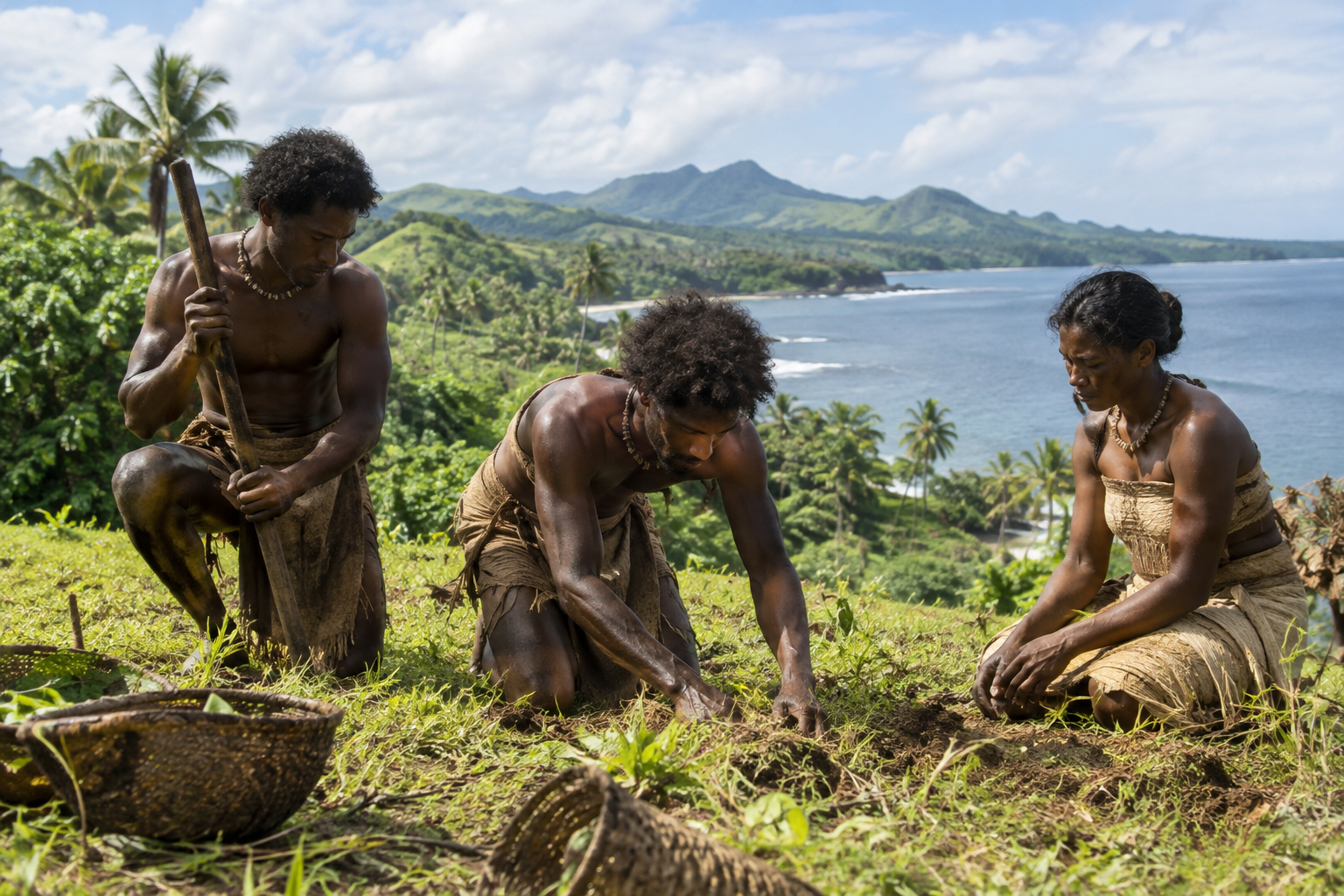
At Sigatoka on Viti Levu in Fiji, three men buried around AD 650 have become unusually important for the history of Y-DNA haplogroup S1d. They are identified as SIG013, SIG020, and SIG012, and although the surviving public details are spare, the pattern itself is striking: the same paternal branch appears more than once at one early Fijian burial site, in the heart of the western Pacific.
That matters because Y-DNA follows one direct paternal line only: father to son, back through generations. It does not describe a whole person's ancestry, language, or identity. But when the same Y-chromosome branch turns up in multiple ancient individuals from the same place and period, it gives us a firmer foothold than a single isolated result. In the case of S1d, Sigatoka provides exactly that foothold.
Sigatoka is one of the best-known archaeological areas in Fiji, especially for the long sequence of human activity preserved on Viti Levu. By around AD 650, Fiji was already part of a wider Pacific world shaped by voyaging, settlement, exchange, and the development of regional island societies. The three men linked here to S1d belong to that later prehistoric island history rather than to the very first Lapita horizon alone, and that distinction is important.
It is tempting to treat any ancient Pacific burial as a simple window onto "the first settlers", but Fiji's past was more layered than that. By the middle of the first millennium AD, communities in Fiji had already been living through centuries of local change, interaction with neighboring islands, and the ongoing blending of lineages. So when SIG013, SIG020, and SIG012 are associated with S1d, they are telling us about paternal ancestry present in Fiji well after initial colonization, in a society that was already fully Oceanic and historically dynamic.
An ancient DNA study of Pacific populations published in research on ancient genomes from the region has helped sharpen this broader picture of island ancestry and population history. Even without overclaiming what can be said for each grave, the Sigatoka cluster fits into a larger effort to understand how paternal and maternal lines were distributed across Remote Oceania.
Ancient Y-DNA is often frustratingly patchy. A burial may yield genome-wide ancestry but no usable paternal call, or a lineage may appear only once, leaving open the question of whether it was common, rare, local, or recently introduced. Sigatoka is different because three separate individuals from roughly the same site and period are associated with S1d: SIG013, SIG020, and SIG012.
That repetition does not prove they were close relatives, nor does it mean every male at Sigatoka belonged to the same branch. But it does suggest that S1d was not a one-off accident in early medieval Fiji. It had enough local presence to appear in multiple sampled men. For anyone researching this haplogroup today, that is far more informative than a lone result detached from context.
There is also a methodological point here. Haplogroup articles often drift too quickly from a branch name to sweeping migration claims. With S1d, the safer and better story is narrower: this branch is attested in ancient Fiji, specifically at Sigatoka on Viti Levu, around AD 650, in at least three sampled males. That is a real archaeological anchor, and it is better to keep hold of that anchor than to decorate it with unsupported detail.
Haplogroup S belongs to a set of paternal lineages with deep roots in the wider region of Near Oceania and surrounding island worlds. But the article here is about S1d, not every branch under S, and it is worth being careful. A broad parent haplogroup may have a very old geographic history, while a narrower sub-branch may have a much more specific and later distribution. The Sigatoka burials therefore matter because they document this more precise branch in a known place and period.
Historically, Fiji sits at a meeting point in Pacific prehistory. It was shaped by ancestries linked to the Austronesian expansion as well as older Papuan-related components already established farther west in Near Oceania. That larger mixture is visible in many population-genetic studies of Oceania. A paternal branch such as S1d belongs inside that story of interaction, not outside it.
In other words, S1d in Fiji is not a badge of a single "people" marching across a map. It is better understood as one paternal thread within the making of Pacific island communities. The Sigatoka evidence shows that this thread was present among men buried in Fiji by the middle of the first millennium AD, which helps place the branch in a concrete human landscape rather than an abstract tree diagram.
One of the persistent misconceptions about Pacific islands is that they were isolated dots at the margins of history. Archaeology has spent decades dismantling that idea. Islands such as Viti Levu were connected by canoe travel, marriage networks, exchange systems, and shared traditions that could stretch over very large sea distances. Fiji was not the end of a route; it was part of a maritime world.
That perspective makes the Sigatoka S1d burials more interesting. A repeated paternal lineage at one Fijian site may reflect continuity within local male lines, but it also belongs to a wider network in which people, kinship, and ancestry were moving between islands over generations. The archaeology does not let us turn SIG013, SIG020, or SIG012 into named voyagers, chiefs, or dynasts. It does, however, place them in a region where mobility and local continuity worked together rather than canceling one another out.
The value of ancient DNA in Oceania is precisely that it lets us test old assumptions against real buried people. Sometimes the result is long-term continuity; sometimes it is mixture; often it is both. That is why Pacific archaeogenetics has become so important to the field more broadly.
Because the sample information here is limited, the best history is the disciplined kind. SIG013, SIG020, and SIG012 should be read first as excavated individuals from a documented site on Viti Levu, dated around AD 650, and associated with S1d. That already gives us several solid things to say: the branch was present in Fiji in the early medieval period; it appears in multiple males at one site; and it forms part of the growing ancient DNA record for Pacific paternal ancestry.
What we should not do is leap from that to assumptions about rank, clan structure, or exact kinship. Nor should we confuse a local repeated lineage with a universal Fijian lineage. Ancient cemeteries are always partial snapshots. Yet partial does not mean trivial. Three S1d-linked burials at one site are enough to show that this paternal line had real historical presence in Fiji, not merely a theoretical place on a modern haplogroup tree.
For readers interested in how ancient DNA is changing the way archaeologists approach human history, MyTrueAncestry has also explored the bigger picture in Ancient DNA and the Rise of Archaeogenetics. The Sigatoka men are exactly the sort of case that makes that wider transformation so compelling: modest-looking burials, but large implications for how we map ancestry in the past.
The clearest supported insight about haplogroup S1d is not a grand imperial saga, but something better grounded. This branch is attested in ancient Fiji at Sigatoka on Viti Levu around AD 650 through more than one male burial. For someone exploring S1d today, that places their direct paternal line within the real archaeological history of Pacific island populations, and specifically within an early Fijian context that is already centuries deep and locally rooted.
That is the strength of this evidence. It does not promise a named ancestor or a simple migration legend. It gives something more durable: a documented connection between a living paternal branch and men buried in Fiji more than thirteen centuries ago.






Comments