Haplogroup R2

– 5 min read


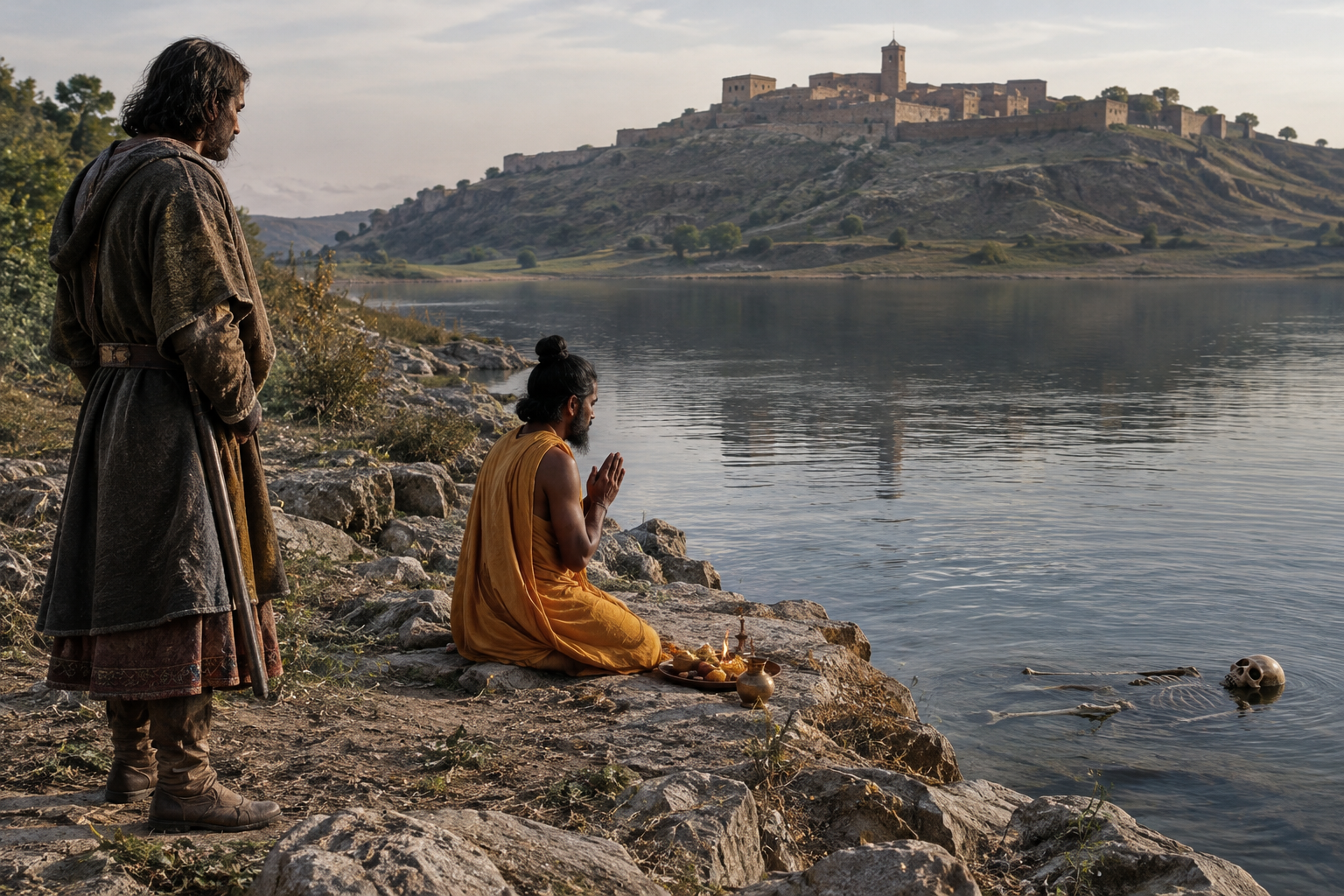
One of the more arresting appearances of Y-DNA haplogroup R2 in ancient remains comes from early medieval Spain. A man identified as I19659, dated to around AD 722, was recovered from Gualda El Tesoro Carramantiel in Guadalajara. That date places him in a moment when the Iberian Peninsula was being remade politically and culturally, just after the Islamic conquest of most of Hispania. Yet the genetic interest here is narrower and, in its own way, more revealing: this individual carried a paternal line associated with R2, a haplogroup much more often discussed in relation to South Asia than Iberia.
That is precisely what makes the find important. Ancient DNA does not simply confirm what historians already expect; sometimes it catches a lineage in an unfamiliar setting and forces a more careful look at movement, mixture, and the small-scale realities of life in the past. In this case, R2 is not a label for an ethnicity or a kingdom. It is a direct male-line marker, one thread out of many in a person's ancestry. But when that thread turns up in both early medieval Spain and a much later individual from India's famous Skeleton Lake, it begins to sketch a history of wide-ranging connections rather than tidy regional boxes.
R2 is a branch within the broader Y-chromosome haplogroup R. In modern populations it is best known from South Asia and neighboring regions, where it reaches much higher frequencies than it does in Europe. That broader pattern matters here, because it helps explain why an R2 assignment in Iberia stands out so clearly. What it does not do is turn every R2-bearing ancient man into evidence for one single migration event or one fixed identity.
Y-DNA follows a strict paternal line: father to son to son across generations. Useful, certainly, but limited. A man with R2 in early medieval Spain may have had ancestors from far beyond Iberia on that paternal line, while the rest of his ancestry could reflect many local and regional mixtures. Ancient DNA studies of Iberia have repeatedly shown exactly that sort of complexity, especially in late antique and early medieval cemeteries.
The sample I19659 comes from Guadalajara, in central Spain, and belongs to a period when the peninsula was anything but isolated. Armies, administrators, traders, local Christian communities, recent converts, and migrants from the wider Mediterranean and North Africa all formed part of the landscape. A genetic study of ancient Iberian populations published in Cell has helped underline just how dynamic these centuries were, with population change and mobility leaving detectable marks in the archaeological record.
Without inventing a biography for I19659, we can still say something historically useful. A paternal lineage like R2 appearing in this setting fits a world in which long-distance connections were real and recurring. The Iberian Peninsula had already been tied into Roman imperial routes, Mediterranean commerce, and later Islamic networks. By the eighth century, a man buried in Guadalajara did not need to be an exotic outsider in the old romantic sense; he may simply represent the kind of mixed and mobile society that ancient genomics is now making easier to see.
There is also a caution here. One individual does not prove that R2 was common in early medieval Spain, nor that it arrived there in a single, identifiable episode. But it does show that this paternal line had reached Iberia by the early eighth century, and that alone is historically significant.
Roman Hispania's Genetic Legacy
The second ancient individual, I6941, is from Skeleton Lake and is described as a Hindu worshipper dated to around AD 940. This is a very different context from Iberia, but in some ways it is the more expected home ground for R2. South Asia is where this haplogroup is far more deeply rooted in the modern record, and so an R2-bearing male from this region sits more comfortably within what population genetics already suggests.
Skeleton Lake, or Roopkund, has drawn enormous attention because the dead there did not all belong to one single event or one homogeneous group. Research published in a major ancient DNA study showed that the individuals represented more than one ancestry profile and more than one period of deposition. That matters because it turns the site from a curiosity into a reminder that mountain pilgrimage, mobility, and repeated human activity can accumulate in surprising places.
For R2, I6941 provides an anchor in a South Asian context where the haplogroup is far less unexpected than in Spain. He does not explain the Iberian case by himself, of course. But together the two samples show something valuable: R2 was not confined to one narrow cultural zone in the early and high medieval world. It appears instead in settings linked by movement, pilgrimage, empire, and exchange, even when the local histories were very different.
It would be easy, and wrong, to force these finds into a single dramatic migration story. The evidence does not justify that. What it does justify is a more grounded historical point. Medieval Eurasia was full of overlapping routes: military roads, merchant circuits, religious travel, slave trading, seasonal movement, and family dispersal over generations. A paternal lineage associated above all with South Asia can therefore appear in Iberia without requiring fantasy, only history.
Seen this way, the two R2-linked individuals illuminate different scales of the past. The man from Skeleton Lake reflects the persistence of R2 in a region where it forms part of a longer local paternal background. The man from Guadalajara shows that the same paternal branch could also appear in a frontier-like, rapidly changing society at the western edge of Eurasia.
This is one of the strengths of archaeogenetics. It rarely hands us a neat ethnic label; instead, it reveals how untidy real human history was. A burial ground in Spain and a high-altitude lake in India seem worlds apart, yet they both preserve men whose direct paternal lines can be placed under the same broad Y-chromosome heading.
For people researching haplogroup R2 today, the ancient evidence is still comparatively sparse, especially outside South Asia. That makes each securely reported case worth attention. The Spanish sample is not important because it proves a royal pedigree or a famous named descent; it is important because it catches R2 in a documented archaeological context where historians already know populations were mixing. The Skeleton Lake sample matters because it places the same paternal branch in a very different medieval environment shaped by pilgrimage and regional South Asian history.
There is a useful parallel here with other ancient DNA work on complex communities: once enough burials are tested, apparently local populations often turn out to have surprisingly varied backgrounds. In that sense, R2 belongs to the same larger lesson as many recent studies of medieval cemeteries and travel corridors. Lineages move with people, but not always in ways visible from texts alone.
The most distinctive thing about ancient R2 is not sheer quantity of finds, but the contrast between where those finds appear. One known case turns up in early medieval Guadalajara, another in medieval South Asia at Skeleton Lake. Together they suggest a paternal lineage with deeper strength in South Asia but a historical reach that could extend far beyond it through the ordinary, complicated mobility of the medieval world. If R2 is part of your own paternal ancestry, these ancient traces are best read not as a promise of one single origin story, but as evidence that your direct male line may belong to a history of connections wider than any one region.
Comments