Haplogroup R1b1a1b2

– 5 min read


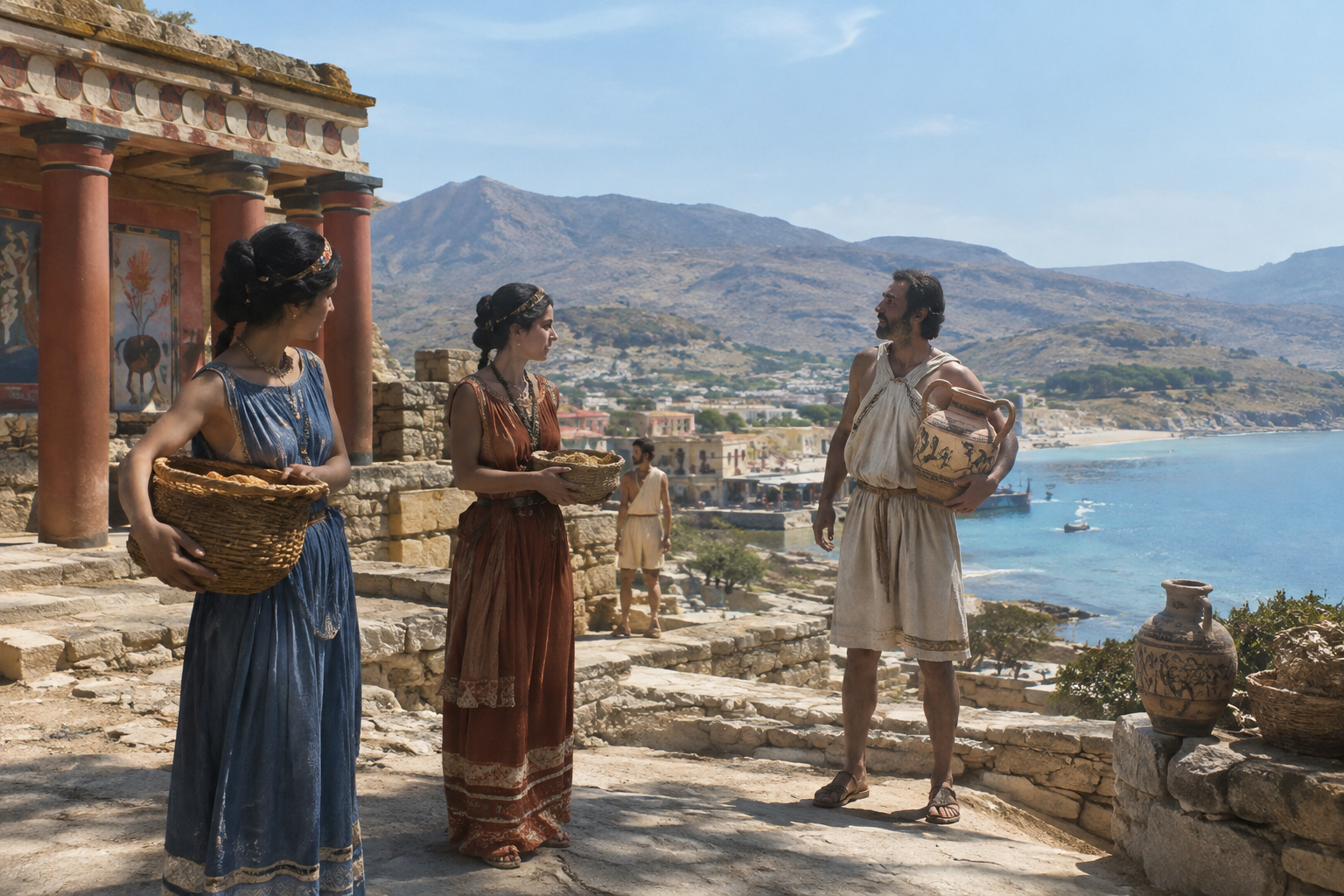
At Chania on Crete, one Bronze Age male identified as XAN030 offers an unexpectedly sharp point of entry into haplogroup R1b1a1b2. He is dated to around 1575 BC, in the Minoan period, and his importance lies not in royal legend or heroic reconstruction, but in something more interesting to archaeologists: he places this paternal line inside the world of second-millennium-BC Crete, at a moment when the island was deeply connected to the wider Aegean.
That matters because Crete is often discussed through art, palaces, seaborne trade, and scripts, while paternal lineages can show a rather different side of the story. Y-DNA tracks one direct male line only, not a person's whole ancestry, but even so, a Minoan-period man from Chania associated with R1b1a1b2 is a useful reminder that Bronze Age Crete was not genetically simple, sealed off, or reducible to a single ancestral strand.
Chania, on Crete's northwest coast, sat in a region tied into the island's wider Minoan networks as well as its overseas contacts. By the time of XAN030, Crete had already seen centuries of social development, exchange, and local variation. It is precisely that local variation which makes individual ancient DNA results so valuable: they let us move from talking about "the Minoans" as a single block to examining real people from real places.
In this case, the sample does not license wild claims about ethnicity, language, or political identity. It does, however, anchor R1b1a1b2 in a documented Bronze Age Aegean context. That is a sober but significant finding. A paternal lineage often associated in popular imagination with later western European histories turns up here in a very different archaeological setting: a Minoan-period community on Crete.
A major ancient DNA study of the Aegean and surrounding regions, published in Science, helped frame this broader question of how Bronze Age populations in the eastern Mediterranean were structured and connected. Even without forcing XAN030 into some oversized migration tale, the larger lesson is clear enough: Bronze Age island societies were part of a moving, mixing human landscape.
The haplogroup name here should be handled carefully. R1b1a1b2 is a paternal branch within the broader R1b family, but a broad family name is not the same thing as a single historical people, language group, or migration event. One of the common mistakes in public discussions is to take a large, widespread parent haplogroup and assign all of its fame or all of its ancient movements to one narrower label. The evidence rarely allows that.
So the right question is not, "What civilization belonged to R1b1a1b2?" but rather, "Where do we securely see this paternal branch or reported association appear in ancient remains, and in what archaeological settings?" For the evidence given here, the answer starts with Minoan Crete. That is already enough to make the lineage historically interesting, because it places a direct paternal line within a society famous for its maritime role in the Bronze Age eastern Mediterranean.
It also helps to remember scale. A Y-chromosome result may reflect one male line among many in a community. It does not tell us that everyone at Chania shared the same ancestry, nor that this line defined Minoan identity. Archaeology and genome-wide ancestry are broader than a single Y-DNA branch, and the best history comes from keeping those categories distinct.
Crete in the second millennium BC was no remote backwater. Its settlements, craft traditions, and trading links tied it to the Cyclades, mainland Greece, Anatolia, and beyond. That wider setting is essential for understanding why a lineage like R1b1a1b2 appearing at Chania should not be treated as anomalous theatre, but as part of the normal human complexity of a connected Bronze Age world.
Ancient DNA has steadily chipped away at the old habit of imagining past populations as neat and bounded. In the Aegean, as elsewhere, communities could preserve local continuity while still receiving new people and new lines of descent over long periods. A paternal branch found in one Minoan-period man therefore invites comparison with broader regional population history, not instant declarations of conquest, replacement, or ethnic transformation.
That point is especially useful for readers tracing their own paternal ancestry. If your line falls within R1b1a1b2, a result like XAN030 does not make you "Minoan" in any simple sense. What it does suggest is that branches of this wider paternal world were present in the Aegean during the Bronze Age, inside one of the most internationally connected societies of its time.
There is an understandable temptation to dismiss a lone ancient sample as too little to say anything worthwhile. Archaeology, though, often advances exactly in this way: one securely placed individual can alter the map. XAN030 is valuable because he is not a theoretical reconstruction or a modern surname project; he is an ancient person from a known place and period, giving us a fixed point for this paternal branch in Minoan Crete.
Single data points become more meaningful when set beside regional patterns. Across Europe and the Mediterranean, ancient DNA has shown that paternal lineages could shift, persist, or coexist in ways that do not neatly match later historical labels. The Bronze Age is particularly important here, because it was a period of intense mobility, local continuity, and cultural change all at once.
That is one reason MyTrueAncestry readers often find ancient Y-DNA results so compelling. They do not merely decorate history with genetics; they force sharper questions. Was a given lineage long established locally? Was it newly introduced? Did it remain one strand among many? In the case of XAN030, the responsible answer is that we can document presence, archaeological context, and period, while leaving the larger demographic story open to further evidence.
One of the most fruitful ways to read this evidence is comparatively. Crete often sits at the crossroads of discussions about early farmers, Aegean island populations, maritime exchange, and later eastern Mediterranean interaction. A haplogroup such as R1b1a1b2 appearing there during the Minoan period reinforces the view that the island's population history cannot be reduced to a single origin story.
That broader caution has become increasingly important in archaeogenetics. The old search for pure populations has not survived contact with the data. What survives much better is a messier, more human picture: people moving, marrying, settling, and becoming local over generations. Chania's XAN030 belongs in that story, not in a cartoon map of arrows racing across continents.
Readers interested in how later Mediterranean populations also show complex mixtures of continuity and change may find useful comparison in work on island and peninsular settings elsewhere in the region.
For haplogroup R1b1a1b2, the standout point here is not a grand dynasty or a sweeping claim of identity. It is the quiet solidity of XAN030: a man from Minoan-period Chania, around 1575 BC, showing that this paternal line was present in Bronze Age Crete. For anyone researching this branch today, that places one part of its ancient record inside the Aegean's most famous island civilization, and inside a world shaped by contact rather than isolation.






Comments