Haplogroup R1b1a1b1b3a1a1a

– 5 min read


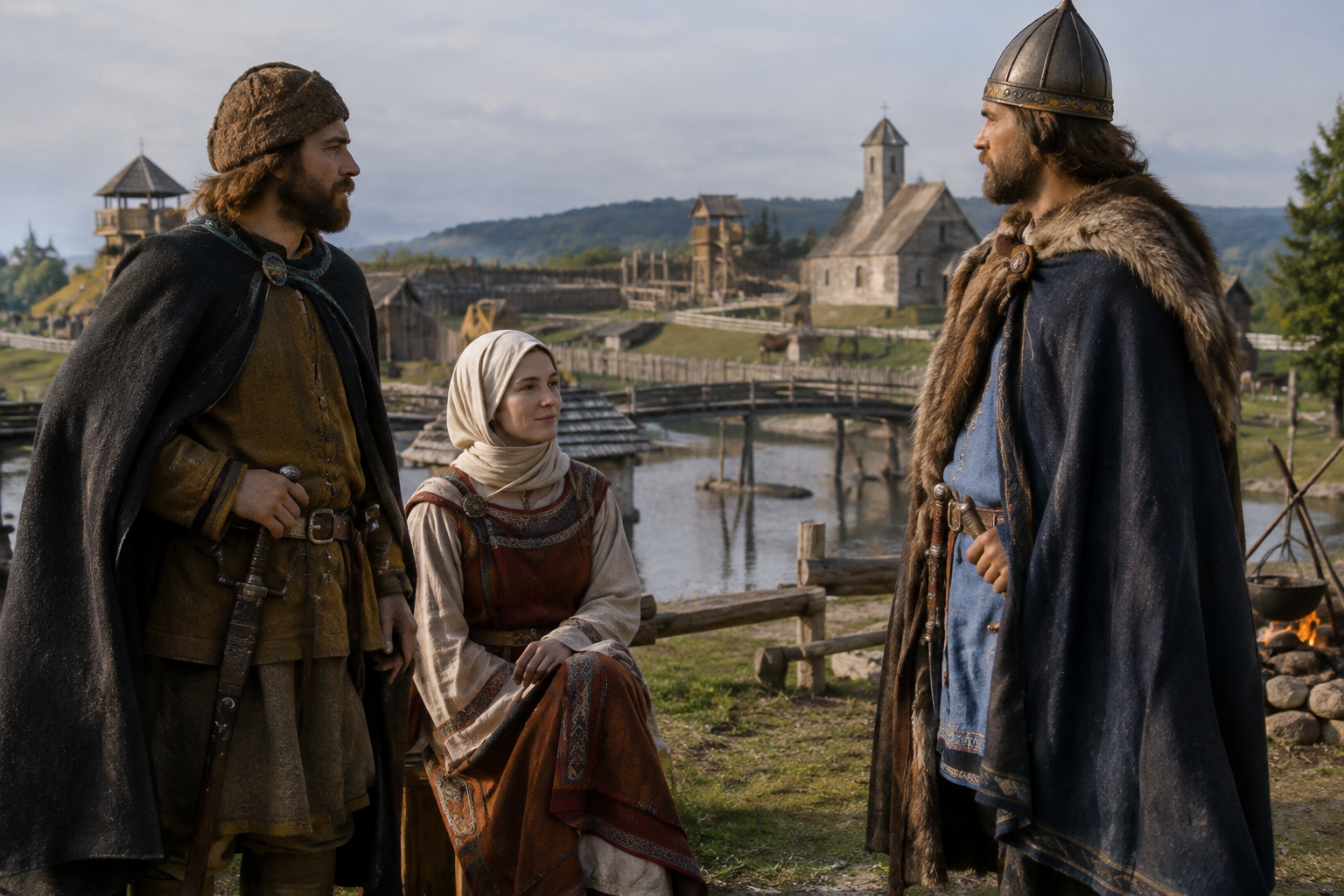
At Gornji Kosinj in inland Croatia, the medieval cemetery of Saint Ana has yielded one of the more telling little clues in the history of Y-DNA haplogroup R1b1a1b1b3a1a1a: sample I35014, dated around AD 1100. On its own, one burial does not make a population. But placed beside earlier finds from Velim-Velistak in Croatia and Zalavar-Varsziget in medieval Hungary, it begins to look less like an isolated curiosity and more like a paternal line moving through the eastern Adriatic and Carpathian worlds of the early and high Middle Ages.
That is what makes this branch interesting. R1b is a very large and widespread Y-chromosome family, but R1b1a1b1b3a1a1a is a much narrower paternal line within it. Y-DNA tracks only one line of descent, from father to son, so it cannot stand in for a person's whole ancestry. Even so, when the same branch appears in several medieval contexts close in time but different in political setting, it helps us think about how male lineages persisted through changing frontiers, languages, and loyalties.
The most recent of the three samples, I35014, comes from Medieval Croatia Gornji Kosinj Saint Ana, around AD 1100. This was a period when the Croatian lands sat within a shifting political landscape shaped by local lordship, ecclesiastical institutions, and growing ties with the Kingdom of Hungary. A burial from such a cemetery is valuable precisely because it is ordinary history rather than royal spectacle: it places this paternal line among the people living through that medieval transformation.
There is a temptation, when one sees a precise haplogroup label, to imagine a neat ethnic badge. Medieval archaeology is much less tidy than that. A man buried in inland Croatia around 1100 belonged at once to a local community, a Christian burial world, and a much wider network of movement across the Balkans and the Pannonian basin. A genetic study that examined long-term population patterns in Croatia has helped show just how much continuity and change could coexist in the region over time, a useful backdrop for thinking about finds like I35014 without turning one chromosome into an entire identity.
Croatia's shifting paternal lineages
The earlier Croatian sample, VEM038, comes from Velim-Velistak and is dated to about AD 750. That date matters. This is the early medieval period, long after Roman imperial rule in the region, but before the political map had settled into the forms familiar from later medieval chronicles. Archaeologically and historically, this was a landscape of reorganisation: old Roman infrastructures lingered, new communities took shape, and identities that later sources would label as Croat, Slavic, or local Christian were still being lived rather than theorised.
In that setting, the appearance of the same narrow paternal branch as the later Gornji Kosinj burial is suggestive. It does not prove that VEM038 and I35014 were close kin, nor that every bearer of this lineage belonged to one community. What it does suggest is that the branch had a real foothold in medieval Croatian territory across several centuries. This is exactly the sort of pattern ancient DNA is good at recovering: not legendary founders, but durable lines embedded in local populations.
More broadly, the archaeology of the eastern Adriatic has increasingly shown that post-Roman society was not a clean break between "ancient" and "medieval." Populations persisted, mixed, and reassembled. One paternal lineage surviving from an early medieval cemetery into a later medieval one fits that larger picture rather well.
The third sample, AHS07, comes from Zalavar-Varsziget in medieval Hungary, around AD 850, and is described in the context of the Carolingian Empire. This takes the story north into a frontier zone of great historical importance. Zalavar, known in early medieval history as an important centre in western Pannonia, lay in a world contested and connected by Franks, local Slavic polities, Avar legacies, and the networks that would later intersect with the Hungarian conquest.
That matters because R1b1a1b1b3a1a1a here is not turning up in exactly the same local context as the Croatian burials. Instead, it appears in another political and cultural environment of the same broad era. The branch therefore looks less like a hyper-local oddity and more like one of the paternal threads present across adjoining parts of central and southeastern Europe during the early medieval centuries.
An ancient DNA study on populations from this wider region has helped underline how mixed and historically layered these frontier communities were, with biological ancestry not mapping neatly onto the labels used in chronicles. That is the right framework for a sample like AHS07: not as the badge of one "tribe," but as evidence that a particular male line existed within the social mosaic of Carolingian-era Pannonia and its neighbours.
Put the three samples together and a clear pattern emerges. VEM038 in Croatia around AD 750, AHS07 in western Pannonia around AD 850, and I35014 in Croatia around AD 1100 all point to the presence of haplogroup R1b1a1b1b3a1a1a in a corridor linking the eastern Adriatic hinterland with the Carpathian basin during the medieval centuries.
That does not mean the branch originated there, and it certainly does not mean every modern carrier descends from one medieval family in Croatia or Hungary. The exact terminal placement of ancient samples can sometimes be more secure in community reporting than in published archaeological summaries, so it is wise to treat the narrow label carefully while still recognising the recurring pattern. The strongest claim here is a modest one: this paternal line was present in multiple medieval communities of the region and persisted across time in ways that archaeologists can now begin to trace.
It is also a reminder that historical change did not erase local male ancestry every few centuries. Kingdoms rose, empires pressed in, churches reorganised burial grounds, and languages shifted in status and use. Yet paternal lines could remain, carried forward by men whose names are lost but whose Y-chromosomes survived in bone.
Deep Balkan roots and medieval admixture
The eastern Adriatic and inland Balkan world of the eighth to twelfth centuries was never a sealed box. Monasteries, hilltop settlements, market routes, river corridors, and frontier strongholds all tied communities together. Genetics now adds another layer to that history. Instead of relying only on later written ethnonyms, we can see that the population history of the region involved both deep local continuities and repeated episodes of mixing.
That is why a haplogroup article built from only three ancient men can still say something worthwhile. Not everything has to be dynastic to be historically meaningful. In fact, these non-elite or not-clearly-elite burials are often more revealing about the real population. They show that R1b1a1b1b3a1a1a belonged to the ordinary demographic fabric of medieval southeastern Europe, not merely to the grand narratives of conquest and kingship.
For readers interested in the broader genetic background of the region, the Balkans have increasingly emerged as a place where very old ancestry layers and medieval mobility met in complicated ways. That makes any securely placed paternal lineage from medieval Croatia or Pannonia especially useful, because it sits right at the point where archaeology, history, and family-line genetics begin to overlap.
Balkan deep ancestry background
The most distinctive thing about R1b1a1b1b3a1a1a in this evidence is not a single famous grave, but its repeated appearance in medieval Croatia and Hungary across roughly three and a half centuries. That gives the branch a grounded historical setting: part of the lived population of the post-Roman and medieval eastern Adriatic-Pannonian world. If you carry this haplogroup today, these finds do not identify an exact ancestor, but they do place your direct paternal line within a real, documented landscape of medieval communities, frontier politics, and long local continuity.






Comments