Haplogroup R1b1a1b1a1a4a

– 6 min read


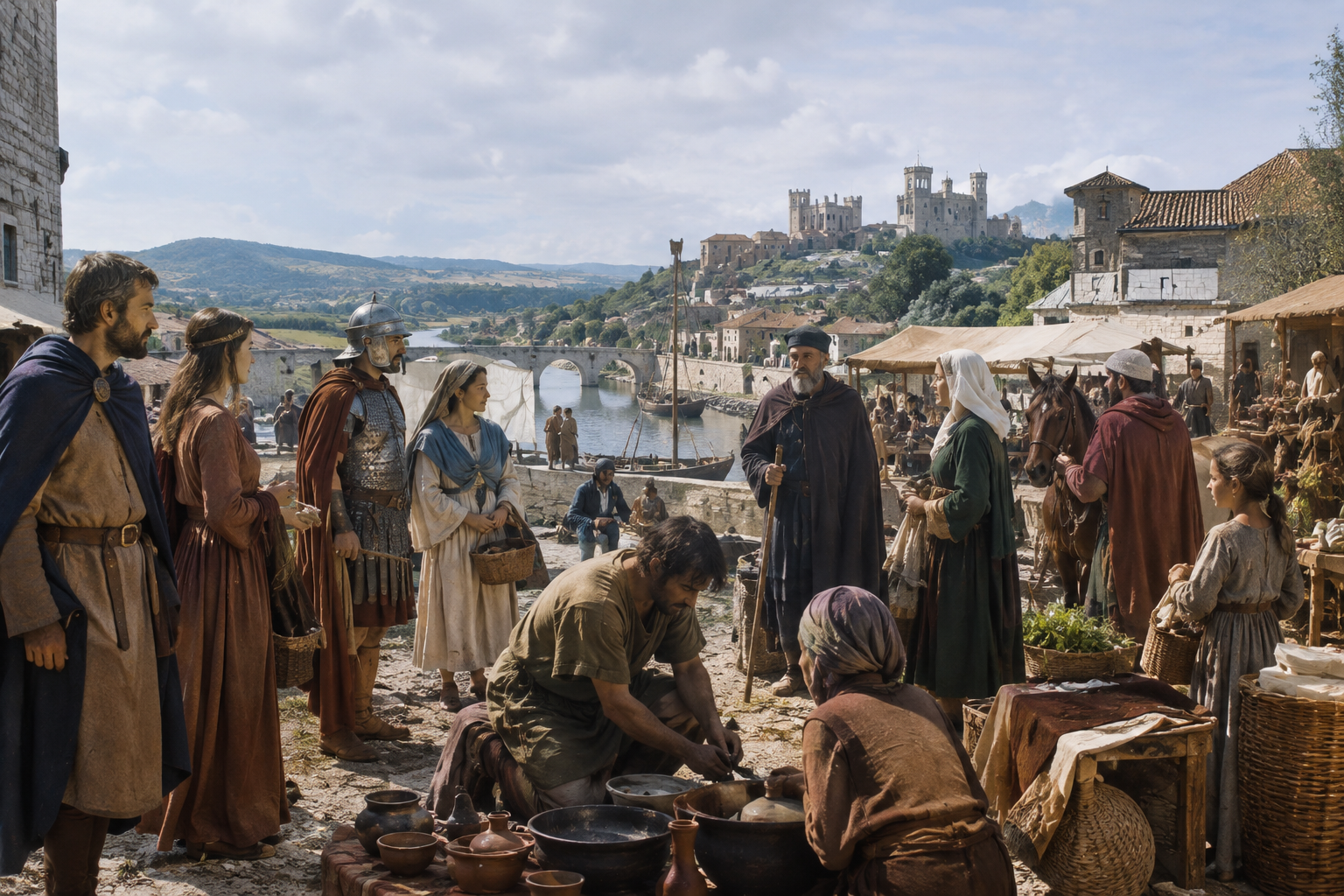
Some Y-DNA haplogroups announce themselves with a great fanfare of famous kings or a single neatly bounded homeland. R1b1a1b1a1a4a is more interesting than that, and rather more human too. What makes it compelling is not a single dramatic moment, but its repeated appearance across a broad sweep of European history: in Copper Age and Bronze Age contexts, among Iron Age communities often associated with Celtic worlds, in Roman and post-Roman settings, and again in medieval Britain, Iberia, the Low Countries, Scandinavia, and central Europe.
That is exactly why Y-DNA matters. A Y-chromosome haplogroup traces one direct paternal line only: father to son, back through time. It does not describe a person's whole ancestry, culture, or identity. But when archaeologists recover ancient DNA from burials and we begin to see the same paternal branch appearing in different centuries and different landscapes, we get something wonderfully concrete: not a myth of origins, but a map of how male lineages persisted, moved, mingled, and survived.
As a downstream branch within the wider R1b family, R1b1a1b1a1a4a belongs to one of the great paternal lineages of western Eurasia. For this very specific subclade, caution is essential. We should not lazily pour the entire deep history of broad R1b into this narrower branch. Still, the ancient samples supplied here suggest that lineages close to or within this branch were present across a remarkably wide corridor of Europe from the Copper Age onward.
Some of the earliest signposts come from central and western Europe. Copper Age individuals such as I7288 from Radovesice in the Czech lands, I4890 from Prague Kobylisy, I5661 from Irlbach in Bavaria, and I7041 and I7043 from Szigetszentmiklos in Hungary place this paternal signature in the world that followed the first farmers and preceded the full flowering of Bronze Age chiefdoms. By the early Bronze Age, we see it again in France in BRE445FK from les Pointes et les Grevottes, Aube, dated 2339 BC, and SMGB54 from Saint-Martin-la-Garenne, Yvelines, dated 2139 BC.
This pattern does not prove a single simple migration. But it does fit a broader picture in which paternal lineages associated with later western European populations were already well established across the continent's northern and central zones by the Bronze Age, often in regions connected to Bell Beaker, Corded Ware-derived, and early metalworking networks.
Then the story sharpens. By the Iron Age, the samples begin to appear in places we instinctively recognise from ancient history: Gaul, Britain, and the Celtic zones of central Europe. An elite burial at Ludwigsburg Roemerhuegel in Germany, LWB002_ss and LWB002_ss_b, dated to 450 BC, places this lineage in a high-status Celtic setting. In France it turns up among the Suessiones at Bucy-le-Long in CGG022436 (330 BC), among the Volcae in BES1096B (450 BC), and in the Gallic burial CHF106 from Marne (430 BC).
In Britain, the same paternal thread appears in distinctly local settings: I7632 from Slonk Hill, Sussex (295 BC), I19653 from Ham Hill Fort, Somerset (250 BC), I20632 from Fin Cop, Derbyshire (200 BC), and WBK106, a Durotriges individual from Duropolis, Winterborne Kingston, dated 125 AD. This is not one people marching in lockstep across Europe. It is better understood as a family of paternal lines embedded in many neighbouring societies that shared trade, warfare, intermarriage, and, at times, language.
There is an especially striking breadth here. The lineage also appears in Iron Age and Celtic-associated contexts further east, including I18835, I18837, and I18838 from Gyor-Moson-Sopron in Hungary, and I11715 from La Tene Iron Age Bratislava (95 BC). That spread reminds us that "Celtic Europe" was not merely Atlantic or British. It stretched deep into central Europe.
One of the pleasures of ancient DNA is that it confirms what historians have long suspected: the Roman world and its aftermath were full of movement. The haplogroup appears in I21059 from Tongeren in Gallia Belgica, dated 35 AD, in the Roman-era setting of the northwestern provinces. It also appears in CGG107747 from Valkenburg Marktveld in the Netherlands (250 AD) and I8202 from Roman-era Emporion in Spain (200 AD). That is a broad western Roman arc, from the Low Countries to the Iberian Mediterranean.
After Rome, the picture becomes even more mixed and, frankly, more interesting. There are Longobard and post-Gothic era samples from Pannonia and Hungary such as SZL061, SZL073, and MFC006, Migration Period and Thuringian samples from Deersheim in Germany, DRH046 and DRH017, and Merovingian-period evidence in Bavaria and North Rhine-Westphalia with Bur6 and IND005. These are not proof of ethnic labels stamped onto genes. They do, however, show that this paternal branch participated in the reshaping of Europe after imperial rule fragmented.
Britain and Scotland also matter here. The cluster from Rosemarkie Cave on the Black Isle in Pictish-era Scotland, including KD001, KD001_2, KD001_3, KD001_4, KD001_6a, and KD001_6b, dated 541 AD, places this lineage in northern Britain during the early medieval centuries. That does not make it "a Pictish haplogroup" in any exclusive sense. But it does show that this paternal line was part of the population landscape of early medieval Scotland.
By the Middle Ages, R1b1a1b1a1a4a appears less like an isolated curiosity and more like an established European paternal presence. In northern Spain, the Las Gobas individuals ldo040 (1000 AD) and ldo046 (1025 AD) are especially valuable because they show continuity into Christian medieval Iberia. Portugal offers another chain of evidence: LP112_13 from Castro de Avelas Torre Velha (750 AD), LP117_2 from the Christian conquest period (1100 AD), LP115_5 from Loule under the Umayyad Caliphate (1250 AD), and several Santarem Rua dos Barcos burials, including LP117_12, LP117_7, and LP123_5 (1300 AD).
The Low Countries and England tell a similar tale. Medieval Sint-Truiden yields ST2455, ST2542, ST3076, ST3037, and ST2335, while England provides ATP_PSN_944 from Cherry Hinton (1034 AD) and ATP_PSN_36 from Cambridge St Johns Hospital (1250 AD). Northern Germany and Scandinavia join in with SRS001 from Schortens (790 AD), DUN002 from Dunum (840 AD), wes004 from Jamtland (1016 AD), and Viking Age Swedish samples such as VK217 and VK57.
That is an impressively durable geography. It suggests not a line tied to one medieval kingdom, but a paternal branch woven into the everyday demography of western and central Europe.
This wider background gives useful context for the later historical association with Clan Forrester. We must be careful here: a clan's appearance beside a haplogroup does not prove that every Forrester male carried R1b1a1b1a1a4a, nor that ancient samples from elsewhere in Europe were their direct ancestors. But the geographical setting is suggestive in the best cautious sense. The Pictish-era Rosemarkie individuals show that paternal lines of this kind were present in early medieval Scotland centuries before the late medieval documentary appearance of families such as the Forresters.
Corstorphine Castle in west Edinburgh began as the stronghold of the Forrest family in the late medieval period, beside the old village kirk, and acted as a local emblem of lordship. Like so many Scottish tower houses, it was not simply a residence but a statement: land held, authority displayed, kin made visible in stone. Over time the estate passed by marriage and inheritance to other noble families, including the Forres and later the Humes. The castle was altered, rebuilt, and eventually declined, before its demolition in the nineteenth century left only records, memory, and landscape behind.
That, if you like, is the historian's counterpart to Y-DNA. A haplogroup tracks one paternal line through mutation; a castle tracks one social world through inheritance, marriage, ambition, and loss. Neither tells the whole story alone. Together, they show how families belong to places, and how places outlast the men who once claimed them.
R1b1a1b1a1a4a is historically interesting because it appears across a long chain of European evidence: prehistoric central Europe, Bronze Age France, Iron Age Gaul and Britain, Roman provincial towns, Pictish Scotland, medieval Iberia, England, the Low Countries, and Scandinavia. It seems, in other words, to belong to the deep furniture of European paternal history.
But a haplogroup is not an ethnicity, not a coat of arms, and not a guaranteed path to a named medieval lineage. Sharing a Y-DNA branch with an ancient individual means sharing part of a paternal story, not proving direct descent from that man, still less from every noble house later rooted in the same region. What ancient DNA offers is something subtler and more rewarding: evidence that the men in burials, hill forts, monasteries, hospitals, caves, and castles were part of long-running biological continuities that written sources only partly capture.
If this branch appears in your own results, it places your direct paternal line in a conversation stretching from Bronze Age graves and Iron Age strongholds to medieval Scotland and beyond. That is not a fairy tale of descent. It is something better: real history, messier and far more interesting.
If you want to explore the wider Scottish backdrop to these paternal stories, including how archaeology and genetics illuminate northern Britain, this community article is well worth reading.
MyTrueAncestry lets you compare your DNA with ancient individuals from sites like Rosemarkie, Las Gobas, Tongeren, and Iron Age Britain, helping you place your ancestry in a far larger historical setting. Those matches do not automatically prove direct descent from a particular ancient person or noble family, but they can reveal remarkable links to the populations that shaped the worlds discussed here.
Upload your DNA and see whether your own results connect with the ancient fathers of prehistoric Europe, the peoples of Roman frontiers, or the medieval communities that later stood behind families such as Clan Forrester.






Comments