Haplogroup R1b1a1b1a1a3a1

– 6 min read


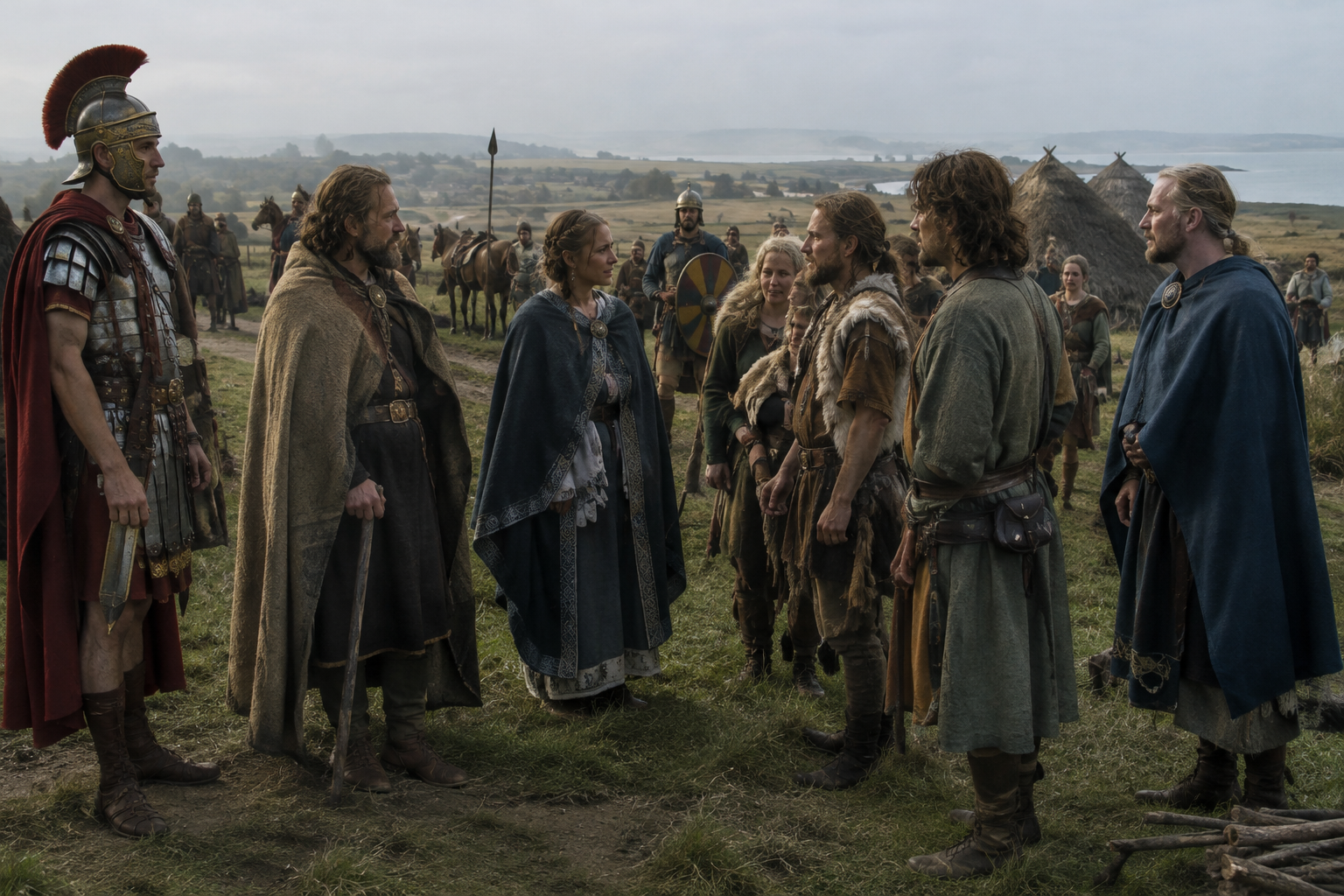
Some Y-chromosome lineages announce themselves with a trumpet blast. Others appear in history the way many real families do: not as emperors on a coin, but as men buried in farmsteads, roadside communities, frontier zones, and local cemeteries over many centuries. Haplogroup R1b1a1b1a1a3a1 belongs to that second category. It sits within the vast R1b branch of the Y-chromosome tree, one of the major paternal lineages of western Europe, yet this very specific subclade is most interesting when we stop treating it as an abstract code and start following where it turns up in ancient graves.
That is the proper use of Y-DNA: it traces one direct paternal line, not a person's whole ancestry, and certainly not a ready-made ethnic label. Still, even one paternal line can be historically revealing. In the evidence supplied here, this lineage appears in Iron Age Britain, in Gaul, in the Roman world, among communities associated with Germanic groups, and in early medieval England. That spread does not prove a single tidy migration story. It does, however, suggest a paternal branch moving through the connected worlds of later prehistoric and early historic northwestern Europe.
The long string R1b1a1b1a1a3a1 marks a downstream branch within the broader R1b family. Broadly speaking, R1b lineages are deeply important in the paternal history of western Europe, especially in regions shaped by Bronze Age and later population movements. But one of the easiest mistakes in popular genetics is to hand the entire history of a huge parent haplogroup to a much narrower twig. We should resist that temptation.
What can be said more carefully is this: the ancient evidence here places this branch, or very near relatives of it, in the northwestern European world across a striking range of settings. It is found among Iron Age groups in eastern Yorkshire, in pre-Roman Gaul, in a Roman-era burial in Cambridgeshire, in a Batavian-associated context in the Netherlands, in a North Germanic-associated context in Denmark, and then again in post-Roman and early Anglo-Saxon England. That pattern points not to a single people, but to a lineage present in the very zones where Celtic-speaking communities, Roman provincial society, and Germanic-speaking groups met, traded, fought, and intermarried.
Readers interested in the bigger archaeological background to such movements may enjoy this related piece on the continental setting from which many later western European paternal lineages emerged.
Explore Celtic Origins in Ancient DNA
The earliest supplied clues come from the centuries before Rome made Britain and Gaul part of the same imperial system. In France, sample CGG022445 from Bucy-le-Long, dated to 457 BC, shows this paternal line already present in a Gallic context. Bucy-le-Long lies in a part of northern France that would later become deeply entangled with Roman power, but in the fifth century BC it belonged to the world of Iron Age Gaul, local communities, shifting elites, and long-distance exchange.
Across the Channel, eastern Yorkshire offers an even denser cluster. At Wetwang Slack, samples I36849 and I36859, both dated to 225 BC, belong to the Celtic Parisi of Iron Age England. So do three more individuals from Pocklington - I21893, I21862, and I21617 - also dated to 225 BC. Five men from the same broad regional and cultural setting carrying the same paternal signature is the sort of pattern ancient DNA researchers notice immediately. It suggests that this was not a stray outsider lineage but part of the local male population in East Yorkshire during the Iron Age.
That matters because the Yorkshire Arras culture and the Parisi have long attracted attention for their burials, chariots, and continental links. DNA does not simply solve every old debate, but it does add one solid fact: this paternal branch was established there before the Roman conquest. It belongs, at least in part, to the male landscape of pre-Roman Britain.
For readers wanting a wider look at family structure and burial relationships in this same broad period, this community article is a useful companion.
Discover Iron Age Britain Through DNA
Then Rome arrives, and with Rome comes mobility on a new scale. Sample DUX010 from Duxford, Cambridgeshire, dated to 100 AD, places this paternal line in Roman-era Britain. By itself, that does not tell us whether the man was descended from local Iron Age families, newly mobile people under Rome, or some mixture of both. But set beside the Yorkshire Iron Age cluster, it raises the possibility of paternal continuity across the conquest in at least part of eastern Britain.
Elsewhere in the Roman orbit, two samples show how widely connected this world had become. CGG107758, dated to 175 AD, comes from Valkenburg Marktveld in the Netherlands and is associated with the Batavi Germanic Tribe. The Batavi are a splendid reminder that Roman history was never simply Romans on one side and barbarians on the other. They served in the Roman military, lived on the frontier, rebelled, negotiated, and became woven into imperial life.
The other is CGG107506 from Vester Egesborg, Vordingborg, Sjaelland in Denmark, dated to 175 AD and described here as a North Germanic Tribe individual. That places the same paternal branch, or a very close relation, in the Scandinavian sphere too. Not proof of one single migration, certainly. But it does show a lineage distributed across the Channel coast, the Low Countries, southern Scandinavia, and Britain during the Roman centuries.
If you would like to think more about this frontier zone as a meeting-place of soldiers, locals, and migrants, this article is worth a look.
Explore the Lower Rhine Frontier
The end of Roman rule in Britain did not wipe the slate clean. It rarely does. Instead, old populations and new arrivals became entangled in ways that archaeology and genetics are only now beginning to trace properly. Two samples in the supplied data are particularly revealing here.
HAD017 from Hatherdene Close, Cambridgeshire, England, dated to 500 AD, belongs to the Early Anglo Saxon Period. Meanwhile CE050 from Worth Matravers, Dorset, dated to 600 AD, comes from a Post Roman context. Together with DUX010 from Roman Cambridgeshire, they show this paternal lineage present in Britain before, during, and after the great political break with Rome.
That does not mean every bearer was "the same people" in any simple sense. By 500 or 600 AD, identity in Britain was being made from many ingredients: surviving Romano-British communities, incomers from across the North Sea, local alliances, language shifts, and changing burial customs. What the lineage does show is that one paternal branch could survive these upheavals and appear in more than one social world. Ancient DNA is good at puncturing neat origin myths like that.
The supplied noble connection brings us far north, to Clan Adams and Blairadam House in Kinross-shire. The house itself is not medieval in date but an eighteenth-century country house, begun in the 1730s for the Adam family and later reshaped as fashion changed. Its surroundings - woods, estate land, and designed landscape - speak of wealth, improvement, and social ambition in landed Scotland. Its later appearance in modern screen culture, including Outlander, is almost the least interesting thing about it.
The deeper point is that houses like Blairadam preserve the memory of families whose prominence belongs to a much later historical world than the Iron Age and Roman burials discussed above. The Adam family's roots at Blair Adam went back centuries, and its best-known son, William Adam, reminds us how landed families moved from local power into law, politics, and national influence.
But we must keep our heads. A historical association between Clan Adams and this haplogroup is not proof that every Adam male carried R1b1a1b1a1a3a1, nor that any ancient individual named above was an ancestor of the family. What we can say is something subtler and more interesting. Scottish landed families stood on landscapes shaped by many earlier layers of population history - prehistoric settlement, Iron Age communities, Roman-era exchange networks, and medieval realignments. Genetics helps restore some of that depth beneath the estate facade.
Readers interested in the clan dimension of this story can continue with the dedicated community feature on the family.
So what does haplogroup R1b1a1b1a1a3a1 tell us? Not that its bearers belonged to one eternal tribe. Not that a modern tester has found a shortcut to nobility. And not that a string of letters on the Y chromosome can replace the messier evidence of archaeology and history.
What it does show, in this case, is a paternal line with a credible footprint across Iron Age Gaul and Britain, the Roman North Sea world, and early medieval England. The cluster of Parisi samples in East Yorkshire suggests real local presence in pre-Roman Britain. The Danish and Batavian-associated individuals show how such lineages also sat within wider northern European networks. The later English samples hint that political rupture did not necessarily mean paternal disappearance.
That is why ancient DNA matters. Written genealogies usually begin late and favor the powerful. Ancient burials do not. They let us see lineages before surnames, before heraldry, before castles and estate houses made family memory look orderly. Blairadam House belongs to that later chapter: the point at which landed power became architecture. The burials belong to earlier chapters, when the same landscapes were occupied by men whose names are lost but whose paternal lines can still be traced.
If you have this haplogroup, or a related branch, MyTrueAncestry can help place your paternal line in that larger historical setting. Ancient DNA matches do not prove direct descent from a particular ancient individual or noble family, but they can offer a remarkable view into the worlds where your deeper ancestry once moved.






Comments