Haplogroup R1b1a1b1a1a2e1

– 6 min read


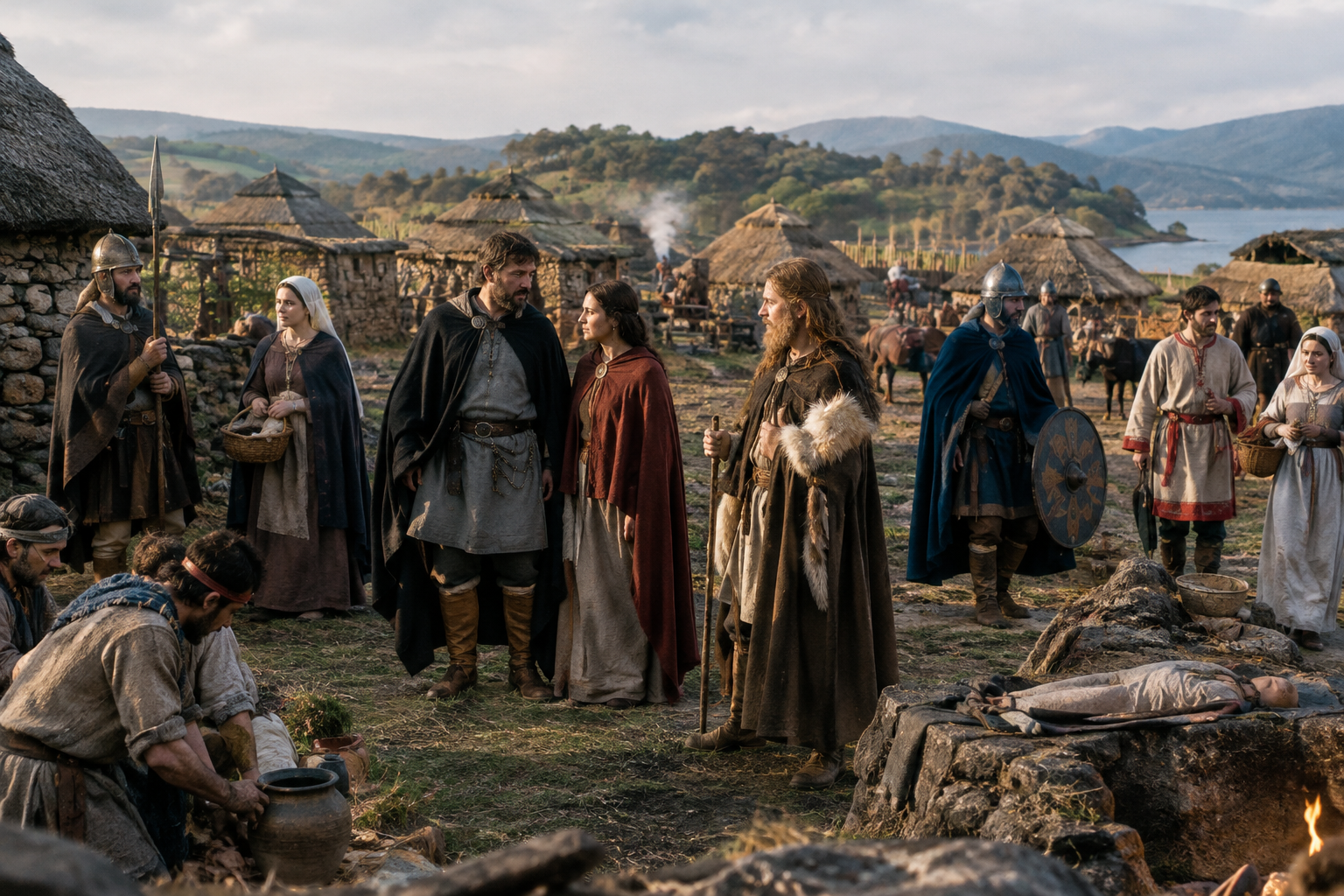
Some Y-DNA haplogroups are easy to place in a single chapter of European history. R1b1a1b1a1a2e1 is not one of them. What makes it interesting is precisely its breadth across time and landscape: it appears in Bronze Age contexts, in Iron Age Celtic burials, in Roman and post-Roman mobility, and in medieval communities from Iberia to the North Sea world. Rather than belonging neatly to one people, one kingdom, or one legend, it seems to belong to the long and complicated making of Europe.
That is also a useful reminder about what Y-DNA can and cannot do. A Y-DNA haplogroup traces one direct paternal line only: father to father to father, across generations. It does not describe a person's whole ancestry, culture, language, or identity. Still, paternal lineages can be remarkably informative. When the same branch or related branches appear in ancient burials across different centuries, they help us glimpse how male lines persisted, moved, and mixed within the shifting political worlds of prehistory and history.
R1b1a1b1a1a2e1 is a very specific branch within the wider R1b family, one of the major Y-chromosome lineages in western Europe today. With such a narrow subclade, caution matters. We should not simply pour the entire history of broad R1b into this one downstream branch as though nothing changed along the way. But the ancient samples supplied here do suggest that this paternal line belongs to a larger story rooted in western and central Europe, and later distributed across Britain, Iberia, parts of Gaul, the Low Countries, Italy, and beyond.
The earlier archaeological horizon is striking. There are Bronze Age examples from central Europe such as LEU024 from Unetice Thuringia Leubingen Sommerda Germany, dated to 1950 BC, and MIB054 and MIB054d from Bronze Age Bohemia, dated to 2500 BC. There are also Bell Beaker and early Bronze Age finds in the Netherlands, including I4073, I4069, and I4074 from De Tuithoorn North Holland, dated to 2080 BC, and I13028 from Ottoland-Kromme Elleboog, dated to 2100 BC. That does not prove this exact subclade began in any one of those places, but it does show that closely related paternal lines were already present in the world of later third- and early second-millennium BC Europe.
By the Iron Age, the picture becomes even more recognisably historical: this lineage appears among communities archaeologists describe as Celtic, Belgic, Brittonic, and continental Iron Age populations.
Explore Celtic Origins in Ancient DNA
If one wanted a set of burials to make the point vividly, one could hardly do better than the elite Celtic graves of southern Germany. At Asperg-Grafenbuehl, dated to 450 BC, we find APG001, APG001c, and APG003. At nearby Ludwigsburg Roemerhuegel, also dated to 450 BC, there are LWB001, LWB001_ss, and LWB001_ss_b. These are not random, shabby burials scraped from the margins. They belong to the high-status Iron Age world of central Europe, a world of prestige goods, warrior display, and emerging aristocratic identities.
The same broader pattern appears farther west and north. In East Yorkshire there is an extraordinary concentration of Parisi and related Iron Age individuals: I36965, I36968, I37333, I36761, I31024, I31510, I31512, I30994, I30975, I30962, I37161, and others from Wetwang Slack and Pocklington, mostly around 225 BC. Add I5502, the high-status Parisi burial from Nunburnholme Wold, dated to 100 BC, and I50137, the elite Celtic chariot burial from Ferry Fryston, dated to 237 BC, and a pattern emerges: this paternal line was not an oddity. It was woven into Iron Age Britain, including some of its most socially visible burials.
Continental evidence broadens the map again. There is 3298 from the Gallic Cenomani tribe in Verona, dated to 300 BC; CGG022421 and CGG022464 from Bucy-le-Long in Iron Age France; UN85 from the Gallic Venelli in Normandy, dated to 100 BC; and several Iron Age Bohemian and Czech examples such as I17146, I14987, I15042, and CGG021846. This is the archaeology of movement and regional continuity together: central European and western European communities linked by trade, warfare, kinship, and perhaps language, but never genetically uniform in any simple sense.
Explore Late Bronze Age Central Europe
Then Rome arrives, and with Rome the old tidy categories begin to wobble. At Fenstanton in Cambridgeshire, FEN008 and FEN012 are dated to 100 AD. At Winterborne Kingston, WBK36 comes from a Celtic Durotriges context dated to 125 AD. In the Low Countries we see Batavi and Frisii-associated finds such as CGG107761, CGG107763, CGG107766, CGG107750, and CGG107748. None of this means a haplogroup equals an ethnic label. It means the same paternal lineage could be found in very different local populations living under Roman rule, frontier service, or regional tribal identities.
The later Roman and Migration periods make the point even better. In Gaul, the cluster from Metz Lunette Sablon - R2055a, R2055b, R2055c, R2055d, and R2055e, dated to 432 AD - hints at local persistence or kin-linked burial in a world where Roman authority was fraying. In Pannonia and the post-Roman Carpathian basin there is a dense sequence: GYS009, GYS059, SZL025, SZL032, SZL040, SZL052, SZL054, SZL072, SZL081, SZL084, GHD001, GHD023, RKO001, and RKF253. Here the old Roman provinces became crossroads for post-imperial communities, including Longobard-period groups and other mixed populations.
Italy too plays its part, from Archaic Etruscan Bologna samples such as I37267 and I37403, to COL_098b from Lombard Era Collegno Northern Italy, dated to 580 AD. The lineage is not confined to one classic "Celtic" or "Germanic" story. It survives through both.
Iberia is especially important for this branch's later visibility. There are Bronze Age examples in Murcia such as ALM040, ALM047, ALM069, ALM078, ALM080, MDP003, and MMI004, showing deep prehistoric roots in the peninsula. Later, we see I20271 and I20382 from Early Visigothic Spain in Girona, I23276 and I23764 from Merida around 450 AD, and I30592 from early medieval Zaragoza, dated to 600 AD. Most evocative of all are the Las Gobas samples in northern Spain: ldo062 from 620 AD, then ldo066 and ldo037 from 1000 AD, and ldo048 from 1025 AD. That sequence gives us something historians love but rarely get so neatly: the chance to watch a paternal line remain visible in one region across centuries of post-Roman change.
Discover Roman Hispania's Genetic Legacy
How, then, do we move from ancient cemeteries to medieval noble houses without becoming silly about it? Carefully. A shared haplogroup can provide historical context, not instant proof of descent. Still, context matters.
One supplied association leads us to the Ottonian Dynasty and Magdeburg Cathedral. The cathedral stands on a site bound up with the rise of the Ottonian Empire because Otto I founded an earlier church there in the 10th century and chose it as his burial place. After fire damaged that first church in 1207, the present cathedral began in 1209, introducing a strongly French-influenced Gothic style into Germany. Building continued for centuries, and the structure remained a focal point through war, reform, and religious upheaval. In other words, Magdeburg is not just a church; it is a monument to how medieval rulership turned memory into stone. If a paternal lineage such as R1b1a1b1a1a2e1 appears in the wider central and western European record, Magdeburg reminds us how those long biological histories eventually entered literate, dynastic politics.
The second association is much farther northwest, with Clan Grant and Castle Grant in Strathspey. The castle began as the 15th-century tower house of Freuchie and later expanded into the seat of an ambitious Highland family. In the 17th and 18th centuries it became a larger baronial residence, reflecting the Grants' regional authority. It stood near the upheavals of the Jacobite age, adapted again in the 19th century, and still carries the layered history of clan power, estate life, and Highland identity. That is rather a good metaphor for Y-DNA itself: not a fixed tribal badge, but something that endures while architecture, allegiance, and politics are repeatedly rebuilt around it.
For readers interested in how genetics has intersected directly with medieval imperial history, the Ottonian case is especially worth exploring.
What makes R1b1a1b1a1a2e1 so compelling is not that it can be reduced to a slogan, but that it resists one. Its ancient record stretches from Bronze Age central Europe and Iberia to Iron Age Britain, Gaul, and Italy, then onward into Roman frontier zones, Migration period communities, and medieval Spain. The pattern suggests durability, mobility, and regional continuity all at once.
That is often how real history looks when ancient DNA enters the room. Written genealogy usually begins late and favors elites. Archaeology recovers the material setting but not always biological relationships. Y-DNA adds one more thread: a narrow paternal trail, sometimes faint, sometimes unexpectedly persistent. It cannot tell us that a man buried at Wetwang Slack was the ancestor of a Highland laird, or that a burial at Las Gobas founded a noble house. But it can show that later medieval societies emerged from deep reservoirs of local and mobile paternal ancestry already established many centuries earlier.
If you want to explore the Highland side of that later story, Clan Grant offers an excellent companion piece.
R1b1a1b1a1a2e1 opens onto a Europe of Bronze Age burials, Iron Age elites, Roman-era movement, medieval villages, dynasties, and castles. That does not mean a shared haplogroup proves direct descent from any one ancient individual or noble family. It does mean your paternal line may belong to a story far older, wider, and more interesting than a surname alone can show.
Upload your DNA to MyTrueAncestry to explore ancient matches, archaeological populations, and the deeper history behind your results.






Comments