Haplogroup R1b1a1b1a1a2d1a1

– 6 min read


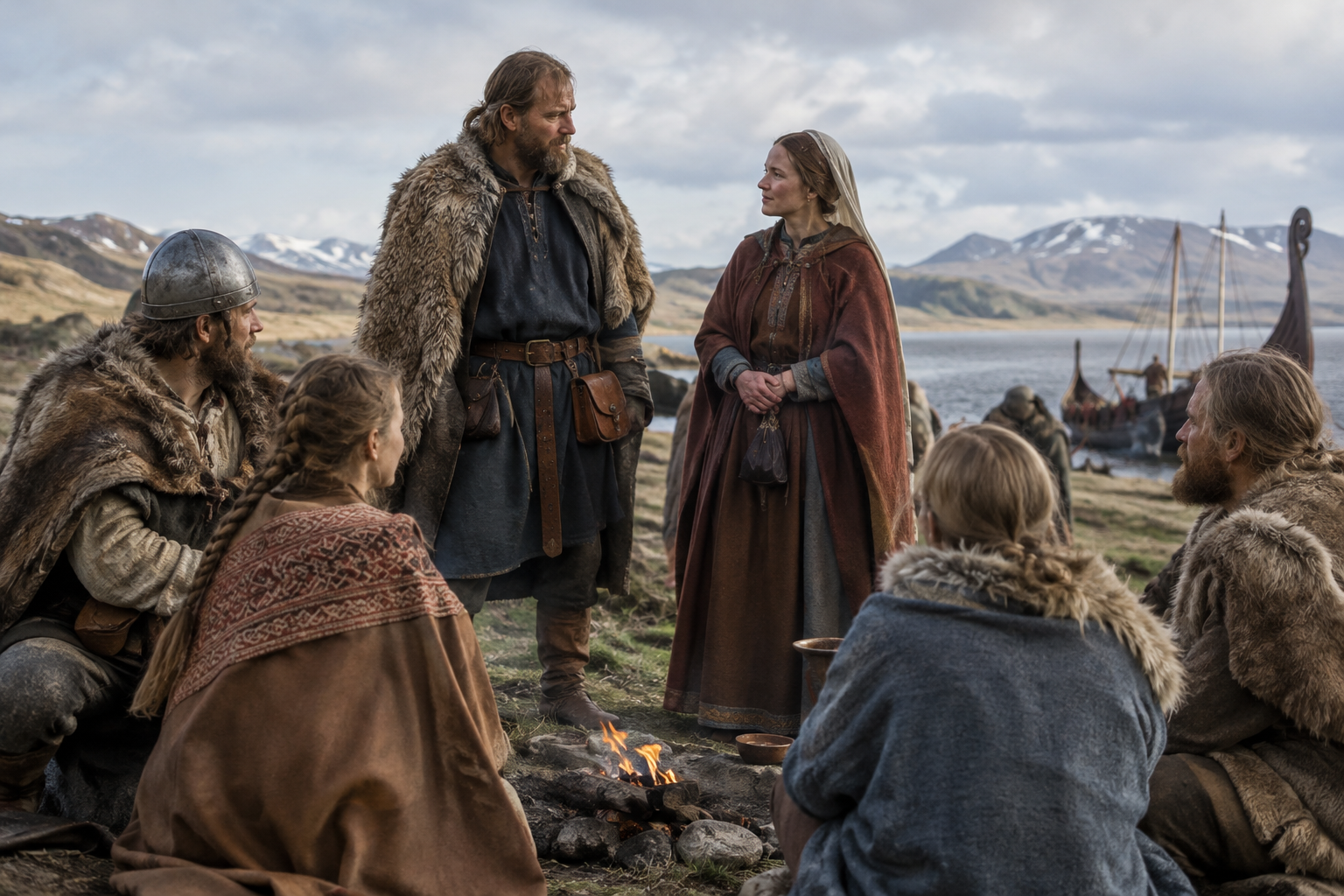
Some Y-DNA lineages are easy to pin to a single historical setting. Others are more elusive, and therefore more interesting. Haplogroup R1b1a1b1a1a2d1a1 belongs to that second category. It sits within the enormous R1b family of paternal lineages, a branch of the Y-chromosome tree found widely across western Eurasia and deeply entangled with later prehistoric and historic population movements. But a very specific subclade such as this one should not simply be handed the whole story of R1b as if nothing changed along the way. The real fascination lies in tracing where this narrower branch appears in the ancient record and what that distribution may suggest.
That is where ancient DNA becomes wonderfully disruptive. Instead of relying only on later surnames, chronicles, or nationalist legends, we can look at real men from real graves: an Iron Age Briton in Yorkshire, Etruscan individuals in Italy, men in Viking Age Norway, Denmark, and Iceland, and an early medieval burial in Spain. Y-DNA traces a direct paternal line only, not a person's full ancestry, but even that single thread can reveal an unexpectedly wide historical map.
At the broadest level, this haplogroup belongs to the wider R1b paternal family, one of the best-known Y-chromosome groupings in Europe. That does not mean every story ever told about R1b can be attached wholesale to R1b1a1b1a1a2d1a1. Broad parent lineages often spread early and diversify greatly, leaving downstream branches with much more regional and chronological stories of their own.
Even so, the supplied ancient samples suggest something important. This lineage, or a very closely related paternal background, appears across a striking arc: Iron Age Italy, Iron Age Britain, early medieval Iberia, and the Viking North Atlantic. That pattern does not prove one continuous elite dynasty, one ethnic identity, or one simple migration route. What it does suggest is a paternal line with a long western European and north European presence, turning up in several different societies that were connected by trade, migration, war, and settlement over many centuries.
For readers interested in the bigger archaeological backdrop to paternal lineages and how ancient DNA changed the field, MyTrueAncestry has a useful introduction here:
One of the earliest clues in the supplied evidence comes from Iron Age Italy. At Casenovole, two Etruscan-period individuals, CSN003 and CSN010, both dated to 292 BC, show this paternal signal in an Etruscan context. That matters because the Etruscan world was not some sealed-off civilization of mystery, despite how often it is presented that way. It was a connected society in central Italy, involved in exchange, local continuity, and interaction with the wider Mediterranean. A paternal lineage found there reminds us that lineages later seen far to the north or west were not confined to one cultural label.
Then there is I13754, a Celtic Briton from Pocklington, Yorkshire, England, dated to 225 BC. Pocklington has become one of the most evocative windows into Iron Age Britain, especially because elite burials and chariot graves from the region force us to picture a society of local power, display, and martial identity. This sample does not prove that the haplogroup was "Celtic" in any exclusive sense. But it does place this paternal line in pre-Roman Britain, in a landscape later central to discussions of Iron Age mobility and insular continuity.
If you would like to follow that British Iron Age thread further, this related article is a natural companion:
Move forward nearly a thousand years and the picture becomes even more intriguing. In Post Roman Early Medieval Spain Guadalajara Cubillejo de la Sierra, sample I19672, dated to 709 AD, shows the lineage in Iberia during the unsettled centuries after Roman rule. This is precisely the sort of period where ancient DNA has been reshaping old assumptions. The collapse of Roman administration did not create empty landscapes waiting for "new peoples" to arrive fully formed. Instead, post-Roman Iberia preserved mixtures of continuity, local survival, and incoming groups from different directions.
That makes I19672 especially useful: not because he can be made to stand for all of Spain, but because he belongs to a world in which Roman legacies, local Iberian populations, Visigothic-era structures, and later early medieval transformations all overlapped. Readers interested in that setting may want to compare this with broader work on Iberia:
The northern evidence is especially vivid. Sample CGG107023 from Viking Age Norway Tomeide Nesna, dated to 700 AD, places the lineage in coastal Norway at the opening of the Viking Age. Sample CGG100918 from Viking Age Denmark Jutland Tjaerby Randers, dated to 1050 AD, shows it again in Denmark at the far end of that era. And then we meet two North Atlantic settlers: TGS-A1 from Viking Norse Iceland, dated to 935 AD, and VK101 from Viking Age Hofstadir Iceland, dated to 1050 AD.
That is a remarkable sequence. Not because it proves a single paternal chain from Norway to Iceland, still less because it identifies the descendants of saga heroes, but because it reflects the historical reality of Viking expansion. Norway, Denmark, and Iceland were tied together by seafaring movement, kin networks, colonization, and shifting political loyalties. A Y-lineage appearing in all three contexts fits the world of North Atlantic mobility rather well.
It also reminds us that paternal continuity can be geographically expansive without being genealogically neat. Men carrying related Y-chromosome branches may have shared an ancestor long before their descendants ended up in different kingdoms, farmsteads, and burial grounds. For more on that wider Scandinavian setting, this article is well worth exploring:
What, then, do we do with a later noble association such as Clan Scrimgeour? Carefully, as always. A historical association between a haplogroup and a clan tradition is not proof that every documented member of that family carried the same Y-DNA, nor does it allow us to leap from an Iron Age grave in Yorkshire or an Icelandic Viking burial straight into a medieval pedigree.
Still, the geographical and historical setting is compelling. The Scrymgeour family were hereditary Constables of Dundee, and their seat at Dudhope Castle reflects the long afterlife of paternal lines in regions shaped by many earlier migrations across the North Sea. Dundee was no isolated backwater. Eastern Scotland sat within a medieval and early modern world connected to Scandinavia, the British Isles, and continental Europe by trade, politics, and war.
Dudhope Castle itself is a useful corrective to romantic nonsense. It began as a late medieval tower house, probably built in the 16th century by the Scrymgeour family. It later expanded into a larger residence, declined after the family's fortunes changed in the 17th century, and by the 19th century had become rather shabby before being restored in the 1890s in baronial style. In the 20th century it served civic purposes. In other words, this is not a pristine relic of one heroic bloodline. It is a building with layers: noble ambition, decline, reuse, restoration, and urban memory.
That layered history is exactly what makes it such a fitting companion to a Y-DNA story. Haplogroups are often imagined as if they were fixed badges passed unchanged through a timeless clan. In reality, families rise, fragment, marry widely, lose lands, reinvent themselves, and leave behind castles that outlast the social order that built them. If you want to read more specifically about this Scottish connection, the community article on the clan offers a good next step:
So what can we say responsibly about R1b1a1b1a1a2d1a1? First, it belongs to a larger paternal family with deep roots in western Eurasia, but its own narrower history must be reconstructed from specific evidence, not inherited by assumption from the whole of R1b. Second, the supplied ancient samples place this paternal background in very different settings: Etruscan Italy, Iron Age Britain, post-Roman Spain, Viking Age Scandinavia, and Norse Iceland. Third, this spread makes it historically interesting precisely because it crosses familiar cultural boundaries.
What it does not tell us is that all these men were one people, one tribe, one dynasty, or one noble house in waiting. Shared Y-DNA means a shared direct paternal ancestor somewhere in the past, but often far back in time. Ancient DNA helps us map those lines across landscapes and periods; written genealogy, where it survives, works on a much shorter and more documented timescale. The real value comes when archaeology, history, and genetics are allowed to illuminate one another without being forced into false certainty.
If this haplogroup appears in your own Y-DNA results, the most exciting question is not whether it makes you Etruscan, Viking, Celtic, or noble. It is whether your paternal line belongs to one of those long-lived branches that kept turning up in different corners of Europe as societies changed around them.
Upload your DNA to MyTrueAncestry to explore how your results compare with ancient individuals such as I13754, CSN003, CSN010, I19672, CGG107023, CGG100918, TGS-A1, or VK101. Those matches cannot by themselves prove direct descent or membership in a historical clan, but they can place your ancestry in a far larger human story.






Comments