Haplogroup R1b1a1b1a1a2c1c

– 6 min read


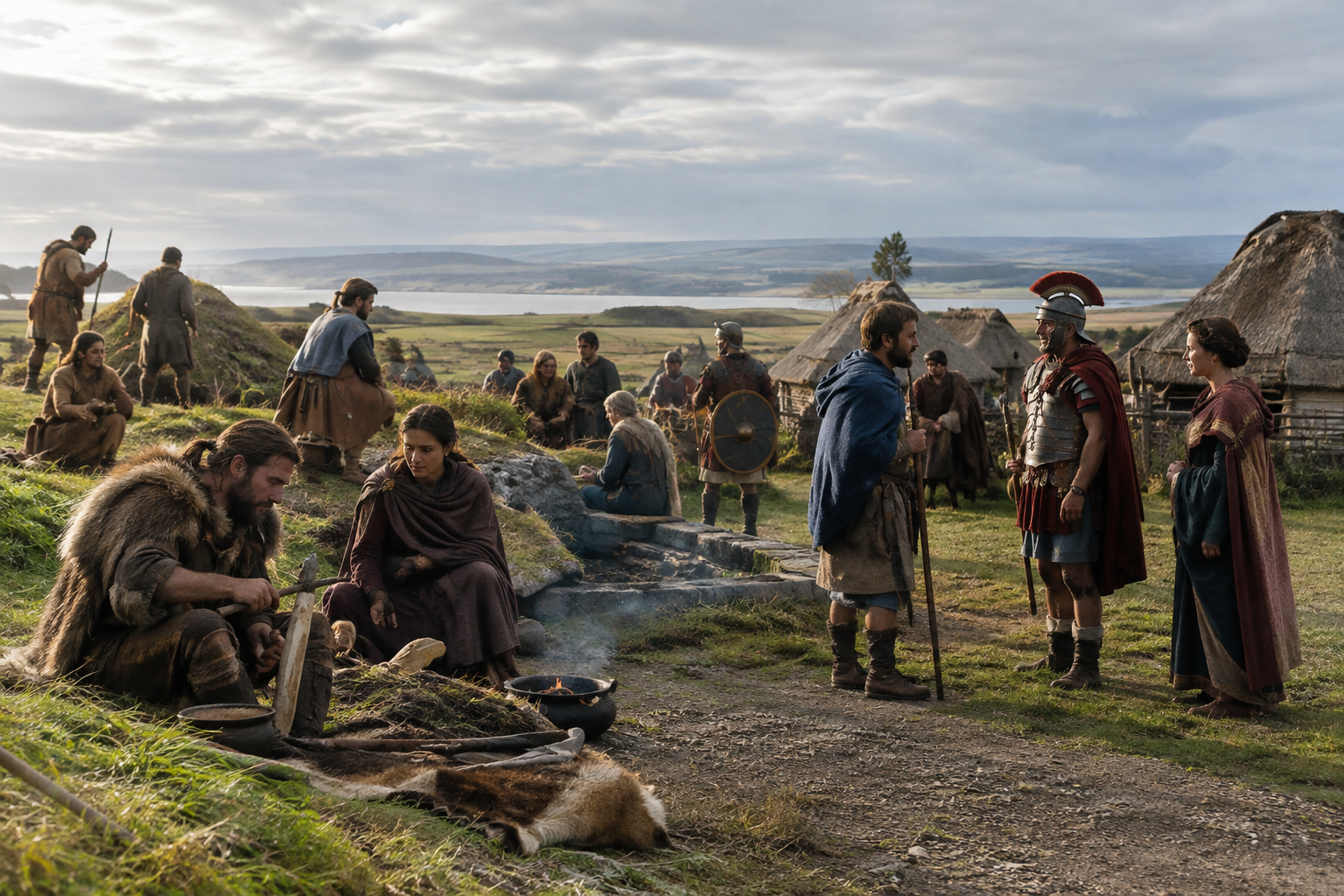
Some Y-chromosome lineages turn up in exactly the places a historian would hope to find them: in barrows, churchyards, frontier settlements, Roman towns, island cemeteries, and quiet Highland kirks where memory has outlived politics. Haplogroup R1b1a1b1a1a2c1c belongs to that sort of story. It sits deep within the wider R1b family, one of the major paternal lineages in western Europe, but this very specific branch should not simply be given the whole biography of R1b as if nothing changed along the way. Narrow subclades have narrower histories, and ancient DNA helps us see that difference.
That is what makes this lineage historically interesting. Y-DNA tracks a direct paternal line only: father to son to son across generations. It does not describe a person's entire ancestry, culture, or identity. But when a paternal line appears in ancient burials from Bronze Age Hungary, Iron Age Yorkshire, Pict-era Orkney, Roman Britain, medieval Ireland, northern Spain, and Viking Age Scandinavia, it offers a remarkably useful thread for thinking about long-term male-line continuity, movement, and local survival across Europe.
The broad R1b family is strongly associated, in general terms, with later prehistoric expansions across Europe, especially after steppe-related migrations in the third millennium BC. But one must be careful here: the existence of R1b1a1b1a1a2c1c today does not mean that every episode in the rise of early R1b can be assigned directly to this exact branch. What the sample list does suggest, however, is that lineages within this part of the tree became deeply embedded across western and northern Europe over a long period.
One of the earliest anchors in the supplied evidence is I3525, from Early Bronze Age Hungary Yamnaya Sarretudvari-Orhalom, dated 2450 BC. This is important not because it proves a neat one-line march from the steppe to every later British or Highland bearer, but because it places this paternal background in the world shaped by steppe-derived Bronze Age movements. From there, the archaeological trail becomes unmistakably western: Britain, Ireland, Iberia, Gaul, Italy, Orkney, and the North Sea zone.
Readers interested in the bigger prehistoric background to these paternal shifts may enjoy this wider look at how ancient DNA changed our understanding of Bronze Age western Europe.
Explore Bell Beaker Population Change
If one were trying to explain this haplogroup through archaeology alone, Britain would demand centre stage. The number of relevant ancient males from Bronze Age and Iron Age Britain is striking. We see early appearances in burials such as I2565 from Bronze Age Amesbury Down Wiltshire England dated 2287 BC, I27380 from Early Bronze Age West Sussex England dated 2300 BC, and I2569 from Early Bronze Age East Lothian Scotland dated 2028 BC. Add to that I2618 from Bronze Age Reaverhill Northumberland England dated 2060 BC, I6774 from Bell Beaker Sussex England dated 2165 BC, and the pattern is already broad.
Then the Iron Age material arrives in force. At Wetwang Slack in East Yorkshire, the Arras culture and Parisi burials provide a cluster: I37339, I36873, I36874, I36847, I36840, I36757, I36763, I36770, I31005, I30998, I36908, I30967, and I41273, all around 225 BC. One does not need to make extravagant ethnic claims to see the significance. This is a paternal line well established among Iron Age communities in eastern Britain.
It turns up elsewhere too: I19909 from the Iron Age Cantii Tribe at East Kent Ramsgate dated 289 BC, I12926 from Celtic Briton Saxon Way Fairford Gloucestershire England dated 100 BC, I17261 from Celtic Briton Suddern Farm Hampshire England dated 200 BC, I19855 from Celtic Ham Hill Fort Somerset England dated 250 BC, and I3567 and I3566 from Iron Age Highland Applecross Scotland dated 70 BC. This is not a fleeting intrusion. It looks much more like a durable paternal presence across multiple British regions.
For a broader look at how these British Iron Age communities are being reinterpreted through genetics, there is an excellent related read on kinship and social structure in Iron Age Britain.
Discover Iron Age Britain Through DNA
The story becomes even more interesting when the lineage appears in very different historical settings. In Orkney, we find KD004 and related entries KD004_1, KD004_2, KD004_3, and KD004_4 from Pict Era Orkney Knowe of Skea Westray dated 205 BC, as well as CGG018915 and CGG018915x from Pict Era Scotland Orkney Mine Howe dated 115 AD. That matters because it places this paternal branch in island communities later associated, at least historically, with Pictish northern Britain. It does not make the haplogroup "the Pict haplogroup" - no serious scholar would say that - but it does show male-line continuity in regions often treated as obscure until written history catches up.
Roman-period mobility adds another layer. VIC016 from Roman Era Cambridge Vicars Farm dated 200 AD shows the lineage in Roman Britain, while I6492 from Roman Villa Tarragona dated 350 AD and I23763 from Roman Iberia Merida Necropolis Blanes dated 450 AD carry it into Hispania. Northern Spain then gives us a valuable sequence at Las Gobas: ldo039 from the Dark Ages Northern Spain Las Gobas dated 650 AD, and ldo052 and ldo242 from Medieval Northern Spain Las Gobas dated 1000 AD. That suggests continuity, or at least repeated presence, across centuries in a region where late Roman and early medieval communities were being reshaped by new kingdoms, monasteries, and frontier societies.
Those Iberian cases sit very neatly beside MyTrueAncestry's broader discussions of Roman and post-Roman Spain.
Explore Roman Hispania's DNA Legacy
This paternal line also appears in early medieval and Viking-connected settings around the North Sea. There are Anglo-Saxon and early medieval English examples such as BUK055 from Early Anglo Saxon Period Buckland Dover England dated 400 AD, HAD018 from Early Anglo Saxon Period Hatherdene Close Cambridgeshire England dated 500 AD, EAS004 from Saxon Palace Eastry Updown Kent England dated 480 AD, LAK010 from Early Medieval Suffolk England Lakenheath dated 650 AD, and 12880A and 12884A from Saxon Hinxton dated 786 AD.
Ireland contributes a particularly suggestive group: KIL025, KIL015, KIL007, and KIL012 from Medieval Ireland Kilteasheen Roscommon Bishops Seat around 650 AD. Scandinavia and the Viking world are represented by VK31 from Viking Age Skara Varnhem Sweden dated 1050 AD, wes008 from Post Viking Era Vasterhus Jamtland Sweden dated 1139 AD, SWG003 from Post Viking Age Hedeby Schleswig Rathausmarkt Southern Jutland dated 1140 AD, and KNS-A1 from Viking Norse Iceland dated 935 AD.
What this suggests is not a single tribe roaming about with a single surname, but a paternal lineage absorbed into many historical populations: Brittonic, Pictish-region, Anglo-Saxon-period, Irish ecclesiastical, Scandinavian, and Iberian. That is precisely why Y-DNA is so useful and so tricky. It preserves continuity where identities change.
The supplied later historical association brings us to Clan MacPhail and Dunlichty Kirk near Loch Dunlichity in the Highlands. This is not a castle in the grand, turreted sense, and that is part of its charm. Dunlichty is described as a small old church and graveyard whose importance lies in layered local memory: medieval parish life, clan society, hardship, worship, burial, and the disruptions of the seventeenth and eighteenth centuries.
That matters for a haplogroup article because paternal history is very often preserved not in palaces but in places like this. A kirk and burial ground can tell us more about long-settled regional communities than a royal pedigree ever could. Dunlichty is especially remembered for its links to the Jacobite age, including graves and carved marks associated with men caught up in the 1745 rising after Culloden. In other words, this is a place where national upheaval struck ordinary Highland lives, and where memory survived in stone even when political causes failed.
We should be properly cautious. A historical association with Clan MacPhail does not prove that every MacPhail man carried R1b1a1b1a1a2c1c, nor does this kirk provide genetic proof of any direct line back to Pict-era Orkney or Bronze Age Britain. But geographically and historically, the fit is compelling: a paternal lineage widely attested in ancient Britain and Scotland, later surfacing in a Highland clan landscape where churchyard, kinship, and memory remained tightly bound.
Readers who want to follow that Highland thread further can explore the wider clan history here.
Read the Story of Clan MacPhail
The most sensible way to read R1b1a1b1a1a2c1c is as a long-lived western and northern European paternal branch that appears across an impressive range of archaeological and historical contexts. The supplied samples place it in steppe-linked Bronze Age Hungary, early Bronze Age Britain, Iron Age Celtic Britain, Pict-era Orkney, Roman Britain and Iberia, medieval Ireland, northern Spain, Scandinavia, Iceland, and eventually even the modern Atlantic world through I8096, an Enslaved Laborer Catoctin Iron-Working Furnace Antebellum Maryland dated 1810 AD. That last case is a stark reminder that paternal lines do not remain politely where historians expect them. They move with conquest, migration, trade, settlement, coercion, and survival.
Ancient DNA does not replace written genealogy. It does something both humbler and grander. It shows that beneath kingdoms, clan traditions, language shifts, and noble memory, male lines can persist, fragment, spread, and reappear in places that connect archaeology to history in unexpectedly vivid ways.
If your own Y-DNA belongs somewhere within this branch, MyTrueAncestry can help you explore whether your paternal line shows affinities with ancient individuals like I3525, KD004, VIC016, or the men buried at Wetwang Slack, Las Gobas, Kilteasheen, and Viking Age Scandinavia. These matches do not prove direct descent from a named ancient person or membership in a particular clan, but they can place your family history inside a much older human story.






Comments