Haplogroup R1b1a1b1a1a2c1b2a1a1a

– 5 min read


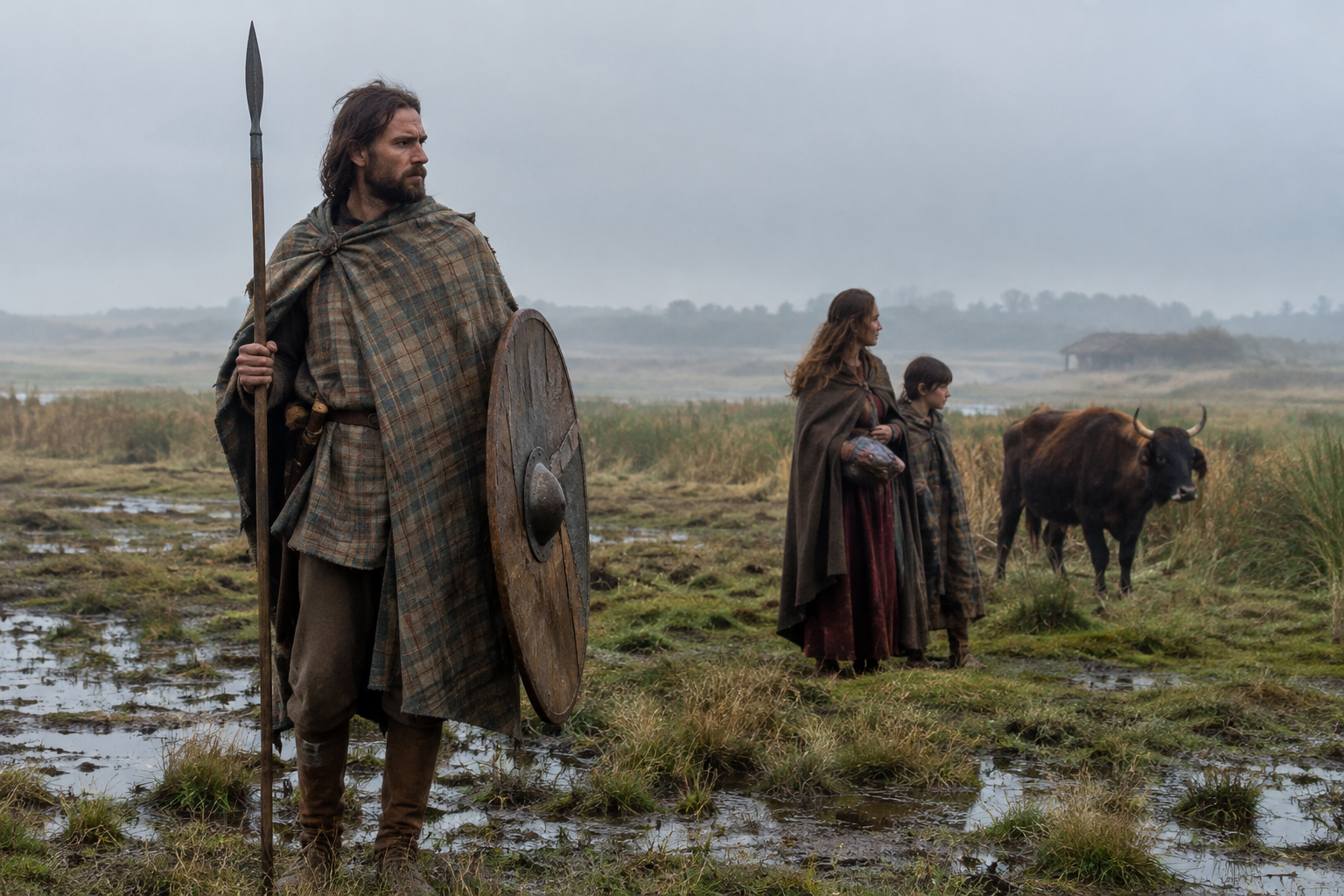
At Bradley Fen in Cambridgeshire, archaeologists recovered the remains of an Iron Age man dated to around 287 BC, identified as I11997 and described as a Celtic Briton. That is already a useful historical anchor. He lived in eastern England before the Roman conquest, in a landscape of wetlands, farmed ground, local territories, and communities that were connected to wider currents moving across Iron Age Europe.
For people exploring the Y-DNA haplogroup R1b1a1b1a1a2c1b2a1a1a, this matters because it places this paternal line, or a reported association with it, in pre-Roman Britain. Y-DNA tracks one direct paternal line only: father to son across generations. It does not describe the whole ancestry of I11997, nor the whole ancestry of any modern tester. But when an ancient individual can be placed in a real archaeological setting, the lineage stops being an abstract string of letters and becomes part of a documented human past.
Bradley Fen sits in the Cambridgeshire Fens, a region whose ancient inhabitants lived with water as a constant fact of life. The Iron Age communities of lowland eastern Britain were not isolated villagers at the edge of nowhere. They farmed, traded, moved livestock, maintained social ties, and participated in material cultures that linked Britain to the near continent even before imperial Rome arrived.
So sample I11997 is valuable not because one skeleton can stand for all Britons, but because he comes from a period when Britain was already complex, regionally varied, and deeply enmeshed in the late prehistoric world. A lineage found in such a context belongs to that complexity. It is part of the population history of Iron Age Britain rather than a later medieval overlay.
A landmark ancient DNA study of prehistoric Britain, published in Nature, transformed how scholars think about long-term population change in the islands. While that broader research is not a biography of I11997, it provides the essential backdrop: Britain had already experienced major demographic shifts long before the Iron Age, and Iron Age communities inherited that layered history rather than springing suddenly into existence.
The full label R1b1a1b1a1a2c1b2a1a1a is a very narrow branch inside the much larger R1b family, one of the best-known Y-chromosome groupings in western Europe. That larger family has a long and complicated history, with many branches spreading at different times and in different directions. It would be careless to pour the entire history of R1b into this one subclade as though they were identical.
What can be said more safely is that a reported connection between this branch and I11997 places it in Iron Age Britain, specifically in a Celtic Briton from Cambridgeshire. That is a historically meaningful point because eastern Britain in the centuries before Rome was not a blank waiting room for later peoples. It was already home to established communities whose ancestry had been shaped by much earlier Bronze Age and prehistoric developments.
The impressive length of the haplogroup label can give the false impression of absolute precision stretching effortlessly into deep antiquity. In practice, ancient DNA resolution varies from sample to sample, and archaeological interpretation remains just that: interpretation. The strongest value here is not in pretending we know every step of this lineage's journey, but in recognizing that one branch of a western Eurasian paternal family is documented in a real pre-Roman British individual.
Calling I11997 a Celtic Briton is historically suggestive, but it needs handling with care. "Celtic" can refer to language, culture, and broad archaeological patterns; it is not a genetic shorthand. What the sample gives us is a man from Iron Age Britain, in a period when Celtic languages were widely associated with much of the island and when communities in southern and eastern Britain were part of a larger world of exchange across the Channel.
That makes this lineage especially interesting for modern testers whose paternal ancestry points toward Britain. It suggests that at least one bearer of this branch was present in Britain before Roman rule, before Anglo-Saxon kingdoms, and before the Norman aristocracy. In other words, the line was already on the island in an indigenous Iron Age setting, not merely introduced by one of the better-documented historical migrations of the last two millennia.
Cambridgeshire is an especially revealing place to encounter an ancient paternal line because it sits in a region that would later become a corridor of repeated demographic and political change. Prehistoric settlers, Iron Age communities, Roman administration, early medieval migrations, Scandinavian influence, and post-Conquest reshaping all left marks on eastern England. Finding this lineage there in the third century BC gives it a firm foothold before many of those later episodes.
That matters because Britain is often discussed backwards, as though everything begins with the Roman invasion or with the Anglo-Saxons. Ancient DNA keeps correcting that habit. The deeper population structure of Britain was already old by the Iron Age, and paternal lines present then may persist through later transformations even as languages, kingdoms, and identities changed around them.
Cambridgeshire has also become increasingly important in population history because its archaeology spans so many periods. Studies of later remains from the county have helped illuminate how communities changed across plague years, migration phases, and medieval society. The Bradley Fen individual therefore belongs to a broader regional archive, one that lets us see continuity and change on the same ground across centuries.
The wider importance of I11997 lies in timing. By around 287 BC, the great population upheavals associated with earlier prehistoric Europe were already in the past. Britain had seen the arrival and spread of new ancestries during the Bronze Age, and those changes shaped the people living there in the Iron Age. A man from Bradley Fen therefore represents a community already formed out of long preceding processes, not a first wave.
That is one reason Y-DNA results can be historically rich even when the sample list is short. A single ancient match in the right place and period can locate a paternal line inside a major historical chapter. In this case, the chapter is the late prehistoric shaping of Britain: local communities with deep roots, continental links, and identities that cannot be reduced to a later English, Roman, or medieval story.
For that reason, this haplogroup is best understood not as a badge of one tribe or one ethnicity, but as a paternal thread visible inside the population fabric of Iron Age eastern England. The real historical gain is specificity of context. Bradley Fen gives this branch a landscape, a date, and a society.
If your paternal line falls under R1b1a1b1a1a2c1b2a1a1a, the most grounded historical insight here is simple and rather powerful: this branch is associated with a documented man in Iron Age Cambridgeshire, living centuries before Rome entered Britain. That does not make every modern carrier a direct descendant of I11997, nor does it assign a single ancient identity to everyone in the branch. But it does place the lineage within the lived world of pre-Roman Britain, where archaeology and genetics meet on solid ground.






Comments