Haplogroup R1b1a1b1a1a2c1a6

– 6 min read


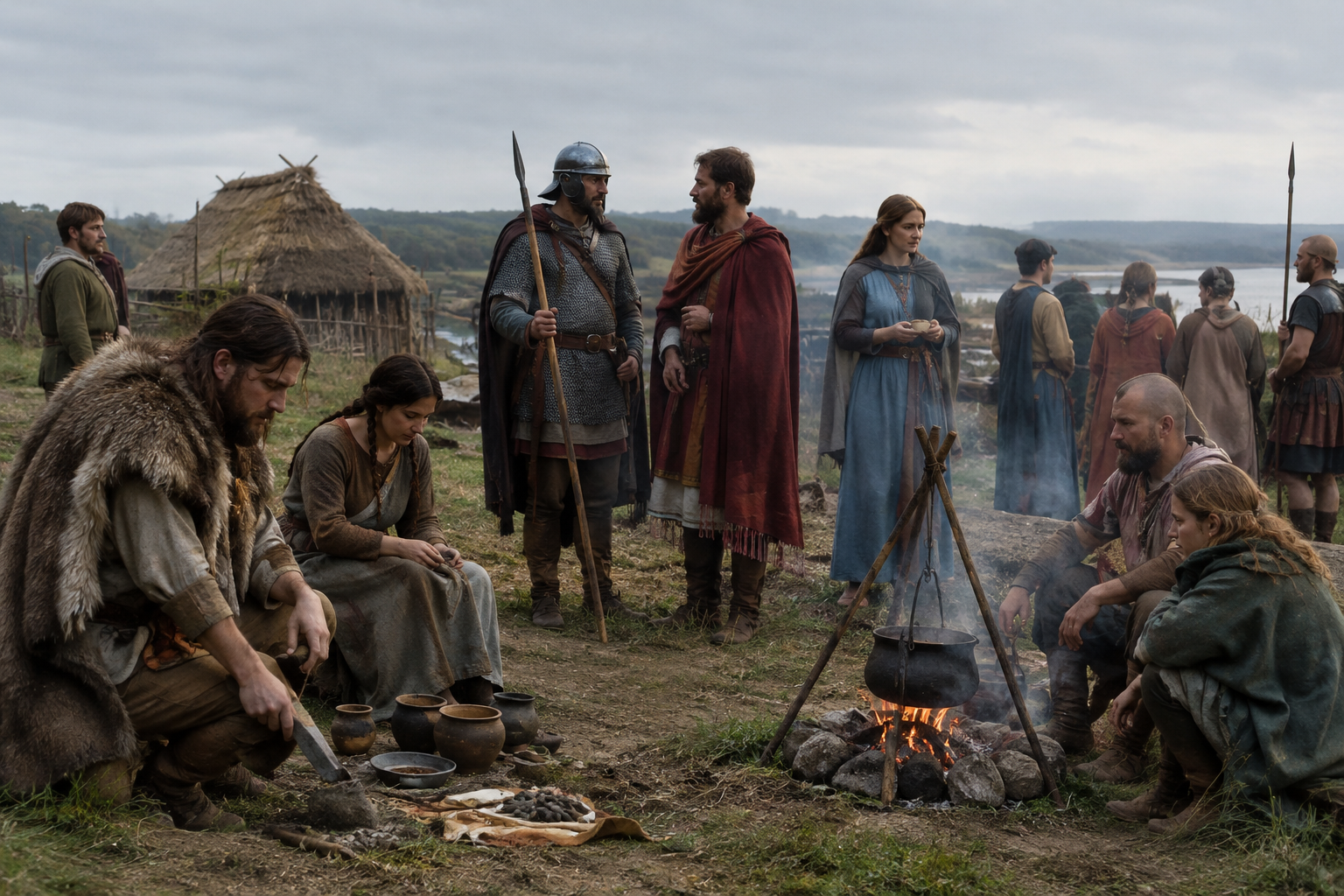
Some Y-chromosome lineages announce themselves with a bang: kings, conquests, famous surnames. Others are more interesting because they refuse to stay neatly in one box. Haplogroup R1b1a1b1a1a2c1a6 belongs to that second category. It sits within the very large and historically important R1b branch of the Y-chromosome tree, a paternal lineage framework that appears again and again in later prehistoric and historic Europe. But this very specific subclade matters not because it can be made to tell a simple national story, but because ancient DNA shows how paternal lines can move across time through very different worlds: steppe herders, Bronze Age communities, Iron Age Britons, Roman-period populations, and medieval societies.
That is also the first thing worth saying clearly. Y-DNA haplogroups trace one direct paternal line only: father to father to father. They do not describe a person's whole ancestry, culture, language, or identity. Still, they are extraordinarily useful. They let us follow one thread through the tangle of the past, and with R1b1a1b1a1a2c1a6 the thread seems to lead us into a particularly western European historical landscape, with strong archaeological visibility in Britain and meaningful appearances from Hungary to Iberia.
The wider R1b family is deeply tied to the great demographic changes of later prehistory in Europe, especially those associated with steppe-derived populations in the Copper and Bronze Ages. For a narrow branch such as R1b1a1b1a1a2c1a6, however, caution matters. We should not simply project the full history of all R1b onto this exact subclade. What the sample list does support is that men assigned to this lineage or its very close context appear across an arc that begins in the Bronze Age and becomes strikingly dense in Iron Age and later Britain.
One of the earliest anchor points is I3525, an Early Bronze Age Hungary Yamnaya Sarretudvari-Orhalom individual dated to 2450 BC. That does not mean this exact branch was "the Yamnaya haplogroup," still less that every later carrier descends from that one man. But it does place this paternal line in a world shaped by steppe-connected mobility. It is a reminder that lineages later common in western Europe often have earlier archaeological visibility far to the east, in societies whose movement helped transform Europe's genetic landscape.
By the Bronze Age, that world had already widened dramatically. Samples such as I2565 from Bronze Age Amesbury Down Wiltshire England dated to 2287 BC, I2417 from Bronze Age Amesbury Down Wiltshire England dated to 2300 BC, and I4950 from Bell Beaker Wiltshire Upavon England dated to 2300 BC point toward the importance of southern Britain in the story of this lineage's broader setting. Add Rathlin2B from Ireland Copper Age dated to 1880 BC, and we are looking at a paternal line well at home in the Atlantic-facing zones of the British Isles by the 3rd and 2nd millennia BC.
Explore Celtic origins through ancient DNA
If the Bronze Age gives us the opening act, Iron Age Britain provides the crowded stage. Few readers could fail to notice the sheer number of relevant samples from East Yorkshire. The Parisi and the wider Arras Culture appear again and again: I36889, I36880, I36885, I36974, I37335, I37336, I37342, I37344, and many more from Wetwang Slack, generally dated to 225 BC. There is also the splendidly evocative I36995, an Elite Celtic Parisi Chariot Burial Iron Age England East Yorkshire Wetwang Slack dated to 225 BC.
This does not prove that the Parisi were defined by one Y-lineage. Ancient communities never work so tidily. But the repetition is hard to ignore. It suggests that this paternal branch, or a very close cluster around it, had become well established in parts of Iron Age Britain. In other words, by the time archaeologists uncover barrows, flat graves, and chariot burials in East Yorkshire, they are not seeing an isolated genetic curiosity. They are seeing a lineage embedded in local society.
The same pattern extends beyond Yorkshire. Dorset gives us a later cluster among the Durotriges at Duropolis Winterborne Kingston, with samples including WBK12, WBK20, WBK29, WBK41, WBK05, WBK30, WBK43, WBK06, WBK08, WBK18, and WBK191, all dated to 125 AD. Here we are already in Roman Britain, yet the men are described as Celtic Durotriges. That is a useful corrective to over-simple history. Roman rule did not erase local populations. Ancient DNA often shows continuity under changing political labels.
Elsewhere in Britain and nearby regions, the lineage appears in places as varied as KD061 from Bronze Age Orkney Westray Links of Noltland dated to 1498 BC, CGG018915 and CGG018915x from Pict Era Scotland Orkney Mine Howe dated to 115 AD, and KNS-A1 from Viking Norse Iceland dated to 935 AD. That is a remarkable geographical spread across island worlds of the North Atlantic.
Read more on Iron Age Britain and kinship
There is also a continental story. In Gaul and neighboring regions we find CGG022427, a Belgic Suessiones Tribe France Bucy-le-Long sample dated to 390 BC, and CGG023699 from Gallic France Parancot dated to 497 BC. In northern Italy, 3214 and 3214s from the Gallic Cenomani Tribe Italy Verona Seminario Vescovile dated to 300 BC show the lineage in another Celtic-speaking context. Again, this does not make the haplogroup "Celtic" in any absolute sense, but it does place it firmly inside archaeological settings often associated with Iron Age Celtic societies.
Iberia is especially interesting because it adds late continuity. At Las Gobas in northern Spain, the lineage appears in ldo039 from the Dark Ages dated to 650 AD, and in ldo052 and ldo242 from the Medieval period dated to 1000 AD. There is also I23763 from Roman Iberia Merida Necropolis Blanes dated to 450 AD, R10488 from Late Roman Conimbriga Portugal dated to 330 AD, and I3809 from Post-Reconquista Granada dated to 1550 AD. This begins to look less like a brief intrusion and more like long-term paternal persistence in parts of the Iberian Peninsula.
For readers interested in how Roman and post-Roman Iberia reshaped local populations, this is a useful neighboring subject.
Discover Roman Hispania's genetic legacy
Now to the medieval afterlife of such lineages, which is where genetics must behave itself. A haplogroup can provide historical context for regions and families, but it does not by itself prove descent from a noble house. That said, the noble associations supplied here are not random. They belong to places where this paternal landscape makes historical sense.
The House of Vauloger is tied to Chateau de Vauloge in Ferce-sur-Sarthe, in western France. The site began as an 11th-century stronghold guarding a crossing of the Sarthe. Rebuilt largely in the 15th century after the devastations of the Hundred Years War, and later softened by Renaissance comforts, it preserves in stone what Y-DNA often hints at in genes: continuity through upheaval. Families changed, buildings were remade, politics shifted, and yet the region kept its deep historical identity.
The House of Normandy and Chateau de Caen present the grander version of the same problem. Founded around 1060 by William the Conqueror, Caen became one of the great fortified enclosures of western Europe. After 1066 it stood at the hinge between Normandy and England. If a lineage such as R1b1a1b1a1a2c1a6 appears repeatedly in Iron Age and later Britain and also in parts of France, that does not prove any Norman dynasty carried it. But it does remind us that the Channel was less a barrier than a busy corridor linking related populations across centuries.
Further north, Clan Menzies and Castle Menzies in Perthshire bring the story into Highland Scotland. The later 16th-century Z-plan tower house near Weem, restored from near ruin in the 20th century, belongs to a landscape where ancient paternal lines had already been present for a very long time. Scottish samples such as I2859x from Late Bronze Age Covesea Caves Moray Scotland dated to 860 BC, I2695 from Iron Age Hillfort Broxmouth East Lothian Scotland dated to 160 BC, and the Orkney finds make that northern continuity difficult to miss.
Explore the history of Clan Menzies
So what can we responsibly say about R1b1a1b1a1a2c1a6? First, it belongs to a wider paternal family strongly implicated in the demographic remaking of later prehistoric Europe. Second, the supplied ancient DNA places this branch in an unusually broad sequence of real archaeological settings, from I3525 in Bronze Age Hungary to dense concentrations in Iron Age and Roman-period Britain, and onward into medieval Iberia and the North Atlantic. Third, this is exactly the sort of pattern that shows how genetics and history complement one another. Written records begin late and usually favor the powerful. Ancient DNA starts much earlier and often speaks for the unnamed.
And that is perhaps the most salutary lesson. A castle, a clan, a Norman fortress, an elite chariot burial, a village cemetery in northern Spain: these are not the same thing. But a Y-lineage can appear in all their worlds, not as proof that they were one family, but as evidence that paternal ancestry can endure while cultures, kingdoms, and identities change around it.
To explore more on the Norman side of that medieval story, readers may also enjoy this closely related article.
If your Y-DNA falls on a branch like R1b1a1b1a1a2c1a6, ancient DNA can place your paternal line in a much bigger historical frame, from Bronze Age mobility to Iron Age Britain, Roman frontiers, and medieval regional continuity. That does not automatically prove descent from any particular ancient individual, clan, or noble house. But it can reveal striking genetic similarities to the people who actually lived in those worlds.
Upload your DNA to MyTrueAncestry and see whether your results connect with ancient samples like I3525, I36995, the Durotriges of Dorset, or the medieval burials of Las Gobas.






Comments