Haplogroup R1b1a1b1a1a2c1a5b1a1a2a1

– 6 min read


Some Y-DNA haplogroups arrive with a grand public reputation. Others hide in the undergrowth of the family tree, known mainly through specialist databases, careful testing, and the occasional ancient burial that suddenly gives them a human face. Haplogroup R1b1a1b1a1a2c1a5b1a1a2a1 belongs to that second category: an extremely specific paternal branch whose importance lies not in fame, but in what it shows about how deep male-line history survives inside later British and Irish history.
That point is worth making at once. A Y-DNA haplogroup tracks one direct paternal line only: father to father to father. It does not describe a person's whole ancestry, identity, or family history. But in the right setting, a branch like this can act rather like a thread pulled from a much larger historical fabric. Follow it carefully and you move from prehistoric population change, to Iron Age communities in southern England, and then into the later landscapes of lordship, castles, and noble houses in Ireland and Scotland.
This long-form subclade belongs within the broad Y-chromosome family known as R1b, one of the major paternal lineages found across western Europe today. In very general terms, many branches of R1b became prominent in Europe after prehistoric population shifts associated with the later Neolithic and Bronze Age. But that broad background should not be lazily pasted onto every tiny downstream twig. A highly specific lineage such as R1b1a1b1a1a2c1a5b1a1a2a1 represents a much narrower paternal history nested within the larger R1b framework.
What we can say responsibly is that such subclades are most useful when ancient DNA and historical geography begin to meet. In Britain and Ireland, the wider R1b landscape intersects with long debates about Bell Beaker expansion, Bronze Age population turnover, and the development of later Celtic-speaking societies. Yet any precise claim about this exact branch needs evidence at the level of actual samples, actual burials, and actual documented family associations.
That is one reason archaeogenetics matters so much. It moves us away from romantic shorthand such as "Celtic blood" or "Norman DNA" and toward something more interesting: named individuals, excavated in real places, dated to real centuries, carrying paternal markers that can be placed in time.
Explore Celtic origins through ancient DNA
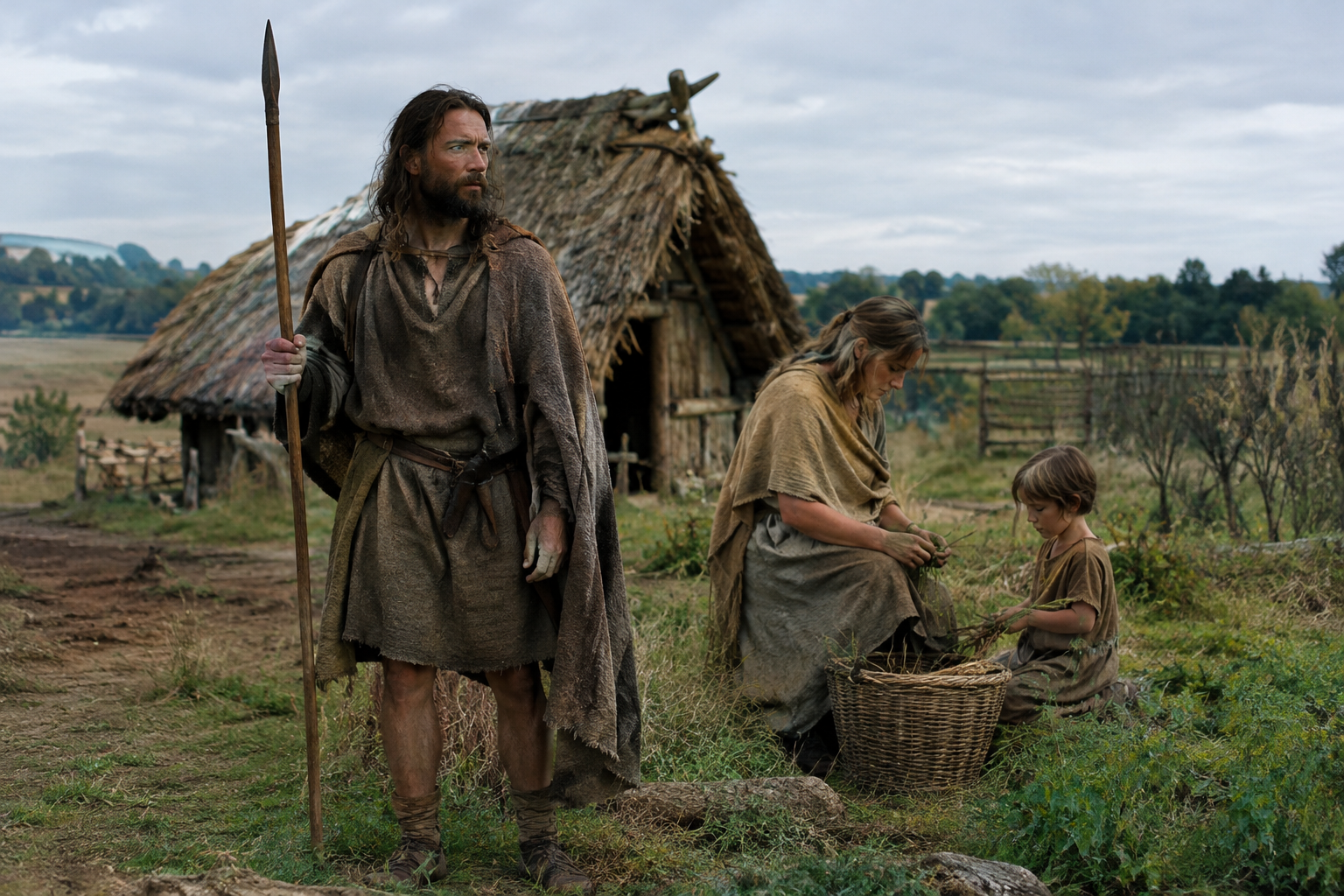
The most important anchor here is the ancient individual I16611, from Middle Wallop Suddern Farm, England, dated to 300 BC. That is already enough to make him historically vivid. We are in Iron Age southern England, centuries before Rome made Britain a province, in a countryside of farmsteads, local power, kin networks, and regional identities that written sources barely illuminate.
Samples like I16611 matter because they show that particular paternal lines were present in Britain well before the medieval pedigrees that dominate later genealogy. They also remind us that the Iron Age was not some dim prologue to "real history." It was a long and changing period in which communities were shaping the social landscape that Romans, and much later Normans, would encounter and transform.
We should be cautious, of course. One burial does not stand for all Iron Age Britons, and shared haplogroup status is not proof of close kinship across centuries. Still, I16611 offers a valuable fixed point. He tells us that a paternal lineage connected to this branch was present in southern England in the centuries before the Roman conquest. That is not a legend or a family tradition; it is physical evidence recovered from the ground.
In that sense, an ancient burial from Hampshire can be more historically disruptive than a shelf of heraldic books. It shows that male-line continuity and regional persistence may run far deeper than medieval surnames, while also warning us that later identities were built on populations already long established.
Read more on Iron Age Britain and DNA
If we step back from the single grave, a broader picture comes into view. Southern Britain was never static. Prehistoric population change, contact across the Channel, Iron Age regionalization, Roman mobility, post-Roman political fragmentation, and later Scandinavian and Norman interventions all left their mark. A Y-line could persist locally through all of that, or spread into new districts through migration, patronage, landholding, or simple demographic luck.
That is why the geography of later noble houses can be suggestive without being conclusive. A paternal lineage seen in ancient Britain may reappear, in one form or another, in regions later dominated by Gaelic dynasties, Anglo-Norman lordships, or Scottish lairds. But the correct language is context, not proof. Ancient DNA can illuminate the stage on which medieval history unfolded; it does not by itself identify which later family inherited which exact paternal branch unless direct testing supports it.
The transition from Iron Age Britain to medieval Britain and Ireland is especially worth pondering. Conquest narratives often make it sound as though one people simply replaced another. Genetics has been steadily complicating that story. Again and again, ancient and medieval data suggest mixtures of continuity and change, not a clean wipe of the slate.
Discover Roman and early medieval Britain
That complexity is written into the castles associated with this haplogroup's historical framing. Consider Gowran Castle in County Kilkenny, linked in its earlier phase to the Butler family and later associated with the House Agar. Its story begins as a medieval stronghold within the manor of Gowran, itself an important place with church, market, and political significance. Over time, the site shifted from fortress to grander country residence. What survives today reflects not just one age of power, but changing ideas of how power should look.
That architectural layering mirrors the genetic lesson rather neatly. Neither lineages nor lordships stay frozen. A medieval stronghold becomes an 18th-century house; a local manor passes through different hands; memory survives even when the original social order has altered beyond recognition.
The same is true, more dramatically, at the Rock of Dunamase in County Laois, associated here with Clan Moore. Its history begins with an early Christian settlement, was punctuated by a Viking attack in 842, and then transformed after the 12th-century Norman invasion into one of the strongest fortresses in Ireland. Granted to Strongbow and later tied through Aoife's marriage to major Anglo-Norman families, Dunamase stands as a monument to conquest and reorganization. Yet even there, the story is not simply one of replacement. It is one of old strategic places acquiring new rulers, new walls, and new meanings.
Then there is Menstrie Castle in Clackmannanshire, associated with the House of Alexander. Built as a 16th-century tower house by the Forrester family, it later became home to Sir William Alexander, who moved from local lairdly status to the court of James VI and I, and played a major part in the early history of Nova Scotia. This is a small castle with an unexpectedly large horizon: local Scottish lordship opening onto Atlantic empire.
None of these castles proves the haplogroup of every man who lived in them. That would be absurd. But together they show the later historical world in which ancient paternal lines continued to circulate: medieval manors, fortified rocks, rebuilt houses, ambitious lairds, Norman colonization in Ireland, and Scottish expansion overseas.
Explore the history of the House of Agar
So what does haplogroup R1b1a1b1a1a2c1a5b1a1a2a1 reveal? First, it reminds us that very specific paternal branches can connect living testers to deep regional histories, especially in Britain and Ireland. Second, it shows why ancient samples such as I16611 are so valuable: they place paternal ancestry in a real archaeological setting, not merely a modern surname project.
Third, it helps explain why castles and noble families remain compelling in DNA history, even when genetics cannot certify every pedigree claim. Sites such as Gowran Castle, the Rock of Dunamase, and Menstrie Castle preserve the political landscapes through which lineages moved, survived, and sometimes rose to prominence.
But there are limits. Sharing a broad or even fairly narrow haplogroup with an ancient individual does not prove direct descent from him personally. Nor does association with a noble house prove membership in that family's exact paternal line. Genetics is powerful, but it is not magic. It works best when used alongside archaeology, documentary history, and a willingness to accept uncertainty where uncertainty remains.
If this mix of ancient burial, regional continuity, and later castle history interests you, the Scottish angle is especially worth following further through the story of the Alexanders and their world.
Read about the House of Alexander
A lineage like R1b1a1b1a1a2c1a5b1a1a2a1 shows how a single paternal branch can lead from an Iron Age burial in England to the later worlds of Irish strongholds and Scottish tower houses. With MyTrueAncestry, you can explore whether your DNA shows similarities to ancient individuals, populations, and historical regions discussed in articles like this one. Those matches can offer remarkable perspective on your past, even though they do not by themselves prove direct descent from a specific ancient person or noble family.






Comments