Haplogroup R1b1a1b1a1a2c1a5b1a1a2

– 5 min read


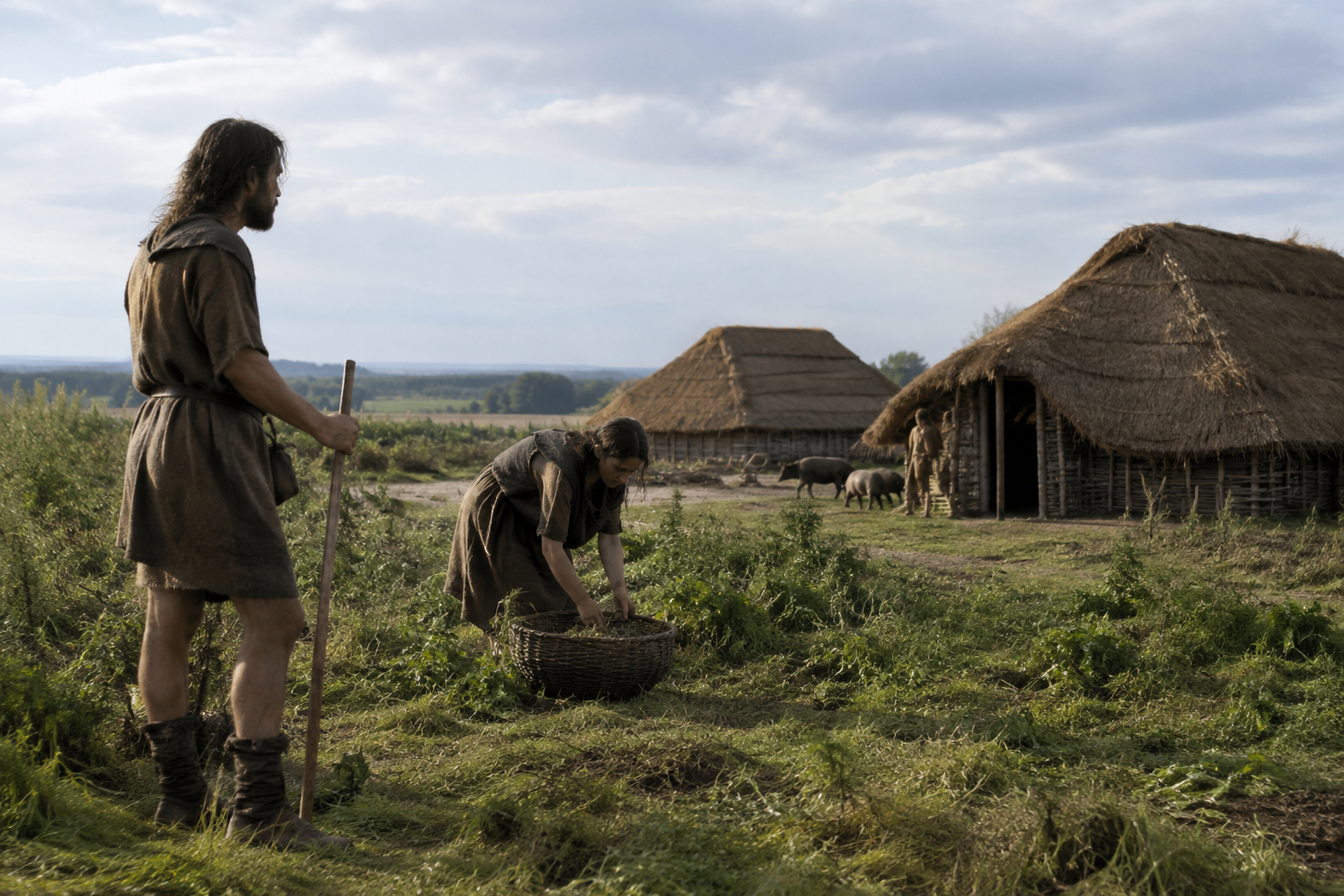
At Suddern Farm near Middle Wallop in Hampshire, archaeologists recovered the remains of an Iron Age man dated to around 300 BC, identified in genetic reporting as sample I16611. On paper that can look like a tiny fact: one individual, one site, one line in a dataset. But for paternal ancestry it is a revealing one, because this man has been associated with the very specific Y-DNA branch R1b1a1b1a1a2c1a5b1a1a2, placing a modern family question into the lived world of later prehistoric southern Britain.
That is the useful scale for understanding a lineage like this. Y-DNA follows one direct male line only: father to son to son. It does not describe a person's whole ancestry, still less a complete identity. Yet when an ancient individual from Iron Age England can be placed on or near such a branch, the result is wonderfully concrete. We are no longer talking about an abstract code, but about a man living in a farmed landscape of hillforts, fields, local communities, and long-established social worlds.
Middle Wallop sits in a part of southern England that was deeply occupied long before the Roman conquest. By 300 BC, this was a countryside shaped by agriculture, exchange, and regional identities. Hampshire was not isolated; it belonged to a wider network of communities across southern Britain, where people shared some material habits yet remained locally rooted.
The importance of I16611 is not that he can be turned into a named tribal chief or attached to some heroic episode. We cannot do that. What we can say is that he offers a direct paternal snapshot from Iron Age England, and that matters because many paternal lines visible in Britain today have deep prehistoric roots mixed with later arrivals. A man like this helps anchor one of those roots in a real archaeological setting.
An ancient DNA study examining populations in Britain and nearby regions, published in Nature, helped show just how powerful this kind of evidence can be for reconstructing population change and continuity. Even when a single sample cannot carry the whole historical argument on its own, it becomes highly informative when placed beside broader genomic patterns.
The branch name R1b1a1b1a1a2c1a5b1a1a2 is, plainly, a mouthful. It belongs within the wider R1b family, one of the major Y-chromosome groupings long associated with many western European paternal lines. But the long string matters because it reminds us not to flatten the evidence. The wider R1b story stretches across large parts of Europe and across millennia; this much narrower sub-branch represents only one twig on that vast paternal tree.
That distinction is especially important in archaeology. It would be careless to take the enormous history of R1b as a whole and simply paste it onto this exact branch. What the Middle Wallop sample gives us is a secure indication that a man linked to this paternal line, or a very near ancestral branch, was present in southern England in the Iron Age. That is already significant without any need for exaggeration.
For people researching their own paternal ancestry, this is often the most meaningful point: a refined haplogroup can connect your line not just to a continent-wide pattern, but to a particular historical setting. In this case, the setting is not a royal court or a medieval pedigree, but an Iron Age rural community in England.
It is easy to treat pre-Roman Britain as somehow vague or dimly understood. In fact, the later Iron Age is increasingly one of the best illuminated periods in British prehistory, because archaeology, isotopes, and genetics now speak to one another. Sites in southern England show settled agricultural life, movement of goods, and communities that were both local and connected.
That makes a sample like I16611 more interesting, not less. He lived before written Roman descriptions of Britain, but not outside history. He belonged to a population that had already inherited many centuries of demographic change behind it, including the deep legacy of earlier Bronze Age transformations in northwestern Europe. By the time he lived, those older population shifts had long since become ordinary local ancestry.
Roman and Early Medieval Britain
So when this haplogroup appears in Iron Age Hampshire, the finding fits a larger archaeological truth about Britain: later prehistoric communities were neither frozen remnants nor simple starting points for later English history. They were fully formed societies, and some of their paternal lines persisted into the worlds that followed.
Southern Britain has seen repeated demographic events: Neolithic farming expansions, Bronze Age population turnover associated with steppe-derived ancestry, Iron Age regional development, Roman-era mobility, and early medieval migration from the North Sea zone. The point is not that one Y-line proves all of this. It does not. The point is that a narrow branch such as R1b1a1b1a1a2c1a5b1a1a2 can survive through these layers, sometimes quietly, while language, politics, and material culture change around it.
That is one of the most useful lessons from ancient DNA. A paternal lineage can be old in a place without making every bearer identical in culture. An Iron Age man in Hampshire, a Roman-period descendant in another county, and a much later medieval Englishman could in principle share parts of the same direct male ancestry while living in entirely different historical worlds.
This is also why caution matters. We should not leap from Middle Wallop to a claim about "the Celts" in the sweeping, romantic sense. Nor should we pretend that a single Y-line maps neatly onto language. Yet the chronology is still suggestive in a sensible way: the branch is present in southern England in the Iron Age, during the period when Brittonic-speaking societies occupied the region before Roman rule transformed the island's political landscape.
One ancient sample is never the whole story, but it can be the right doorway into it. Middle Wallop is valuable precisely because it is local. Grand narratives in archaeogenetics are built from such places: farms, cemeteries, villages, and modest burial grounds where actual people lived and died. The glamour, if one wants to call it that, lies in precision.
For Britain, that precision has steadily revised older stereotypes. Ancient genomics has shown both continuity and change: continuity because many lineages and ancestries persisted for long periods, and change because later migrations did indeed leave major marks. In that context, a branch like R1b1a1b1a1a2c1a5b1a1a2 should be read as part of a layered historical process rather than as a badge of a single people forever.
If your own paternal line falls on this branch, the Middle Wallop connection does not make you the direct descendant of sample I16611. That would be far too strong. But it does place your line in a documented paternal environment that already existed in Iron Age England, and that is a genuinely meaningful historical anchor.
North Sea Migrations to Britain
The most distinctive thing about R1b1a1b1a1a2c1a5b1a1a2 here is not breadth but focus. Instead of a vague western European label, we can point to an Iron Age individual from Middle Wallop in southern England and say that this paternal branch, or an immediately related one, was present there around 300 BC. That is exactly the sort of finding that turns a modern haplogroup from a technical result into a historical clue: not a promise of noble descent, but a solid glimpse of one male line moving through the long, complicated making of Britain.






Comments