Haplogroup R1b1a1b1a1a2c1a5

– 4 min read


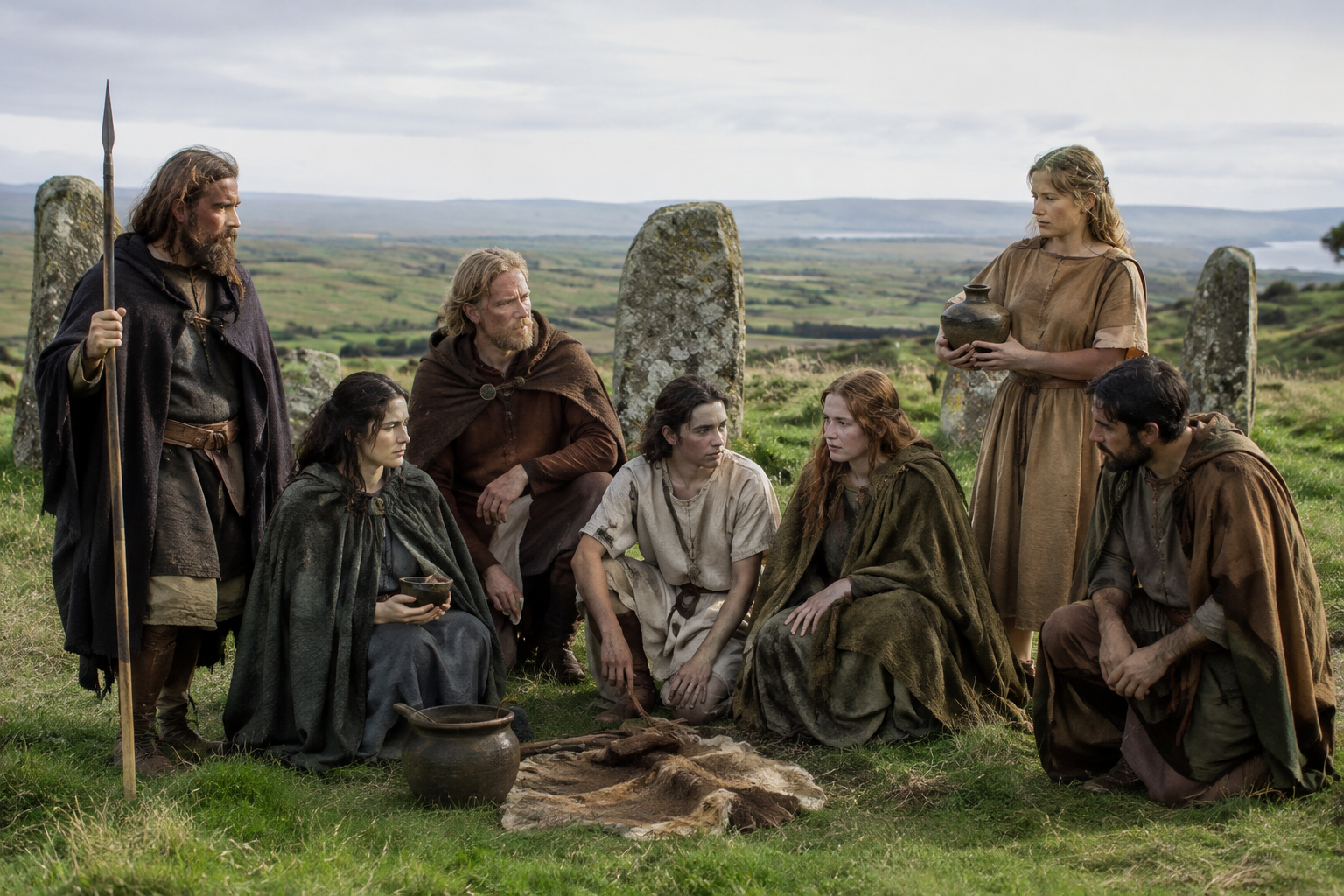
At West Heslerton in Yorkshire, one early Anglo-Saxon burial, sample I11586, dated to about AD 550, brings this Y-chromosome line into unusually sharp historical focus. The cemetery belongs to that awkward, fascinating period after Roman rule in Britain, when local communities, incoming migrants, and older regional populations were all entangled in new ways. In this case, the haplogroup associated with the burial is R1b1a1b1a1a2c1a5, a very specific branch within the wider R1b family.
That matters because the same branch also appears in much earlier ancient individuals from Britain and Ireland: a Copper Age man from Rathlin Island, several Iron Age and earlier Celtic Britons from Derbyshire, Gloucestershire, and Cambridgeshire, and then this early medieval Yorkshire burial. Y-DNA tracks one direct paternal line only, not a person's whole ancestry, but even so the pattern is striking. Here we are not looking at a lineage that suddenly appears in England with the early Anglo-Saxons; we are looking at one that seems to have been present around the Irish Sea and in Britain long before them.
The earliest sample in this group is Rathlin1B, dated to about 1950 BC in Copper Age Ireland. Rathlin Island, off the Antrim coast, has become one of the best known places for early Irish ancient DNA because it anchors genetic discussions in real archaeology rather than later legend. A major ancient DNA study on prehistoric Ireland, published in Nature, helped establish how transformative the Bronze Age horizon was for the island's population history.
For the purposes of this haplogroup, Rathlin1B is important not because he can be made to stand in for all later Irish or British men, but because he shows that a paternal line associated with R1b1a1b1a1a2c1a5 was already present in the islands nearly two millennia before the Roman conquest of Britain. That gives the lineage real chronological depth. It belongs to the long prehistoric making of Atlantic Europe, not merely to the political identities that would come much later.
The British Iron Age samples are, if anything, even more revealing because they come from different landscapes and contexts. I12775, a Celtic Briton from Carsington Pasture Cave in Derbyshire, is dated to about 270 BC. Cave sites in later prehistory can be awkward to interpret: they are not all the same sort of place, and they do not automatically imply one neat ritual explanation. But what matters here is that this branch appears in upland Derbyshire well before Roman rule.
Then there is I12783 from Lechlade-on-Thames in Gloucestershire, dated to about 660 BC, and I12785 from Greystones Farm in Gloucestershire, around 100 BC. Add I11156 from Bradley Fen, Cambridgeshire, dated to about 290 BC, and a pattern begins to emerge. This is not one isolated valley or one family plot repeated over generations in a single excavated cemetery. It is a paternal line turning up across western, central, and eastern parts of Britain in the later prehistoric centuries.
That distribution fits rather well with what archaeology has long suggested about Iron Age Britain: regional societies were distinct, yet connected. Rivers, pasture zones, lowland farming districts, and cave landscapes all formed part of a larger world of mobility, exchange, and local identity. A lineage like R1b1a1b1a1a2c1a5 could persist through that world without belonging to any one tribe named by later classical writers.
An ancient DNA study of Britain and the western Mediterranean published in Nature has helped sharpen this bigger picture, showing both substantial continuity and episodes of movement. The lesson for this haplogroup is not that one Y-line explains Iron Age Britain, but that some paternal lines clearly endured across major cultural changes.
That brings us back to I11586 at West Heslerton. The cemetery is one of the key sites for understanding early Anglo-Saxon England, not least because it belongs to a period when identities in eastern and northern Britain were being renegotiated at close quarters. Burial archaeology from such cemeteries has often been made to carry heavy ethnic labels, as though grave form or object style could settle who was "native" and who was "migrant." Ancient DNA has made that picture at once clearer and more complicated.
Research on the early English gene pool, including work associated with West Heslerton and similar cemeteries, has shown that early medieval communities in England could contain people with quite varied ancestry profiles. In other words, an Anglo-Saxon cemetery is not a simple synonym for one homogeneous continental population. The presence of R1b1a1b1a1a2c1a5 in sample I11586 sits neatly within that more mixed and more human picture.
What makes this particularly interesting is the contrast between cultural setting and paternal continuity. The burial belongs to an early Anglo-Saxon cemetery, but the broader sample pattern for this lineage reaches back through Iron Age Britain to Copper Age Ireland. That does not prove that I11586 was descended directly from any named prehistoric individual, of course. It does suggest that some paternal lines in early medieval England may have deep insular roots even within communities shaped by migration from across the North Sea.
It is tempting to turn a lineage like this into a badge of "Celtic" or "Anglo-Saxon" identity, but the archaeology resists that sort of tidiness. The earlier samples are described as Celtic Britons because of their date and archaeological context in later prehistoric Britain, while I11586 belongs to an early Anglo-Saxon cemetery because that is the culture-history of the site. The Y-chromosome line passes through both worlds.
So the strongest point about R1b1a1b1a1a2c1a5 is continuity across change. It appears in a Copper Age Irish individual, in several pre-Roman Britons from quite different regions, and then in early medieval Yorkshire. That is precisely the sort of pattern ancient DNA is good at uncovering: not a heroic origin story, but the survival of one paternal thread through shifting languages, burial customs, and political landscapes.
Roman to Early Medieval Britain
For someone researching this haplogroup today, the ancient evidence points most firmly toward long-standing roots in Britain and Ireland rather than a single dramatic migration event visible in the current sample set. The distinctive feature of R1b1a1b1a1a2c1a5 is not grandeur or royal association, but persistence: a paternal line present in the islands from the Copper Age, still visible among Iron Age Britons, and still turning up in the complex society of early Anglo-Saxon England.






Comments