Haplogroup R1b1a1b1a1a2c1a4c

– 6 min read


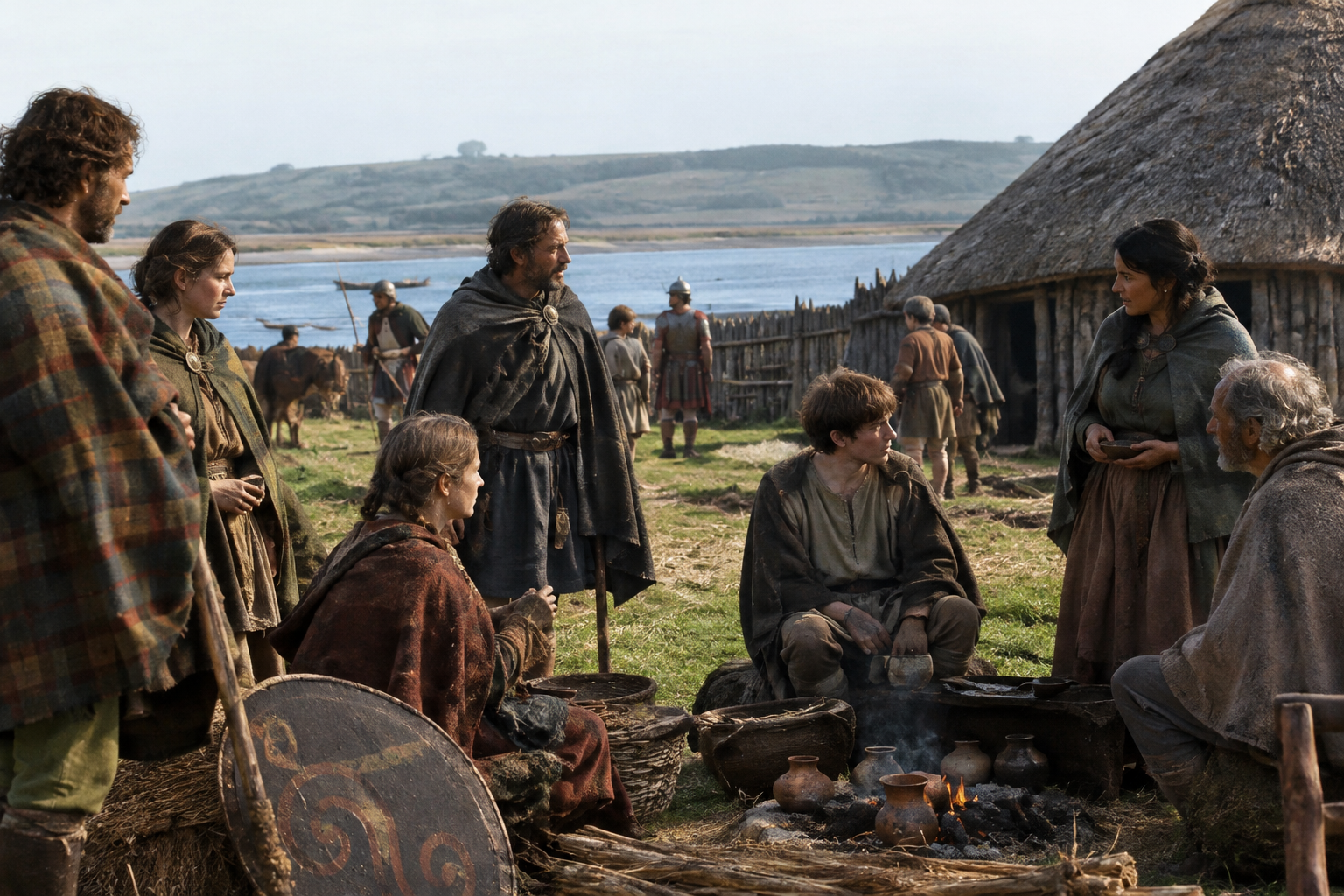
There is something wonderfully stubborn about a Y-chromosome lineage. Kingdoms fall, languages shift, frontiers harden and dissolve, yet a paternal branch can still be detected in burials scattered across centuries. Haplogroup R1b1a1b1a1a2c1a4c belongs to one of those lineages whose story is best understood not as a single tribe marching across a map, but as a long record of men living in very different worlds: Bronze Age Britain, Iron Age Yorkshire, Roman Croatia, early medieval Ireland, and the violent border country of later Scotland.
As always with Y-DNA, a note of caution matters. A Y-haplogroup traces one direct paternal line only: father to father to father. It does not describe a person's whole ancestry, culture, or identity. Nor does sharing a haplogroup prove close kinship across long spans of time. But it can do something else, and it is no small thing: it can show us how one paternal branch appears again and again in the archaeological record, allowing history to be read not just in chronicles and ruins, but in bone.
This very specific subclade, R1b1a1b1a1a2c1a4c, sits deep within the wider R1b tree, one of the major Y-chromosome lineages in western Europe. For such a narrow branch, it would be careless to assign all the grand history of R1b directly to it. Still, its sample pattern is revealing. The evidence supplied here points strongly toward a western European story with a particularly striking concentration in Britain, especially in Iron Age and Roman-era contexts.
That matters because ancient DNA has changed the old habit of speaking about "Celts," "Britons," or "Romans" as if each were a neatly bounded biological category. They were not. What the evidence more often shows is regional continuity mixed with mobility: paternal lines persisting in local populations while political and cultural labels changed around them. In that sense, this haplogroup looks less like the badge of a single people and more like a durable thread woven through several historical settings.
Explore Celtic Origins in Ancient DNA
The earliest anchors in the dataset already place this lineage, or closely related paternal presence, in Bronze Age Britain. Sample I2417, from Bronze Age Amesbury Down, Wiltshire, England, dated 2300 BC, and I4950, from Bell Beaker Wiltshire Upavon, England, also dated 2300 BC, suggest that the branch belongs in the long aftermath of the Bell Beaker horizon and the reshaping of paternal lineages in Britain during the later third millennium BC.
Other Bronze Age finds reinforce that impression of continuity rather than isolated appearance. We see I3256 from Bronze Age Trumpington Meadows, Cambridge, England at 2100 BC; I5377 from Early Bronze Age England Thames at 1800 BC; dfb002 from Dorset Cranborne Chase Down Farm Pond Barrow at 1900 BC; and KD061 from Bronze Age Orkney Westray Links of Noltland at 1498 BC. That is an impressive geographic range inside Britain, stretching from southern ceremonial landscapes to Orkney in the far north.
There is even a Scottish marker in I5473, from Bronze Age Boatbridge Quarry, South Lanarkshire, Scotland, dated 2250 BC. For anyone interested in later Scottish clan landscapes, that sample is especially evocative. It does not prove anything about medieval or early modern families, of course, but it does remind us that paternal lines found in the Scottish Borders and Lowlands can have very deep roots in Britain indeed.
The dataset is not confined to Britain. Rathlin2B, from Ireland Copper Age dated 1880 BC, places the lineage in prehistoric Ireland too, while GMO015 from Bronze Age Calabria, Cosenza, Grotta della Monaca, Sant'Agata di Esaro at 1300 BC hints that related paternal branches were also present in Mediterranean contexts. That does not collapse Britain and Calabria into one tidy migration tale. It simply shows that this branch belongs to a wider western European world, within which local histories unfolded very differently.
If the Bronze Age gives us the deep background, the Iron Age gives us density. Few parts of the dataset are as striking as the cluster from East Yorkshire, especially the Wetwang Slack and Pocklington burials associated with the Celtic Parisi and the Arras Culture.
There is a whole gallery of individuals here: I36889, I36880, I36885, I36974, I37335, I37336, I37342, I37344, I36867, I36869, I36870, I36843, I36844, and I36972, all tied to Wetwang Slack around 225 BC, plus I36995, the Elite Celtic Parisi Chariot Burial from the same place and date. Add to them I14100 from Pocklington, Yorkshire, England at 320 BC, and I14102, I14104, I21978, I21644, I5509, I13753, and I13760 from related East Yorkshire contexts.
Now, one must not turn a shared haplogroup into a fantasy of one giant ruling family. But the pattern is still historically suggestive. Here we seem to be looking at a paternal lineage well established among Iron Age communities in East Yorkshire, including people buried with notable status and distinctive local rites. The famous Arras culture chariot burials have long attracted attention for their continental links and local character; the Y-DNA evidence helps show that behind the glamorous grave goods stood real lineages embedded in the region.
Elsewhere in Iron Age Britain, the branch appears in I11991 from Iron Age Worlebury, Somerset, England at 150 BC, I21309 from Iron Age Hillfort Battlesbury Bowl, England at 57 BC, and HI2 from Celt Hinxton, Iron Age at 45 BC. This is not a narrow Yorkshire curiosity. It is a lineage visible across a substantial swathe of later prehistoric Britain.
One of the pleasures of ancient DNA is that it refuses to respect the tidy compartments of school history. A lineage prominent in prehistoric Britain also appears in later Roman and early medieval settings. The Durotriges burials at Duropolis, Winterborne Kingston, England, dated 125 AD, include a remarkable series: WBK12, WBK20, WBK29, WBK41, WBK05, WBK30, WBK43, WBK06, WBK08, WBK18, and WBK191. Here again, the branch appears not as an isolated oddity but as part of a living local population in Roman Britain.
Then there is movement. I26776 from Imperial Roman Era Zadar, Croatia at 200 AD, R10656 from Late Roman Era Klosterneuburg, Lower Austria at 407 AD, and R10488 from Late Roman Conimbriga, Portugal at 330 AD show related paternal presence in widely separated parts of the Roman world. That is not surprising. Roman rule moved soldiers, merchants, slaves, administrators, and families over long distances. What is interesting is how the same branch can be found both in strongly local British settings and in imperial ones.
The early medieval record keeps the story going: I11580 from Post Roman Era Worth Matravers, Dorset, England at 600 AD, KIL034 from Medieval Ireland Kilteasheen, Roscommon, Bishops Seat at 650 AD, IND013 from Merovingian Grave, North Rhine-Westphalia, Germany at 600 AD, and the Belgian samples ST2025 and ST1308 from Sint-Truiden at 900 AD. This is the sort of evidence that makes written categories look rather flimsy. The paternal line persists, but the political map keeps changing around it.
Explore Roman and Early Medieval Britain
If we leap forward from prehistoric barrows and Roman cemeteries to the Scottish Borders, we enter a world no less rough for being better documented. The supplied family connection here is Clan Turnbull, associated with Fatlips Castle in Roxburghshire. It is a small ruined pele tower, probably built in the 16th century by the Turnbull family, in a landscape where feuding, raiding, and watchfulness were ordinary facts of life.
This is important not because a castle proves a haplogroup - it does not - but because it places a later historical family in a region where deep British paternal continuity is perfectly plausible. Fatlips Castle belonged to that practical border architecture shaped by insecurity. It later passed to the Scotts of Harden, another reminder that surnames, lordship, and property can shift even when local populations retain older roots.
Only part of the tower now survives on a lonely hillside near Hawick, but that survival is enough. Pele towers are not grand royal statements; they are defensive farmhouses for a dangerous frontier. In some ways they are the perfect architectural counterpart to a Y-lineage like this one: persistent, local, and not particularly interested in the neat narratives historians like to tell.
For readers interested in the wider historical setting of the family itself, the MyTrueAncestry community article on Clan Turnbull offers a natural next step.
What, then, can we responsibly say about R1b1a1b1a1a2c1a4c? First, the supplied evidence places this paternal branch repeatedly in Britain from the Bronze Age onward, with especially strong visibility in Iron Age and Roman-period contexts. Second, it also appears in Ireland and on the continent, reminding us that regional continuity and mobility are not opposites but partners in European history. Third, its story illustrates the real value of ancient DNA: it lets us compare prehistoric burials, Roman communities, and medieval regions without pretending that shared Y-DNA equals direct descent.
So a man with this haplogroup today is not "a Durotrige," "a Parisi noble," or "a Turnbull" by genetics alone. But he may be carrying a paternal line that was already present in Bell Beaker-era Wiltshire, in the Iron Age cemeteries of East Yorkshire, in Roman Dorset, or in the older population background from which later Border families emerged. That is not a fairy tale of identity. It is, in truth, much more interesting.
If you want to see how your own DNA compares with ancient individuals like I2417, Rathlin2B, I36995, or the Winterborne Kingston series, MyTrueAncestry can help place your results in this deeper archaeological setting. These matches do not by themselves prove direct descent or noble ancestry, but they can open an unexpectedly vivid window onto the ancient populations behind your family story.






Comments