Haplogroup R1b1a1b1a1a2c1a4b3

– 6 min read


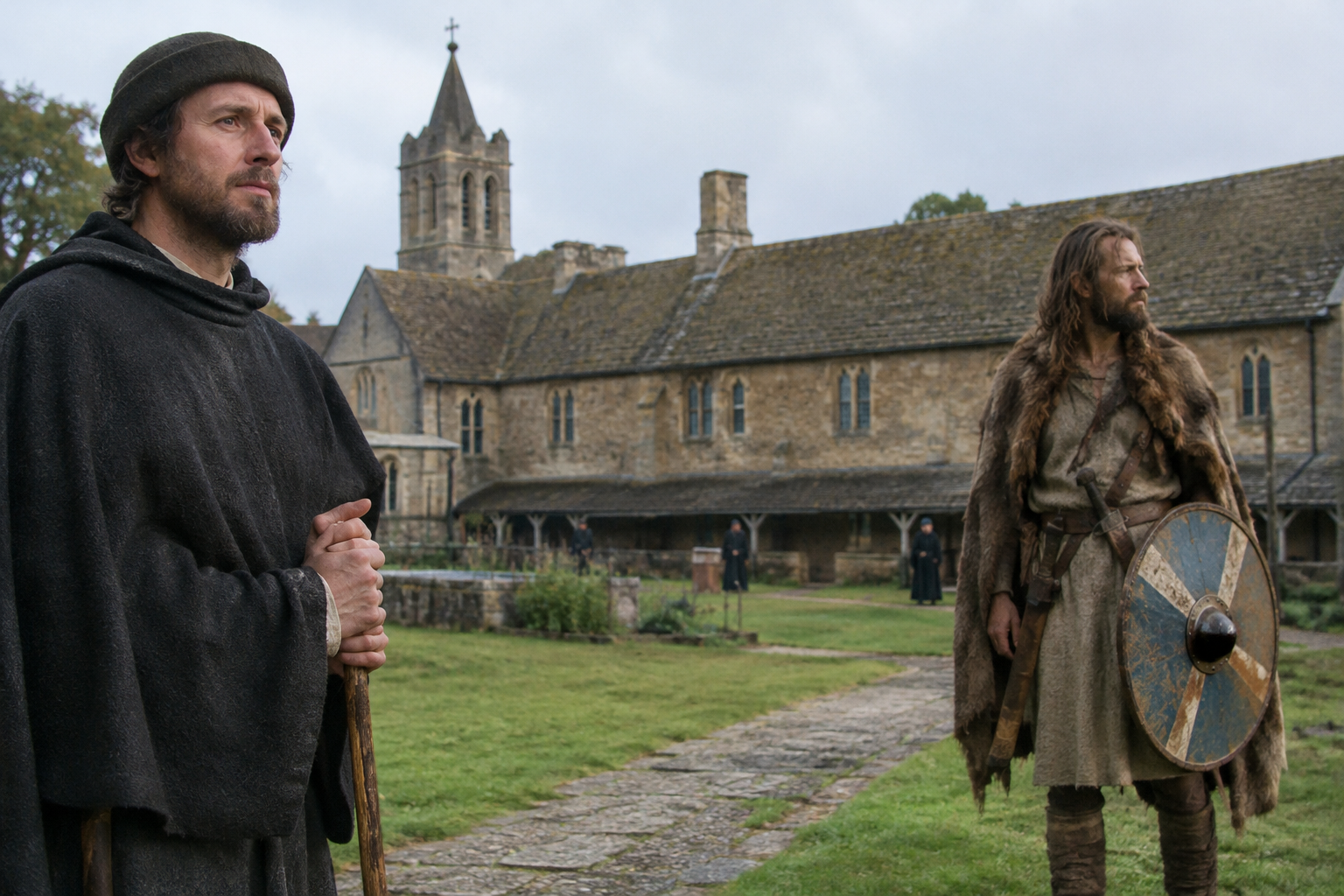
Some Y-DNA branches are famous because they are broad and easy to spot across half of Europe. Others are interesting precisely because they are narrow, late-forming, and reveal how a very old paternal story can survive inside very specific regional histories. Haplogroup R1b1a1b1a1a2c1a4b3 belongs to that second category: a fine-grained branch within the wider R1b tree, one of the major paternal lineages in western Europe.
That distinction matters. A Y-DNA haplogroup traces only one line of descent: father to son to son across many generations. It does not describe all of a person's ancestry, culture, language, or identity. Still, as archaeologists and geneticists have learned, even one narrow paternal thread can lead us into a remarkable historical landscape: Iron Age communities in Britain, medieval burials in Cambridge, and later the world of castles, river lordships, and Highland clan power.
R1b is a very large Y-chromosome family with deep roots in the population history of western Eurasia and a strong presence in much of western Europe today. Many of its branches became widespread through prehistoric and later historic population movements, especially after the Bronze Age. But one must be careful here: the long history of R1b as a whole cannot simply be pasted onto every tiny downstream subclade.
For a specific branch such as R1b1a1b1a1a2c1a4b3, the safer historical approach is contextual rather than triumphalist. Its importance lies in the fact that it belongs to a paternal framework often found in northwestern Europe, especially in regions tied over time to Atlantic and North Sea worlds: Britain, the Low Countries, and parts of adjacent Europe. That makes the supplied ancient samples especially valuable, because they place this lineage's story in real landscapes rather than abstract phylogenetic charts.
In other words, we are not looking at "the haplogroup of a people" in some simplistic sense. We are looking at one branch inside a larger paternal network that ancient DNA can occasionally catch in the act, at a burial ground, a hospital cemetery, or an Iron Age community.
Explore How Ancient DNA Reconstructs History
The earliest supplied anchor is I28928, listed as Ancient Individual:Celtic Parisi Iron Age England East Yorkshire Burton Fleming Year:269 BC ID:I28928. Even in that short label, there is a great deal to notice. East Yorkshire in the Iron Age was not some blank prehistoric field. It was part of a distinct regional world of communities, burial customs, and local identities. The reference to the Parisi places the individual in one of the best-known Iron Age settings of eastern Britain.
Now, one must not leap from one Y-chromosome result to broad ethnic certainties. A single paternal line does not "prove" the essence of the Parisi, nor does it tell us what language every man nearby spoke. But it does show that a branch within the wider R1b world was present in Iron Age eastern England before Rome, before Anglo-Saxon kingdoms, before Norman castles. That alone is historically important.
It suggests that when we later encounter similar paternal frameworks in medieval Britain, we may be seeing not a single migration event but a long history of continuity, movement, and reshuffling within the islands. Britain did not repeatedly empty and refill like a bathtub. Populations changed, mixed, and reorganized, but many paternal lines persisted through those changes.
That is especially relevant for lineages later associated with regions facing the North Sea. East Yorkshire was connected not only inland but outward, into maritime routes and coastal contact zones that mattered long before written chronicles became plentiful.
Discover Iron Age Britain Through Ancient DNA
The second sample brings us forward more than 1,500 years: ATP_PSN_192, listed as Ancient Individual:Medieval England Cambridge St Johns Hospital Year:1250 AD ID:ATP_PSN_192. If the Iron Age burial from Burton Fleming gives us a pre-Roman horizon, this Cambridge individual places the lineage in a very different social world: urban, Christian, institutional, and unmistakably medieval.
St John's Hospital in Cambridge was part of that dense medieval fabric of charity, religion, and everyday hardship. Here ancient DNA meets not a warrior legend but a lived townscape of illness, care, and community. The value of ATP_PSN_192 is that it shows the paternal story still present in England in the thirteenth century, in a setting utterly unlike an Iron Age burial landscape.
Again, caution is needed. Sharing a broad or even fairly specific haplogroup does not make the Iron Age man of Burton Fleming the direct ancestor of the Cambridge individual. The point is subtler and, in some ways, more interesting: a paternal branch can persist across radically different historical worlds. The man buried in medieval Cambridge inhabited a society of parish bells, scholars, guilds, and royal government; the man from Iron Age East Yorkshire did not. Yet ancient DNA can reveal that some paternal lines ran through both worlds.
For readers interested in how medieval English populations were being transformed by conquest, mobility, and survival, that makes the Cambridge evidence particularly evocative.
Read More on Medieval Cambridgeshire DNA
So where does a branch like R1b1a1b1a1a2c1a4b3 belong in the later historical landscape? Not to one kingdom or one surname alone, but to a wider northwestern European zone where paternal continuity could survive while politics altered beyond recognition.
That helps explain why the supplied noble associations feel geographically plausible without being genealogically provable. In the Low Countries, the House van der Merwede evokes the watery borderlands of Holland. Merwede Castle near Dordrecht, built in the late 1200s, was a modest but strategic stronghold, tied to river control, local power, and later to the Hook and Cod conflicts. It was not a fairy-tale fortress but a machine for managing traffic, land, and status in a difficult landscape. Its later ruin, damaged by warfare and flooding, reminds us how fragile noble authority could be in the delta.
In Scotland the picture shifts, but not entirely. Clan Farquharson, associated with Invercauld Castle in Aberdeenshire, represents a Highland pattern of authority rooted less in great curtain walls than in landholding, kin politics, and adaptation. Invercauld, enlarged over centuries from a fortified residence into a grand estate house, belonged to a world of late medieval and early modern clan maneuvering, Jacobite loyalties, and royal hunting in the Cairngorms.
Then there is Clan Gilmore and Craigmillar Castle in Edinburgh, a place where architecture and politics properly collide. Beginning as a tower house in the late fourteenth century and expanding into a courtyard castle, Craigmillar became entangled with some of the darkest dramas of sixteenth-century Scotland, including Mary Queen of Scots and the discussions later remembered as the Craigmillar Bond. It survives as a ruin, but a ruin of the most eloquent sort: one that still speaks of residence, defense, ambition, and intrigue.
None of these families should be treated as genetically "proven" bearers of this haplogroup merely because they are associated here with it. That would be bad history and worse genetics. But they do belong to regions where lineages within the wider R1b landscape were long established, and they illustrate how paternal continuity can sit behind very different forms of recorded power.
Explore the House van der Merwede
What castles preserve, after all, is not DNA but memory. Merwede Castle preserves the memory of contested noble power in Holland's wet frontier. Invercauld preserves the memory of a Highland family whose authority endured by changing with the times. Craigmillar preserves the memory of elite residence within the orbit of royal politics.
Ancient DNA works differently. It does not tell us which tower a man slept in or whose side he took in a civil feud. But it can show that paternal lines in Britain and the North Sea zone often have much deeper roots than the documents do. A surname may appear in the late Middle Ages; the Y-line behind some members of that surname may have been in the region for centuries or longer. That is the quiet revolution of archaeogenetics.
For this haplogroup, the supplied evidence points us toward exactly that sort of historical depth: an Iron Age individual in East Yorkshire, a medieval individual in Cambridge, and later noble associations in Scotland and the Low Countries. Not one dynasty, not one tribe, not one uninterrupted family tree, but a chain of historical settings in which a paternal branch within the R1b world may be traced across time.
Discover the Story of Clan Farquharson
R1b1a1b1a1a2c1a4b3 is a reminder that the most specific haplogroups are often the most historically human. They move us away from grand slogans and back toward actual men in actual places: one in Iron Age East Yorkshire, one in medieval Cambridge, and later the families who built, occupied, lost, and remembered castles across the North Sea world.
For anyone exploring direct paternal ancestry, that is the real fascination. A Y-DNA branch can connect your results to broad patterns of European history, but it can also sharpen your eye for place: eastern England before Rome, Cambridge in the thirteenth century, river lordship in Holland, clan territory in Highland Scotland. Genetics does not replace documentary genealogy or archaeology. It stands beside them, offering a different kind of evidence and sometimes a much longer timeline.
If this lineage appears in your results, the most responsible conclusion is not that you "are" an Iron Age Parisi noble or descended from a castle lord. It is that your direct paternal line belongs to a historical network that ancient DNA now allows us to glimpse across many centuries.
Upload your DNA to MyTrueAncestry to explore whether your paternal ancestry shows links to ancient individuals like I28928 or ATP_PSN_192, and to discover how archaeology, genetics, and history can illuminate one another. These matches do not by themselves prove direct descent or noble identity, but they can open a remarkable window onto your deeper past.






Comments