Haplogroup R1b1a1b1a1a2c1a4b2c1a

– 6 min read


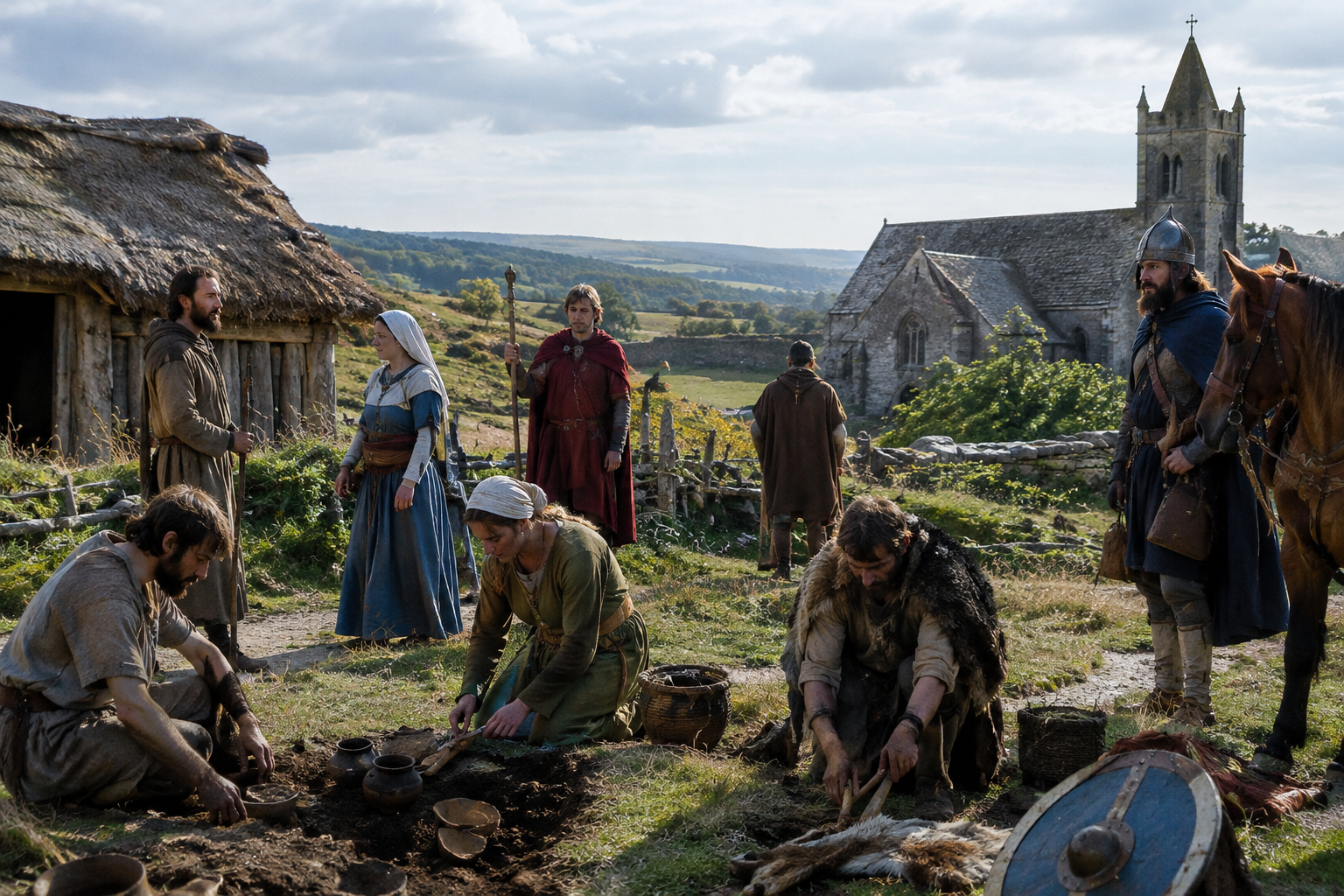
Some Y-chromosome lineages announce themselves with a thunderclap. Others are more elusive, appearing not as a single imperial signature but as a trail of men buried across centuries: a Bronze Age fighter in northern Germany, Iron Age communities in Yorkshire, a medieval man in Roscommon, a Viking Age burial on Oland, and later individuals in England and Belgium. The Y-DNA haplogroup R1b1a1b1a1a2c1a4b2c1a belongs to that second sort of story.
That long string of letters and numbers represents a very specific branch on the wider R1b tree, one of the major Y-chromosome lineages in western Europe. Y-DNA traces a direct paternal line only - father to son to son - and not a person's full ancestry. That matters, because a haplogroup can illuminate one narrow but powerful thread of the past without explaining everything about language, identity, class, or family history. With a branch this specific, caution is especially important: we should not simply pour the whole history of broad R1b into it as if nothing changed along the way. But the ancient samples linked with this lineage do let us watch one paternal tradition moving through the worlds of Bronze Age conflict, Iron Age Britain, early medieval Ireland, Viking Age Scandinavia, and later northwestern Europe.
In broad terms, R1b is deeply tied to later prehistoric and historic Europe, especially in its western half. Many of its branches became prominent after the great population changes of later prehistory, including movements often associated with steppe-derived ancestry and the reshaping of Europe in the Bronze Age. But a narrow lineage such as R1b1a1b1a1a2c1a4b2c1a needs to be treated as a later twig on that much larger tree, not as a synonym for all R1b history.
What the sample distribution suggests, at least from the evidence supplied here, is a lineage at home in the North Sea and Atlantic-facing parts of Europe: Britain, Ireland, Belgium, northern Germany, and even Viking Age Sweden. That does not prove a single unbroken regional homeland, but it does place this paternal branch in a zone long shaped by movement across water as much as by movement across land. The Channel, the North Sea, and the Irish Sea were not barriers in the simple modern sense. They were working routes, military corridors, trading lanes, and migration highways.
Explore Celtic DNA and language spread
The earliest anchor point in this set is WEZ59, from the Bronze Age Germany Tollense Valley Battlefield Mecklenburg-Vorpommern, dated to 1250 BC. Tollense has become famous as evidence for organized violence on a striking scale in Bronze Age northern Europe. To find a related paternal line in that setting is a reminder that these haplogroups belonged to real men caught up in dangerous, mobile, and politically complex worlds. This is not the stuff of neat ethnic boxes. It is the world of routes, weapons, rivalries, and shifting alliances.
Not far behind comes I7640, from Bronze Age Trumpington England, dated to 1330 BC. Together, Trumpington and Tollense place this paternal signature on both sides of the North Sea zone in the later Bronze Age. That does not prove close kinship between those individuals, but it does suggest that related paternal branches were present in societies linked by exchange and movement long before Roman writers began naming tribes.
Then the picture sharpens dramatically in Iron Age eastern Yorkshire. At Wetwang Slack and Melton, several individuals appear in the orbit of the Celtic Parisi and the Arras Culture: I36850, I36846, I36825, I31007, I30993, I36894, I36898, I39730, and I28922, dated around 225 BC or 270 BC. This is remarkable not because it proves a dynasty, but because repeated finds in one region hint at genuine local depth. A lineage seen once may be a curiosity; seen again and again, it begins to look like part of the settled paternal landscape.
Another important English sample is I17264, from the Belgic Tribe Hillfort Danebury Hampshire England, dated to 60 BC. Danebury belongs to a very different Iron Age setting from Arras-culture Yorkshire. So already, before Rome, this paternal branch or its close kin seem to appear in more than one regional tradition within Britain.
Discover Iron Age Britain through DNA
The early medieval and Viking-era samples widen the map again. KIL020, from Medieval Ireland Kilteasheen Roscommon Bishops Seat, dated to 650 AD, places the lineage in Connacht in a period when monasteries, local kingship, and dynastic rivalries structured Irish society. VK349, from Early Viking Age Oland Sweden, dated to 829 AD, shows that related paternal lines also belonged to the Scandinavian world. It would be wrong to leap from that to any simple "Viking origin" claim. Better to say that by the early medieval period this branch was present in several connected northern European settings.
Later still, the record moves into named medieval and early modern communities: ATP_PSN_1268 from Late Medieval England Clopton Cambridgeshire, dated to 1300 AD; STR105d from Late Medieval Belgium St. Rombouts, dated to 1677 AD; and STR105b, STR105c, and STR105f from Early Modern Belgium St. Rombouts, dated to 1800 AD. These do not give us a neat family tree. What they give us is something more historically useful: continuity of paternal presence across the medieval and early modern Low Countries and England.
If one stands back from the sample list, a pattern emerges. This lineage is repeatedly found in the broader northwestern European zone, especially in Britain and its neighboring regions. That could reflect long-term continuity in some places, later migration in others, and probably both at once. Ancient DNA is so valuable precisely because it interrupts our lazy assumptions. A medieval surname, a tribal name in a Roman text, and a modern nationality are not the same thing. But genetics can show that certain paternal lines kept reappearing in the same broad regions over very long stretches of time.
In this case, Yorkshire's Iron Age burials, Roscommon's early medieval ecclesiastical landscape, Cambridgeshire's later medieval dead, and St. Rombouts in Belgium all belong to different political worlds. Yet they sit within an arc of interaction stretching from the North Sea to the Irish midlands. That is a useful historical frame for understanding how a lineage like R1b1a1b1a1a2c1a4b2c1a might have persisted and spread.
The later historical associations supplied here are equally revealing, though in a different way. They do not prove that every member of a noble house carried this haplogroup, nor do they establish direct descent from any ancient sample. What they offer is context: the social landscapes in which such paternal lines may have survived, multiplied, or been remembered.
In Oxfordshire, the House of Churchill is inseparable from Blenheim Palace, the immense Baroque seat built in the early 1700s as a national gift to John Churchill, 1st Duke of Marlborough, after the Battle of Blenheim in 1704. Designed by John Vanbrugh with Nicholas Hawksmoor, it turned military success into architecture on a grand scale. Whatever haplogroup any Churchill line may or may not have carried, Blenheim shows how elite paternal memory was staged in stone, landscape, and political ceremony.
Nearby stands another Oxfordshire memory-site of lineage and status: Rycote House, associated with the House of Norreys. Once a grand Tudor residence near Thame, it passed from the Quatremayne family to the Norreys family by marriage. In 1542 Henry VIII met Catherine Howard there on royal progress. The great house was later reduced, but the chapel of St Michael and the surviving estate preserve the afterlife of a once powerful household. Such places matter because Y-DNA studies and written genealogy often ask the same question in different languages: who belonged, who inherited, who carried the line on?
Further north, Clan McKerrel is represented here through Hill House in Helensburgh. This is not a medieval fortress but a modern masterpiece shaped in the early 1900s, when Walter Blackie commissioned Charles Rennie Mackintosh to create a total work of art. Even so, it speaks to a familiar theme: families root themselves in places, and those places become containers of memory long after politics and architecture have changed.
And in Ireland, Clann Mac Bradaigh brings us back to the Connacht world hinted at by KIL020 in Roscommon. Mac Bradaigh was a Gaelic family name embedded in medieval lordship, kinship, and landholding among the Ui Briuin and related Connacht groupings. The surname survived the Tudor conquest, plantations, and pressure on Irish law and language. Here the connection is not a claim of proven shared descent, but a striking geographical and historical parallel: an early medieval Roscommon male line in the record, and later Gaelic family traditions rooted in the same wider region.
Explore the House of Churchill
The real lesson of R1b1a1b1a1a2c1a4b2c1a is not that one can jump from a DNA result to a duke, a clan chief, or an Iron Age warrior. It is more interesting than that. This lineage appears across a very long chronology and across historically connected parts of northwestern Europe. It turns up in Bronze Age conflict, Iron Age regional societies, early medieval Ireland, Viking Age Scandinavia, medieval England, and early modern Belgium. That makes it a useful witness to continuity, mobility, and the stubborn survival of paternal lines through enormous cultural change.
Ancient DNA also reminds us that written genealogy has limits. Castles, surnames, and noble pedigrees usually reach back only so far. A Y-chromosome branch can extend the story much deeper - but only along one thin line, and never with automatic proof of identity, ethnicity, or aristocratic descent. The excitement lies in bringing these sources together responsibly: graves, genomes, chronicles, houses, churches, battlefields, and family memory.
If you want to place your own paternal story against that wider backdrop, MyTrueAncestry can help you explore ancient DNA matches and historical populations connected to the worlds discussed here. You may discover links to ancient individuals from Britain, Ireland, Scandinavia, or the Low Countries - not as proof that you descend from a named warrior or noble house, but as a fascinating way to see where parts of your deeper ancestry fit into the human past.






Comments