Haplogroup R1b1a1b1a1a2c1a3a2

– 6 min read


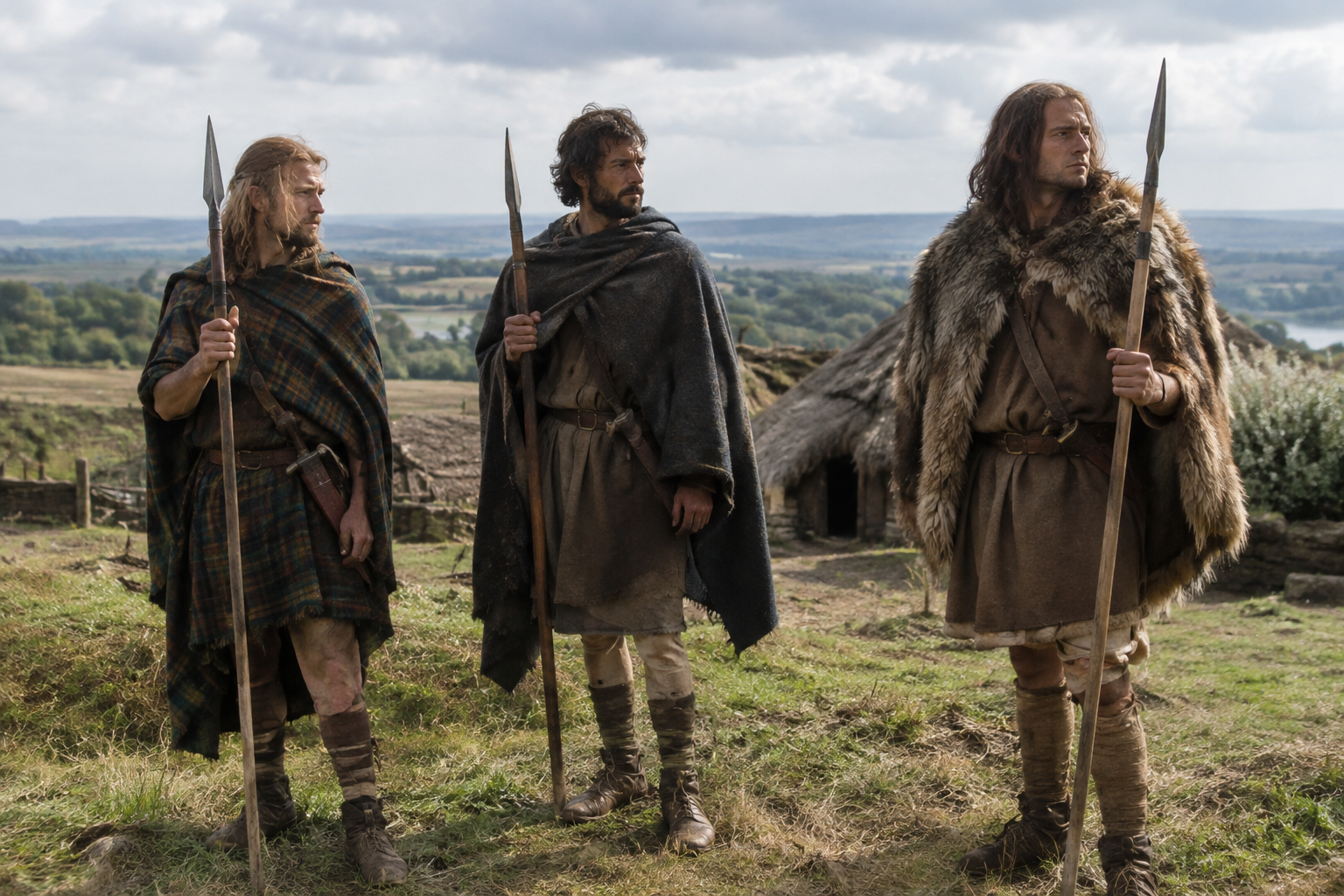
Some Y-chromosome lineages become historically interesting not because they belong to one famous king or one neat national story, but because they keep turning up in the same broad Atlantic-facing world over very long stretches of time. That is the appeal of R1b1a1b1a1a2c1a3a2: a very specific paternal branch nested deep inside the wider R1b tree, and one that invites us to think carefully about continuity, migration, and survival in Britain and Ireland.
As ever with Y-DNA, a note of caution comes first. A Y haplogroup traces only one line of ancestry: the direct paternal line from father to son. It does not represent a person's whole ancestry, culture, language, or identity. And with a branch as specific as R1b1a1b1a1a2c1a3a2, we must be especially careful not to load onto it the entire history of broad R1b. Still, ancient DNA gives us something precious here: a few real men from prehistoric and Iron Age Britain whose remains help place this paternal line, or its close context, in a landscape that later produced border clans, Gaelic lordships, and the ruined towers that still dominate their regions.
R1b is one of the major Y-chromosome families of western Europe, and many of its downstream branches became widespread in regions such as Britain, Ireland, and Atlantic France. But that broad fact should not be lazily copied onto every tiny twig of the tree. What matters for a subclade like R1b1a1b1a1a2c1a3a2 is that it belongs within a paternal framework long associated, in general terms, with later prehistoric western Europe and with lineages that became well established in the British Isles.
That does not mean we can point to a single migration and say, "there it is." The deeper history of R1b involves major population changes after the Neolithic, often discussed in connection with Bronze Age movements and the spread of steppe-related ancestry into western Europe. But whether this exact branch formed on the Continent before arriving in Britain, or emerged later within Britain or Ireland from a parent lineage already present there, is not something the supplied evidence lets us settle. What we can say is that the ancient samples place the wider story firmly in northern Britain and Iron Age eastern England.
Explore Celtic language origins
The oldest sample in the material provided is I2859, from Scotland Late Bronze Age Year:900 BC. Even in that terse description, there is something rather thrilling. Late Bronze Age Scotland was no fringe. It was part of a connected world of metalwork, exchange, seaways, and local power. A paternal lineage found in this setting suggests that the ancestry behind this branch, or its close paternal neighborhood, was already present in northern Britain well before Roman writers, medieval chroniclers, or clan genealogists had anything to say.
Then we move south and slightly later into the Iron Age with two striking samples from East Yorkshire: I28743, described as Celtic Parisi Iron Age England East Yorkshire Melton Year:270 BC, and I31516, Celtic Parisi Iron Age England East Yorkshire Wetwang Slack Year:225 BC. Wetwang Slack is particularly evocative because it belongs to that famous East Yorkshire Arras culture zone, with its chariot burials and high-status graves. The label "Celtic Parisi" places these individuals in an Iron Age community long discussed by archaeologists in relation to continental links, regional identity, and elite display.
What these men give us is not proof of a simple ethnic formula, and certainly not proof that everyone called Parisi shared one paternal line. What they do offer is a glimpse of a paternal lineage, or closely related lineage context, in Iron Age eastern Britain among a population that was both local and connected. In other words, this was not an isolated bloodline hiding in some remote valley. It was part of the social world of late prehistoric Britain.
Once you have a Late Bronze Age Scottish sample and Iron Age Yorkshire examples in view, the map starts to look less accidental. This is a line rooted, at least in the evidence we have here, in the northern and eastern reaches of Britain before the medieval period. That matters because later Scotland, northern England, and Ireland were not sealed boxes. They were linked by sea routes, warfare, marriage, raiding, lordship, and migration over centuries.
One should not jump from an Iron Age grave in Yorkshire to a medieval clan pedigree. But neither should one ignore geography. The Irish Sea world and the western seaways connected communities from southwest Scotland to Ulster, Man, Wales, and Munster. Paternal lineages could persist locally, split into new branches, and move through these networks long before surnames fixed themselves in written records.
This is where ancient DNA is so useful. Written genealogy tends to begin late, flatter complexity, and privilege elites. Ancient DNA reaches behind heraldry and manuscripts into populations who left no family trees at all. It cannot tell us everything, but it can show that paternal continuity and paternal change were both part of the story.
The later historical associations supplied for this haplogroup draw us into two regions where lineage, lordship, and fortress architecture mattered enormously: the Scottish Borders and southwest Ireland. Here the evidence changes character. We are no longer dealing with prehistoric burials but with named clans and named strongholds. That does not make the genetics simpler. Quite the reverse. A historical association with a haplogroup does not prove that every man in a clan, still less every bearer of a surname, belonged to the same Y-DNA branch. Medieval and early modern families were shaped by adoption, illegitimacy, fosterage, and the absorption of allied lines.
Still, the historical settings are wonderfully apt. Clan Johnstone was anchored at Lochwood Tower in Dumfries and Galloway, near an earlier seat at Lochwood. The medieval castle was destroyed by fire in the late 1500s during the savage Johnstone-Maxwell feud, and the present tower house was built nearby around 1595 by James Johnstone. What remains is a ruin, but an eloquent one: a reminder that paternal identity in the Borders was not an abstract matter of DNA markers, but something defended with stone, fire, and feud.
Across the water in County Cork, Clan OSullivan held Dunboy Castle on the Beara Peninsula. It guarded a harbour and a strategic route for trade and war, and it entered history dramatically in 1602 during the Nine Years War. After Kinsale, Dunboy became bound up with hopes of Spanish aid and Gaelic resistance. English bombardment shattered the walls; the defenders were overwhelmed; many were killed and survivors executed. If Lochwood evokes the violence of the Borders, Dunboy speaks for the collapse of a Gaelic order under Tudor conquest.
Not far away stands Dunlough Castle, associated with Clan OMahony on the Mizen Peninsula. Built in the early 13th century by Donagh O Mahony, it formed part of a striking line of three towers connected by a defensive wall above a long lake. The setting is magnificent, but the history is practical too: this was a coastal lordship, Atlantic-facing and defensible, a place where seaborne power and local kingship met. By the 17th century it had fallen into ruin, yet the ruins still preserve the memory of a Gaelic political landscape that once seemed durable.
So what does R1b1a1b1a1a2c1a3a2 reveal? First, it belongs to a paternal world that is at home in later prehistoric Britain, with supplied ancient samples ranging from Late Bronze Age Scotland to Iron Age East Yorkshire. Second, its later historical associations fit regions where old paternal lineages could persist through centuries of political change: the Borders, Atlantic Munster, and the Irish Sea sphere more broadly.
But the limits matter just as much. A shared haplogroup is not proof of close kinship. An ancient man from Wetwang Slack is not thereby the direct ancestor of a Johnstone, an OSullivan, or an OMahony. A clan tradition is not the same thing as a genetic demonstration. What genetics does offer is context: it shows that some paternal lines now found in family or surname projects sit within a much older framework already present in Britain long before castles, surnames, or written pedigrees.
That is, in its way, more interesting than a fairy tale of direct descent. It means that when we look at Lochwood Tower, Dunboy Castle, or Dunlough Castle, we are not just looking at noble ruins. We are looking at places built in landscapes already inhabited for millennia by men whose paternal lines sometimes survive, however brokenly and unpredictably, into the present.
If your Y-DNA falls within R1b1a1b1a1a2c1a3a2 or a nearby branch, ancient DNA can place your direct paternal line into a far deeper story than any modern surname alone can provide. MyTrueAncestry lets you compare your DNA with ancient individuals and historical populations, offering a fascinating window onto possible connections with prehistoric Britain, Iron Age communities, and later regional histories. Those comparisons do not prove direct descent from a specific ancient individual or noble family, but they can illuminate the world your ancestors came from.






Comments