Haplogroup R1b1a1b1a1a2c1a3

– 5 min read


Some Y-chromosome lineages announce themselves in one dramatic royal tomb. Others emerge more interestingly: in a scatter of burials across centuries, in frontier towns, hillfort cemeteries, Roman provinces, and medieval strongholds. Haplogroup R1b1a1b1a1a2c1a3 belongs to that second sort of story. It sits within the very large R1b branch of the Y-chromosome tree, a major paternal lineage in western Eurasia, but this particular subclade has to be understood with care. A man who carries this Y-DNA line inherits only one narrow paternal line, not the whole of his ancestry, and the history of a specific downstream branch is never identical to the history of all R1b.
What makes this lineage historically compelling is the pattern of evidence surrounding it. The supplied ancient DNA points not to one isolated episode but to a long arc: from an Early Bronze Age Yamnaya-associated individual in Hungary, through Bronze and Iron Age Britain, into Roman Iberia, northern Spain, and late antique Portugal. That is exactly where archaeogenetics is at its best. It does not give us a neat family tree for whole peoples, still less a magical route to noble descent. What it does give us is a series of hard, datable paternal markers attached to real men buried in real places.
The broad R1b family is closely tied, in general terms, to major population changes across Bronze Age Europe, especially those connected with steppe-derived ancestry. For this narrow branch, the earliest striking anchor in the supplied material is I3525, an Early Bronze Age Hungary Yamnaya Sarretudvari-Orhalom individual dated to 2450 BC. That does not mean that every later carrier of R1b1a1b1a1a2c1a3 descends directly from this man, but it does place the wider paternal background of the lineage in the world of steppe-linked movements that helped reshape Europe in the third millennium BC.
After that, the evidence shifts westward and, above all, toward Britain. There is a remarkable density of Bronze Age and Iron Age individuals in England and Scotland connected with this lineage cluster: I2565 from Amesbury Down, Wiltshire dated to 2287 BC, I4950 from Bell Beaker Wiltshire Upavon dated to 2300 BC, KD061 from Westray Links of Noltland, Orkney dated to 1498 BC, and Rathlin2B from Ireland Copper Age dated to 1880 BC. Taken together, these do not prove one tidy migration route, but they do show that paternal lines within this neighborhood of R1b were well established across Atlantic-facing Britain and Ireland by the Bronze Age.
Explore Celtic origins in ancient DNA
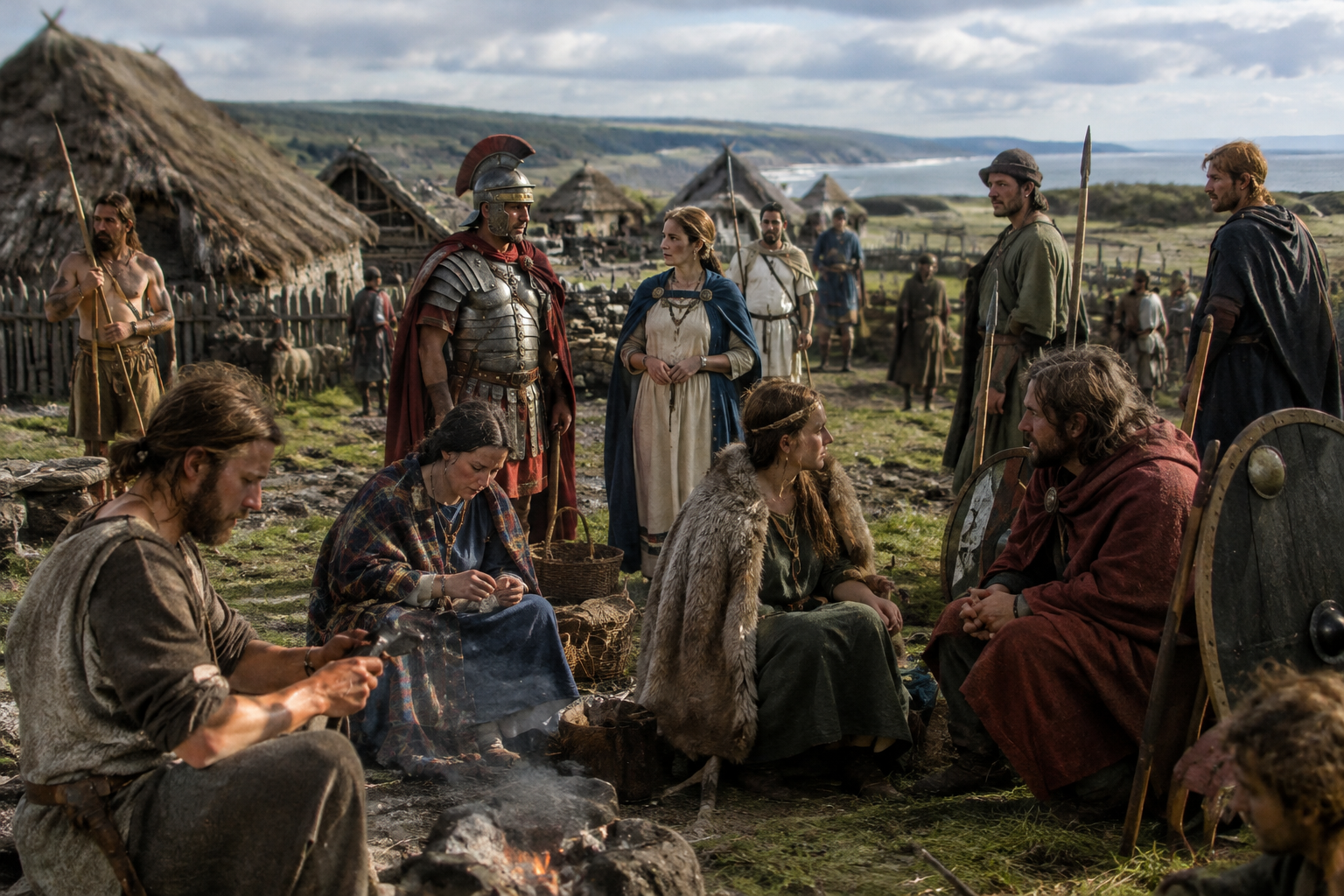
Now for the really arresting part: this lineage is not represented by one or two British Iron Age samples, but by a whole spread of them. East Yorkshire is especially important. The Parisi and Arras Culture cemeteries around Wetwang Slack, Pocklington, Melton, and Burton Fleming supply a cluster that would make any archaeologist pause. Among them are I36995, the Elite Celtic Parisi Chariot Burial Iron Age England East Yorkshire Wetwang Slack dated to 225 BC, along with many other Wetwang Slack individuals such as I36889, I36880, I37335, I36972, and I30911, all around 225 BC.
This matters because it suggests that the lineage, or closely related paternal lines, were not peripheral oddities in Iron Age eastern Britain. They appear in ordinary burials, barrow burials, and one elite chariot burial. In other words, the Y-line was present across more than one social setting. That is a useful corrective to romantic habits of thought: ancient DNA often shows that lineages were shared by communities, not monopolized by chiefs.
The same broad picture appears further south and west in Britain. Dorset gives us a later concentration in the territory of the Durotriges, with samples from Duropolis Winterborne Kingston dated to 125 AD: WBK12, WBK20, WBK29, WBK41, WBK05, WBK30, WBK43, WBK06, WBK08, WBK18, and WBK191. These are especially interesting because they sit in Roman Britain while preserving local Celtic regional identities in the archaeological record. The Roman conquest did not wipe the paternal map clean. It layered empire over existing populations.
Discover Iron Age Britain through DNA
The story is not only British. There are continental markers too: 3214 and 3214s from the Gallic Cenomani Tribe Italy Verona Seminario Vescovile dated to 300 BC; CGG022427 from the Belgic Suessiones Tribe France Bucy-le-Long dated to 390 BC; and CGG023699 from Gallic France Parancot dated to 497 BC. These samples help place the lineage in Iron Age western and central Europe, in communities often associated archaeologically with Celtic-speaking worlds, though genetics alone cannot prove language.
Then come the Roman and post-Roman Iberian anchors. R10488 from Late Roman Conimbriga Portugal dated to 330 AD is particularly valuable, because it places the lineage in Lusitania itself. Add I23763 from Roman Iberia Merida Necropolis Blanes dated to 450 AD, and the northern Spanish individuals from Las Gobas - ldo039 dated to 650 AD, and ldo052 and ldo242 dated to 1000 AD - and you begin to see a pattern of paternal continuity across the Iberian Peninsula from late Roman into medieval contexts.
That does not prove a continuous unbroken local dynasty of one male line. But it does show that this paternal branch, or its close neighborhood, belonged to the sort of populations living through the transformation of Roman Hispania into Visigothic and then medieval Christian and Islamic borderlands.
Read about Roman Hispania's genetic legacy
That Iberian background brings us naturally to the House de Correia and to the Castle of Mertola in southern Portugal. Mertola is the sort of place historians love because it refuses to sit obediently in one period. Its hilltop was already defended in Roman and late antique times, commanding the Guadiana River. Under Islamic rule it became part of the political and military fabric of al-Andalus. In the 12th and 13th centuries it was a frontier stronghold before being taken by Christian forces in 1238 and handed to the Order of Saint James. Much of the surviving castle, including its keep, belongs to later 13th-century rebuilding for the defense of the Portuguese borderlands.
This layered setting matters more than any simplistic genetic claim. A noble house associated with a region like this belongs to a landscape where Roman, Visigothic, Islamic, and Christian histories all overlap. The House de Correia cannot be genetically equated with every man carrying this haplogroup, nor does a haplogroup establish noble descent. But the association is historically suggestive in a different way: it places the later family in a region where ancient DNA already shows paternal continuity from late Roman Portugal and neighboring Iberia.
Mertola, then, becomes a historical lens. If R10488 from Conimbriga gives us one late Roman paternal datapoint in Portugal, Mertola gives us the later medieval fortress-world in which such long-established regional lineages, mixed and remixed over centuries, might still be present among local populations, military settlers, and noble kin networks. Genetics cannot identify the lord from the battlements. It can, however, remind us that castles were built by people whose paternal lines often reached far deeper into the past than their charters did.
So what does R1b1a1b1a1a2c1a3 reveal? First, it belongs to a paternal tradition with deep roots in the post-steppe Bronze Age world of Europe. Second, the supplied ancient DNA makes Britain - especially Iron Age and Romano-British Britain - look unusually important for its documented archaeological presence. Third, Iberian samples from Conimbriga, Merida, and Las Gobas show that this was not only an Atlantic British story but part of a wider western European pattern extending into late Roman and medieval Hispania.
And what can it not tell us? It cannot summarize a person's total ancestry. It cannot prove that someone descends from the Parisi, the Durotriges, or the House de Correia. It cannot turn a shared branch into a family tree spanning two thousand years. What it can do is something more disciplined and, in the end, more interesting: it can place a direct paternal line inside the long human history of migration, settlement, survival, and local continuity.
If you want to understand how your own paternal story might connect with ancient populations - whether in Bronze Age Britain, Roman Iberia, or the medieval borderlands of Portugal - MyTrueAncestry lets you compare your DNA with the archaeological record. Those matches may reveal striking historical connections, even when they do not prove direct descent from any ancient individual or noble house.






Comments