Haplogroup R1b1a1b1a1a2c1a2a2a1a

– 6 min read


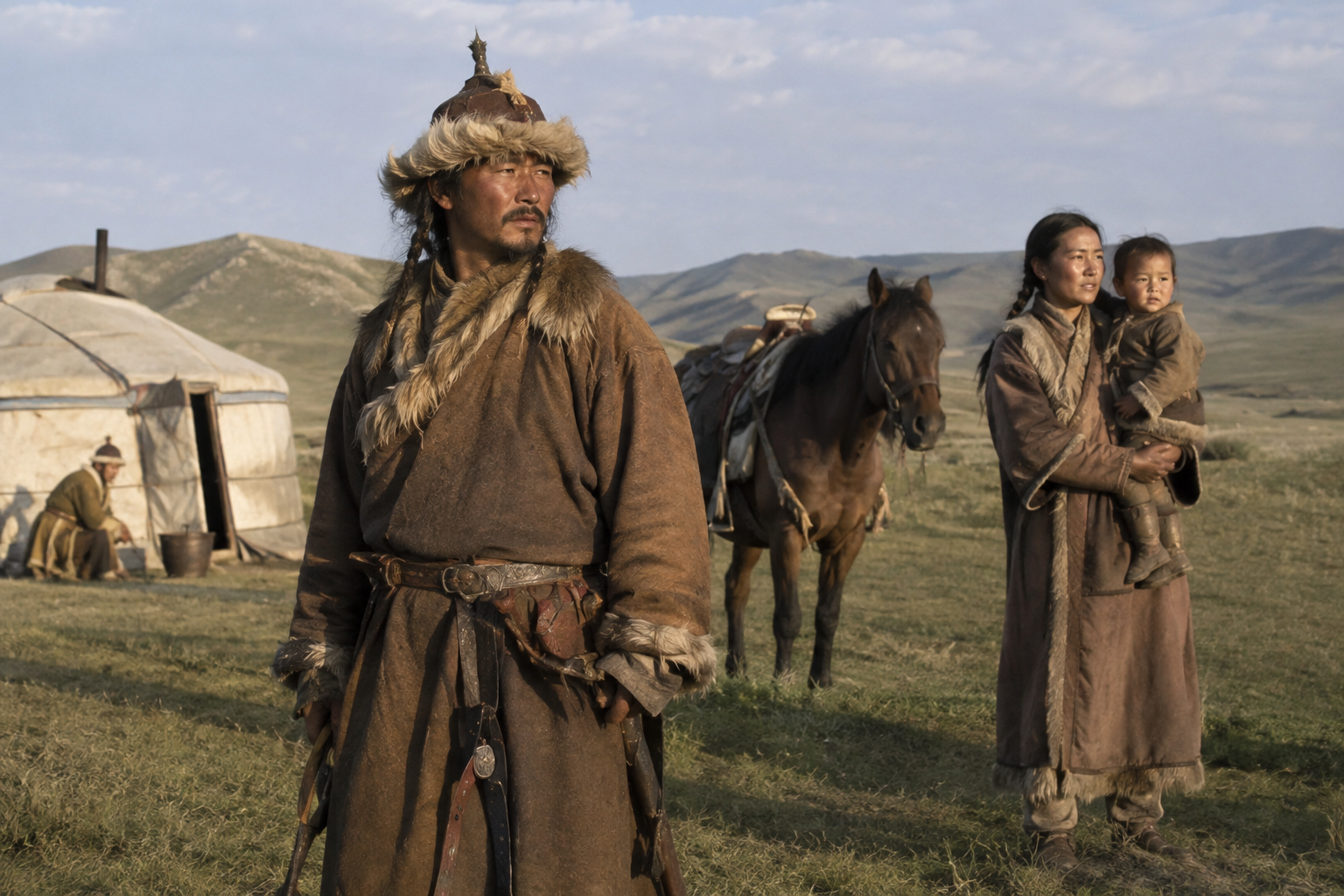
Some Y-chromosome lineages are easy to place in the familiar historical landscapes of western Europe. Others are more awkward, and for that very reason more interesting. Haplogroup R1b1a1b1a1a2c1a2a2a1a belongs to the vast R1b family, one of the best-known paternal lineages in Eurasia, yet this very specific branch reminds us that the story of R1b is not a simple tale of one people in one place. It is a branching history of movement, fragmentation, survival, and local reinvention across enormous distances.
That is worth pausing over. A Y-DNA haplogroup tracks one direct paternal line only: father to father to father across the generations. It does not describe all of a person's ancestry, culture, language, or identity. But when ancient DNA turns up a particular paternal branch in an unexpected place, it can force us to rethink old maps of the past. In this case, the supplied evidence points us not first to Ireland or Scotland, but to the Mongolian steppe in late antiquity.
At the broadest level, this haplogroup belongs to R1b, a major Y-chromosome lineage with a long and complex history across western and central Eurasia. Different branches of R1b are associated with very different regional histories. Some became prominent in western Europe; others appear in steppe, central Asian, or mixed frontier contexts. That is why it is important not to pour the whole history of R1b into one narrow downstream subclade as if every branch shared the same later path.
For a highly specific lineage such as R1b1a1b1a1a2c1a2a2a1a, caution is essential. We can say it is part of the wider R1b paternal tree. We can also say that the ancient sample supplied here places a related paternal line in the eastern Eurasian steppe world. What we should not do is pretend that a single sample solves the entire biography of the branch, or proves a neat chain from prehistoric migrations to later noble houses in the British Isles.
Still, even that limited evidence is evocative. It suggests that at least some descendants of the wider R1b world were present far beyond the Atlantic facade so often associated with the haplogroup in popular imagination. The steppe was not an empty corridor but a crowded political and biological zone, full of confederations, raiders, herders, traders, and shifting loyalties.
The key ancient anchor here is RISE603, from the Iron Age Mongolian Steppes Kam-Tyttugem, dated 400 AD. That date alone places him in a remarkable world. Around the 4th and 5th centuries AD, the steppe zone linked Mongolia, southern Siberia, Central Asia, and the fringes of eastern Europe in a restless chain of contacts and conflicts. This was the age in which imperial frontiers were under pressure and mobile powers could rise suddenly.
What makes RISE603 especially valuable is not that he can be turned into a mascot for any modern nation or surname, but that he gives us a fixed point. He shows that a paternal line related to this haplogroup was present in the Mongolian steppe in late antiquity. That matters because ancient DNA often corrects our instincts. Without the archaeology, many readers would glance at a deep R1b label and assume a straightforward western European setting. RISE603 says: not so fast.
Kam-Tyttugem also invites a broader historical question. Was this paternal line part of long-standing steppe diversity, or had it arrived there through earlier movements across inner Eurasia? Ancient DNA can sometimes answer that sort of question when many samples accumulate across time. With one sample, we must remain modest. But modesty is not dullness. One excavated skeleton from 400 AD can still show that paternal ancestry moved through political worlds far more expansive than medieval family trees usually allow.
And there is a second lesson. Ancient DNA does not give us ethnicity in a tidy label. It gives us biological relationships and clues about population history. RISE603 was a real man buried in a real landscape, not simply a code in a database. His Y-line is a historical signal, not a complete identity card.
So how do we move from a late antique steppe sample to later Ireland and Scotland without slipping into fantasy? Carefully. The honest answer is that we are not tracing a documented family pedigree from RISE603 to any named medieval house. What we can do is place both the ancient sample and the later noble associations within the larger history of Eurasian mobility.
The wider R1b family spread through multiple regions over long periods, and paternal branches could persist, split, and reappear in very different cultural settings. Over centuries, lineages travel with migration, conquest, alliance, fosterage, mercenary service, marriage networks, and sheer demographic luck. Written genealogy usually reaches back only so far; genetics can show that the deeper paternal background of medieval and early modern populations was already ancient and geographically layered.
That is one reason noble families should be handled with care. A family association in a haplogroup article may reflect later surname projects, reported traditions, or regional clustering, but it does not prove that every bearer of a name shared one exact Y-line. Medieval dynasties were complicated things, and castles even more so. A stone fortress tells us about power, continuity, and memory. It does not, by itself, certify a chromosome.
Readers interested in how paternal history intersects with documented lineages may enjoy the MyTrueAncestry article on Clan Vans, which explores one of the names associated here in a fuller historical setting.
The supplied family material gives us two very different strongholds at the edge of the Atlantic world. The first is Loch Slin Castle in Roscommon, associated here with the House Vals. The castle was a late medieval tower house, built in the sixteenth century, probably by the MacDermot Roe family. It stood on an island in Loch Slin and controlled local routes, which is exactly the sort of practical and political positioning Gaelic lordship depended on. This was not merely a residence. It was a statement about who ruled movement across the landscape.
Its later history is equally revealing. During the Tudor wars, Loch Slin was drawn into the contest between Irish chiefs and the expanding English state. In 1599, it was attacked and damaged by forces under Sir Conyers Clifford during the Nine Years War. After that, decline followed, and the castle was abandoned. What survives now is ruin, but ruin with a very specific historical meaning: a reminder of lake strongholds, clan rivalry, and conquest in early modern Ireland.
The second stronghold, Dirleton Castle in East Lothian, tied here to Clan Vans, belongs to a rather different political world. It began in the 13th century as a Norman stronghold built by the de Vaux family. That alone tells us something important about medieval Scotland: it was not sealed off, but deeply connected to Anglo-Norman aristocratic culture, trade, war, and royal politics. Dirleton later passed through the hands of the Haliburtons and the Ruthvens, who enlarged and modernised it.
Its walls also bear the scars of larger struggles. The castle was battered during the Wars of Independence, then badly damaged again in the 17th century when Oliver Cromwell's forces attacked it and left it ruined. Like Loch Slin, Dirleton survives as a fragment of an older order, though here the setting is one of Norman lordship, Scottish court intrigue, and repeated siege.
Neither castle proves a direct genetic link to the ancient steppe sample. But together they show how paternal lineages, if they persist in a region, can become wrapped in very different historical worlds over time. The same broad biological inheritance can sit beneath Gaelic lake lordship in Roscommon and a Norman-founded fortress in East Lothian.
Haplogroup R1b1a1b1a1a2c1a2a2a1a is interesting precisely because it resists lazy storytelling. It belongs to a famous paternal super-family, yet the ancient evidence supplied here points into the steppe world of RISE603 at Kam-Tyttugem in 400 AD, while the later historical associations belong to castles and lineages in Ireland and Scotland. That is not a contradiction. It is what real history looks like when you stop expecting neat ethnic boxes.
Ancient DNA, archaeology, and written records do different jobs. DNA can reveal deep paternal structure and unexpected geographic range. Archaeology gives us burials, landscapes, and dates. Written history introduces names, wars, and castles. Put together, they do not usually hand us a perfect family tree across fifteen centuries. What they do give us is something better: a more honest account of how human ancestry survives through change.
If you would like to keep following the overlap between genetics, migration, and elite history, another useful stop is MyTrueAncestry's feature on Ancient DNA and Dynastic Rule among Iron Age Scythian Elites, which places paternal lines in another steppe context where power and ancestry meet but do not always align neatly.
Explore Iron Age Steppe Elites
To explore whether your own DNA shows links to ancient individuals, historic populations, and deep paternal ancestry, upload your results to MyTrueAncestry. Ancient DNA matches can open striking new perspectives on your past, even when they do not prove direct descent from a particular ancient person, clan, or noble house.






Comments