Haplogroup R1b1a1b1a1a2c1a2a1a

– 6 min read


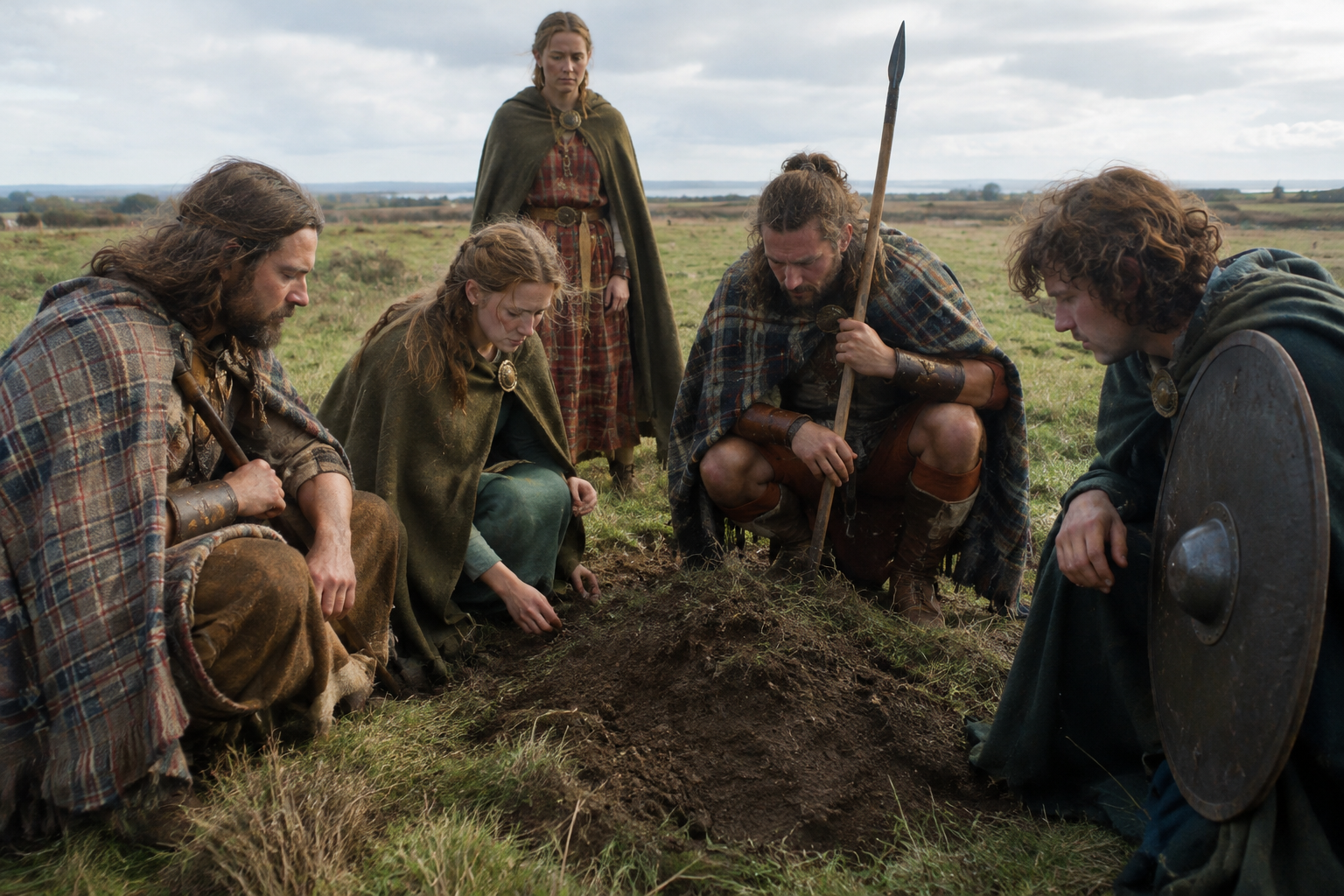
Some Y-chromosome lineages are famous because they turn up in royal tombs or in sweeping discussions of prehistoric migration. Others are interesting for a subtler reason: they appear in exactly the sort of place where archaeology and history begin to overlap, not in a blaze of certainty, but in a series of clues. The Y-DNA haplogroup R1b1a1b1a1a2c1a2a1a belongs to that second category.
At first glance, the label looks forbidding, all numbers and letters. But it simply marks a very specific branch on the Y-chromosome tree, a paternal line passed from father to son. That matters because Y-DNA can help us track one narrow strand of ancestry across time. It does not represent a person's whole ancestry, culture, or identity, and it certainly cannot by itself prove descent from a named clan or castle-owning family. What it can do is place one paternal line into a larger historical landscape. In this case, that landscape leads us toward Iron Age Britain, the Parisi of East Yorkshire, and much later, the aristocratic world of Aberdeenshire and Aboyne Castle.
This haplogroup is a very narrow downstream branch within the large and widespread Y-DNA macro-lineage known as R1b, one of the major paternal lineages in western Europe today. That broad R1b story stretches across several prehistoric and historic horizons and is often discussed in connection with Bronze Age population movements in Europe. But we have to be careful here: the history of a huge parent lineage is not automatically the history of every tiny branch within it.
For a highly specific subclade such as R1b1a1b1a1a2c1a2a1a, the safest approach is to focus on where ancient DNA gives us firmer footing. The supplied ancient evidence points strongly toward Iron Age southern and eastern Britain. That does not rule out earlier roots elsewhere in Europe, nor does it tell us the exact moment this branch formed. It does suggest that by the middle and later Iron Age, paternal lines of this kind were part of the male population in Britain, including communities associated with the Arras Culture in East Yorkshire.
Readers interested in the bigger archaeological background to Celtic-speaking populations and their spread may enjoy this related piece:
Explore Celtic language origins
If you want to see this haplogroup come alive, East Yorkshire is the place to look. The Arras Culture burials of the region have long fascinated archaeologists: square barrows, chariot burials, and distinctive funerary customs that seemed, from the moment of discovery, both British and connected to a broader continental Iron Age world. Ancient DNA now gives that old archaeological puzzle an added dimension.
Among the supplied individuals are several from Wetwang Slack, one of the best-known Arras Culture cemeteries. I36970, described as a Celtic Parisi individual from Iron Age England, East Yorkshire, Wetwang Slack, comes from a flat grave burial dated to 225 BC. Alongside him are I31009 and I30904, also from Wetwang Slack and also dated to 225 BC. These are not just labels in a database. They were real men buried in a landscape of fields, trackways, and local power, in a region associated with the ancient Parisi.
Then there is I21615 from Pocklington, East Yorkshire, dated to 295 BC, and I28929 from Burton Fleming, dated to 115 BC. Together, these individuals hint at continuity across nearly two centuries in the same wider region. That is useful historically. It suggests that this paternal branch, or very close related branches, was not a one-off arrival represented by a solitary grave, but part of an enduring local male landscape in Iron Age eastern Britain.
We should not turn that into more than it is. Shared haplogroups do not automatically mean these men were all close kin, still less that they belonged to one ruling dynasty. But taken together, they show that this paternal lineage had a clear presence among Iron Age communities of East Yorkshire.
For a broader look at how genetics is reshaping our picture of family and community in this period, see:
Discover Iron Age Britain kinship
The story does not stop in Yorkshire. Another supplied sample, I13730, is identified as a Celtic Briton from East Kent, England, dated to 300 BC. That matters because it places the same specific paternal branch, or at least the same named haplogroup assignment in your input, in a different corner of southern Britain.
This is the sort of evidence historians love and hate in equal measure. Love it, because it widens the map. Hate it, because it refuses to explain itself neatly. Did this distribution reflect mobility between British regions? A broader paternal background shared among some Iron Age Britons? Connections between communities on either side of the North Sea and the Channel? Ancient DNA alone cannot settle that. But it does suggest that this lineage was not confined to a single Yorkshire enclave.
That wider spread fits rather well with what we know of Iron Age Britain as a world of movement, exchange, and local identities rather than sealed tribal boxes. The ancient Parisi of East Yorkshire were not living in splendid isolation. Nor were the communities of Kent, a region with strong continental contacts. Genetics, archaeology, and geography all point toward interaction, though not necessarily simple migration stories.
Here is where caution is especially important. The supplied noble connection is Clan Bissett, linked with Aboyne Castle in Aberdeenshire. That does not mean the Bissetts, still less every later holder of the estate, can be confidently assigned this exact Y-DNA haplogroup. Nor does it mean an Iron Age man from Wetwang Slack is the ancestor of a medieval Scottish lord. History is rarely so accommodating.
But there is still a worthwhile connection to make. Ancient DNA gives us a deep-time map of paternal lines in Britain. Medieval clans and castles belong to a much later layer of regional history, where written records, lordship, warfare, inheritance, and architecture take over. Sometimes the interest lies not in proving direct descent, but in seeing how the same island landscape preserves traces of both worlds.
Aboyne Castle began as a tower house in the 1200s. Later rebuilt and enlarged by the Gordons, it became a Highland seat of power for centuries. In the 1600s it was drawn into the civil wars, and in 1689, after the Battle of Killiecrankie, it was burned by government troops because of its Jacobite association. Repaired in the 1800s and made more comfortable as a country house, it survives as a layered building rather than a single frozen medieval relic.
That layered quality is what makes it such a good historical partner for a haplogroup article. A castle like Aboyne is not a genetic document. It is, however, a record of how lineages, loyalties, and regional power were remembered and rebuilt over centuries. The same is true, in a different register, of Y-DNA: both preserve continuity, but not in identical ways.
For readers who want to explore the clan side of that later story, this related article is the obvious next step:
One of the temptations in public DNA history is to draw a straight line from prehistoric graves to medieval castles. It is understandable, and usually wrong. The safer and more interesting truth is messier. Paternal lineages can persist for very long periods, but families rise, fall, merge, and change names. Castles are destroyed and rebuilt. Territories shift. Written genealogies appear late and often serve political purposes.
So what can we reasonably say? We can say that a paternal lineage represented by R1b1a1b1a1a2c1a2a1a was present in Iron Age Britain, with especially vivid evidence from East Yorkshire and an additional point in East Kent. We can also say that later Britain and Scotland, including aristocratic centers like Aboyne Castle, were built upon populations whose roots stretched deep into earlier British history, though repeatedly reshaped by migration, conquest, marriage, and social change.
That is why ancient DNA and later history complement one another so well. Ancient DNA gives us people before surnames, before charters, before castles. Medieval history gives us named families, contested properties, and buildings that still carry memory in stone.
If you want to follow that long British story beyond the Iron Age into later centuries, this article is a useful companion:
Explore post-Roman Britain DNA
R1b1a1b1a1a2c1a2a1a is not historically interesting because it comes with an easy slogan. It is interesting because it anchors us in a real archaeological landscape. Through I21615 at Pocklington, I36970, I31009, and I30904 at Wetwang Slack, I28929 at Burton Fleming, and I13730 in East Kent, we can see a paternal line present in Iron Age Britain across multiple places and dates.
That does not make it "the Celtic haplogroup," nor a badge of tribal or noble identity. It does something better. It reminds us that behind the grand labels of archaeology stood individual men, buried in local cemeteries, living in communities with their own customs and connections. And it reminds us, too, that later castles and clans occupied landscapes already old with human history.
For a wider perspective on how these kinds of discoveries are changing the field itself, readers may also enjoy:
Learn how archaeogenetics works
If this haplogroup appears in your own results, MyTrueAncestry can help place that paternal line in a deeper historical setting by comparing your DNA with ancient individuals and past populations. Those matches can offer remarkable clues about ancient connections, even though they do not by themselves prove direct descent from a particular Iron Age burial or noble family. Upload your DNA and explore where your story meets the archaeology of the past.






Comments