Haplogroup R1b1a1b1a1a2c1a2a1

– 6 min read


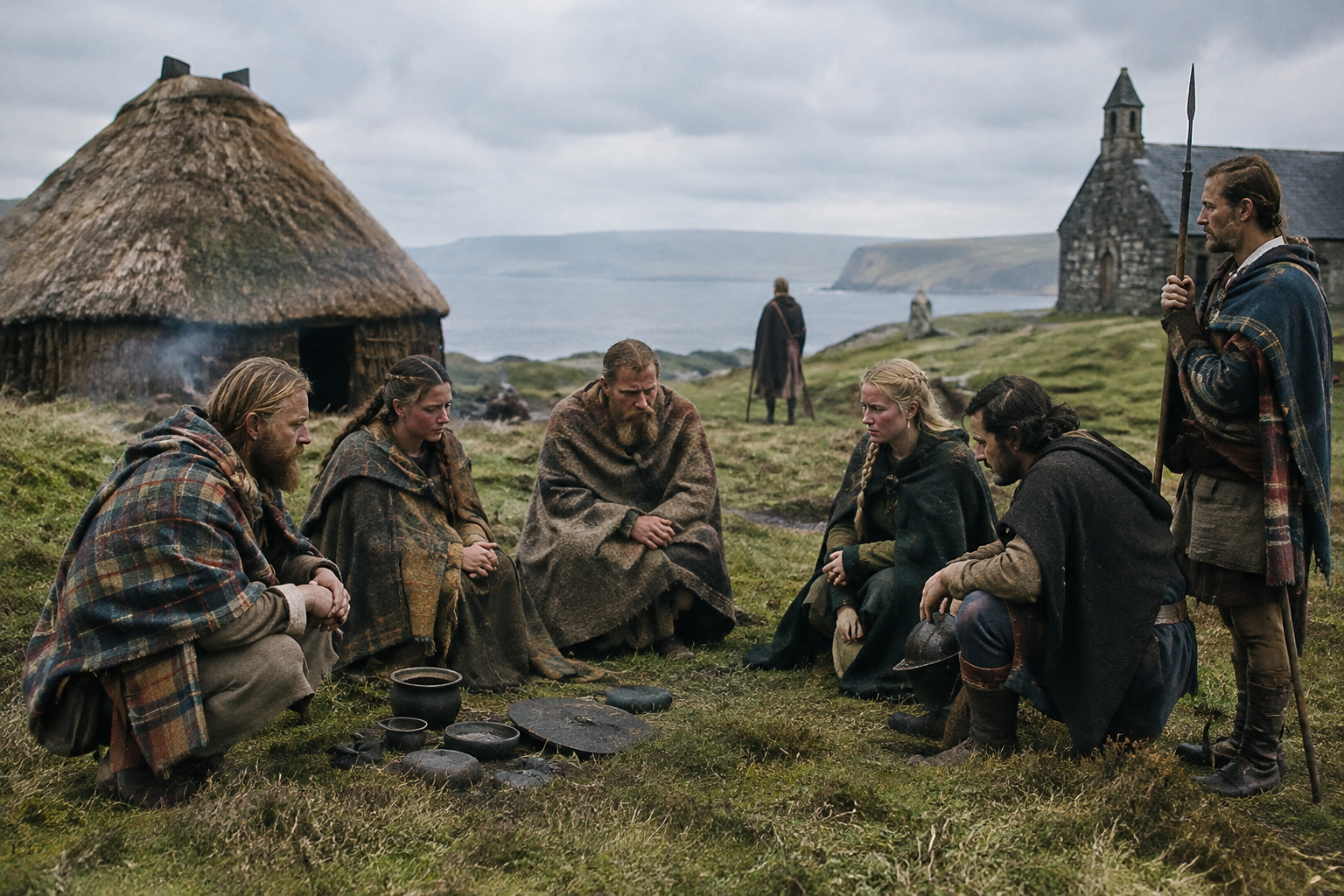
Some Y-chromosome lineages are famous because they turn up in royal tombs or sweeping migration stories. Others are interesting for a subtler reason: they appear again and again in the graves of ordinary and local communities, and in doing so they show us how paternal ancestry can persist through changing languages, kingdoms, and political worlds. The haplogroup R1b1a1b1a1a2c1a2a1 belongs to that sort of story.
At first glance, it is an intimidating string of letters and numbers. In practice, it is simply a very specific branch on the larger Y-DNA tree. Y-DNA traces one direct paternal line only - father to son to son - and so it tells us something important but narrow. It does not describe a person's whole ancestry, and it certainly does not assign anyone to a single ancient people. Still, when a branch like this appears in ancient burials from Iron Age Britain and later in the North Atlantic world, it offers a remarkably concrete way of following one strand of male-line history across time.
This haplogroup sits within the very large and historically important umbrella of R1b, one of the best-known Y-chromosome families in western Europe. That broad parent clade has deep prehistoric roots in Europe and is often discussed in connection with later prehistoric population changes, including the spread of lineages associated with Bell Beaker and post-Beaker societies. But one must be careful here: the long history of broad R1b is not automatically the history of every tiny downstream branch.
For R1b1a1b1a1a2c1a2a1, the evidence supplied here points especially toward Britain and the North Atlantic fringe in later prehistory and historical times. What makes that notable is not simply movement, but continuity. We are not looking at one spectacular imperial dynasty. We are looking at a paternal branch found among Iron Age communities in eastern and northern Britain, and then still visible much later in an Atlantic island setting.
That pattern fits a broader archaeological picture in which Iron Age Britain was neither isolated nor uniform. Communities in Yorkshire, Kent, Orkney, and farther north lived in quite different local worlds, yet ancient DNA increasingly shows that paternal lineages could link these places in ways that written history never recorded.
Explore Celtic origins in ancient DNA
The strongest cluster of evidence for this haplogroup in the supplied material comes from Iron Age eastern Yorkshire, above all the famous Arras Culture landscape. This is the world of the Parisi, known to archaeology through cemeteries, chariot burials, weapon graves, and carefully structured funerary rites. One should not turn a haplogroup into an ethnicity, but it is perfectly reasonable to say that this paternal line appears repeatedly in that cultural setting.
At Wetwang Slack, several individuals dated to about 225 BC carry this same line: I36866, I36970, I36835, I31009, I36921, I36893, and I30904. That is already striking. One sample, I36970, is explicitly described as from an Arras Culture Flat Grave Burial, grounding the lineage within one of the most discussed regional burial traditions in Iron Age Britain. When a lineage appears repeatedly in one cemetery landscape, the immediate thought is not grand conquest but local kin structure, paternal continuity, and the social importance of family lines.
The same world appears at Pocklington, where I21615 is dated to 295 BC, and at Burton Fleming, where I28929 is dated to 115 BC. Taken together, these samples suggest that this branch was not a one-off curiosity. It formed part of the paternal background of communities in East Yorkshire over a span of generations.
Then there is I13730, a Celtic Briton from East Kent, England, dated to 300 BC. Kent is not Yorkshire. Its links across the Channel, its material culture, and its political geography all differed. Yet the presence of the same haplogroup there hints that this paternal branch was more broadly distributed in Iron Age Britain than one local cemetery alone might suggest.
And farther north still, I2982 from an Iron Age Roundhouse Bu in Orkney, Scotland, dated to 240 BC, extends the story into the northern isles. That does not mean there was one single tribe stretching from Kent to Orkney, which would be absurd. It means that one male-line branch could be present in several distinct British regions during the Iron Age, each with its own local culture and history.
Read more on Iron Age Britain and kinship
One later sample gives the story an extra twist. VK27, from Sandoy Church in the Faroe Islands, dated to 1600 AD, shows the same paternal branch in a much later North Atlantic context. By that point, of course, we are in a thoroughly different world: post-medieval Christianity, seafaring networks, Scandinavian and Atlantic connections, and centuries of population mixing behind the scenes.
Still, VK27 matters because it shows how a paternal lineage present in Iron Age Britain could also be found in a later island society shaped by movement across the northern seas. This is not proof that the man from Sandoy Church descended from any one named Iron Age individual in Yorkshire, and it certainly does not give us a neat family tree from 225 BC to 1600 AD. What it does provide is evidence for the durability and geographic reach of this male line across a very long historical arc.
That is one of the quiet strengths of archaeogenetics. Written genealogies usually begin late and privilege elites. Ancient DNA can reveal lineages moving through places that left no chronicles at all.
Discover the Faroese genetic story
The noble association supplied here takes us to a very different landscape: the House de Crombrugghe and Castle Stas de Richelle in Richelle near Vise, in the Belgian province of Liege. This is not an Iron Age burial ground but a place shaped by the long afterlife of the old Prince Bishopric of Liege. That phrase alone tells us a good deal. Here was a region where clerical lordship, aristocratic landholding, and local identity overlapped for centuries.
The present house took shape in the 19th century, when many country estates in the region were rebuilt or reimagined in a romantic historic style after the French Revolution had swept away the old clerical state. In other words, Castle Stas de Richelle is less a medieval fortress than a memorial to how aristocratic Europe reinvented itself after revolution. That makes it a rather apt companion to Y-DNA history. Both are about survival through change, though in very different registers.
The castle later became known for something no medieval genealogist could have predicted: in 1961 it hosted the secret meeting that helped end the Katanga secession during the Congo Crisis. So this small chateau in Liege reaches from Belgian regional history into the politics of decolonisation. One should not claim any direct genetic link between Iron Age British lineages and the de Crombrugghe family on the basis of shared association alone. But historically, the pairing is still revealing. It reminds us that paternal lines and family memory often outlast the political systems around them, whether those systems are tribal polities, prince-bishoprics, or colonial empires.
In that sense, castles and noble houses are not genetic evidence. They are historical containers of memory. They tell us where later families rooted themselves, how they wished to be seen, and what sort of past they curated around their names.
Explore the House of de Crombrugghe
The most responsible reading of R1b1a1b1a1a2c1a2a1 is also the most interesting one. It seems to mark a paternal line found among several Iron Age men in Britain, especially in the Parisi-associated cemeteries of East Yorkshire, but also beyond them in Kent and Orkney. Much later, it appears in the Faroe Islands as well. That combination suggests persistence, dispersal, and the survival of one direct male line through very different historical settings.
What it does not tell us is that everyone with this haplogroup was "Celtic" in some simple sense, or that any modern noble house can be securely tied to those Iron Age burials without much more specific evidence. Haplogroups are powerful because they are precise along one line and modest about everything else. They help reconstruct patterns of paternal ancestry, kinship, and movement. They do not replace archaeology, and they do not magically supply complete genealogy.
Yet there is something rather thrilling in seeing men from Wetwang Slack, Pocklington, Burton Fleming, East Kent, Orkney, and Sandoy Church set beside one another. Not because they form a tidy legend, but because they do not. They reveal a real, complicated past: local families, regional cultures, sea crossings, and long continuity where no chronicler bothered to look.
Explore the Rhine-Meuse region's deeper past
If this haplogroup's story has shown anything, it is that ancient DNA can connect burial grounds, island churches, noble landscapes, and forgotten family lines in unexpected ways. MyTrueAncestry lets you explore whether your DNA shows links to ancient individuals and historical populations like those discussed here. Those matches do not by themselves prove direct descent from a named ancient person or noble family, but they can offer a fascinating new perspective on where parts of your ancestry fit into the human past.






Comments