Haplogroup R1b1a1b1a1a2c1a1h1

– 6 min read


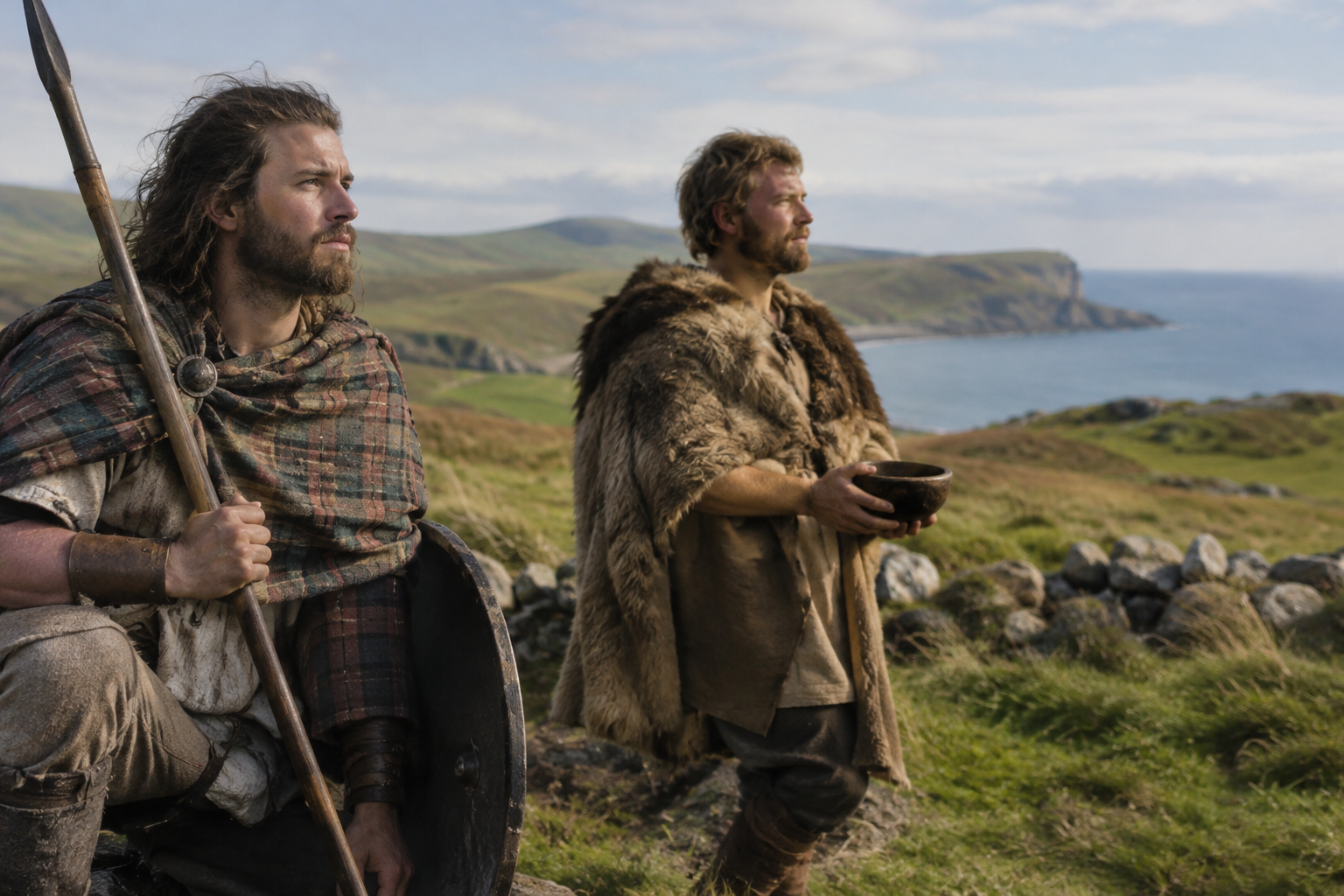
Some Y-DNA haplogroups announce themselves with a familiar historical label. Others arrive looking like a line of railway stations: R1b1a1b1a1a2c1a1h1. Yet behind that rather forbidding string lies a perfectly human story, because a Y-DNA haplogroup is simply a way of tracking one direct paternal line across deep time: father to son, and then father to son again, over centuries and millennia. It does not describe a person's whole ancestry, still less their culture or identity, but it can illuminate one narrow thread with remarkable precision.
This particular branch sits within the wider R1b family, a major Y-chromosome lineage long associated in broad terms with many ancient and modern populations of western Europe. That broad statement, however, must be handled carefully. A highly specific branch such as R1b1a1b1a1a2c1a1h1 should not simply be handed the entire history of R1b as if nothing changed along the way. What ancient DNA can do is give us glimpses of where related paternal lines appear in time and place, and in this case those glimpses point us toward later prehistoric and Iron Age Britain, and then much later toward the clan country of the Scottish Highlands.
The larger R1b tree is important to understanding why this subclade matters at all. In European archaeogenetics, branches of R1b became especially visible after major prehistoric population shifts in the later Neolithic and Bronze Age. Those shifts are part of the background to much of western Europe's paternal history. But background is not destiny. The task is not to say, "R1b equals this people," but to ask a more modest and more interesting question: when do closely related paternal lines show up in the places that matter for this branch?
For R1b1a1b1a1a2c1a1h1, the supplied evidence draws attention to Britain, especially its western and insular world. One ancient sample comes from Late Bronze Age Wales, another from Iron Age Oxfordshire. That does not prove an uninterrupted line from one to the other, and still less to any medieval clan. But it does suggest that paternal lineages within this part of the tree were present in Britain before Rome, before the Anglo-Saxons, and long before surnames or castles.
That matters because Britain in the Bronze and Iron Ages was not isolated. Goods, styles, ideas, and sometimes people moved between Wales, southern Britain, Ireland, Atlantic Europe, and beyond. Ancient DNA helps us see that mobility without reducing it to a cartoon of invasions. In other words, paternal continuity and movement can coexist.
Explore Celtic Origins Through Ancient DNA
The older of our two anchor points is I16488, described as Late Bronze Age Wales West Glamorgan Gower Peninsula Year:1105 BC. The Gower Peninsula is one of those landscapes where archaeology and geography seem to conspire together: a projecting piece of coast, deeply tied to the sea, to local settlement, and to long exchange networks across the western seaways. A paternal lineage found there in the Late Bronze Age belongs to a Britain already full of regional societies, metalworking traditions, and connections stretching far beyond any village horizon.
Then there is I21182, listed as Celtic Briton Oxfordshire Yarnton England Year:200 BC. By 200 BC, we are in a very different historical atmosphere. This is Iron Age Britain, the age of communities conventionally labelled Celtic in material culture and, often more cautiously, in language. Yarnton in Oxfordshire sits in a landscape of river valleys, settlements, and routes through southern Britain. The significance here is not that I21182 can be turned into a mascot for "the Celts," but that he gives us a direct paternal data point from pre-Roman Britain in an inland English setting.
Placed side by side, I16488 and I21182 do something wonderfully useful. They show related paternal history appearing in both western Britain and inland southern Britain across a very long interval. That is exactly the kind of evidence archaeogenetics is good at: not proving a family tree across a thousand years, but showing that certain paternal branches formed part of the human landscape of Britain before recorded history begins to speak clearly.
And one should linger for a moment on the humanity of this. These are not mere labels in a spreadsheet. One man lived in Bronze Age Wales, another in Iron Age Oxfordshire. Each had a father, and a father before that. Their Y-chromosome line survived long enough for us to detect it, while their voices, names, and local loyalties have vanished.
Read More on Iron Age Britain and DNA
What happened between those prehistoric and Iron Age communities and the later historical world? Quite a lot, obviously. Roman rule, post-Roman fragmentation, Norse movement, Gaelic influence, medieval lordship, and the slow formation of the kingdoms and regions we recognise from written history. Y-DNA does not flatten all that complexity. Instead, it offers a reminder that beneath political upheaval there can be deep local continuities in paternal lines, even as languages, allegiances, and elite identities change.
That is especially relevant in the British Isles, where ancient DNA increasingly shows that later populations often combined continuity with episodes of migration and admixture. A lineage present in Bronze Age or Iron Age Britain need not belong to one neat "ethnic block." It may persist through changing social worlds, picked up into different cultural settings over time. That is why it is wise to speak of context rather than direct descent unless a specific documented link exists.
Readers interested in how these longer British patterns continued into later centuries may enjoy the MyTrueAncestry article on Ancient DNA in Post-Roman Britain, which explores that difficult but fascinating transition from Roman province to early medieval kingdoms.
The supplied noble connection brings us far north, to Clan Bayne and Tulloch Castle near Dingwall in the Scottish Highlands. Here we step out of prehistory and into the layered world of medieval and later Highland lordship. Tulloch Castle began as a fortified tower house probably in the 12th century. It later became closely linked with the powerful Clan Davidson, and over time it was rebuilt, enlarged, and altered, gathering Georgian and Victorian additions as it went.
That is, in fact, exactly what makes Tulloch Castle historically interesting. It is not a frozen medieval relic from one heroic moment. It is a built record of changing ambition, changing ownership, and changing taste. Like many Highland houses, it moved from fortress-like defensibility toward lairdly residence. In the 20th century it served practical roles before restoration and conversion into a hotel, leaving a structure in which medieval origins still sit beneath later remodelling and modern heritage life.
What has this to do with a Y-DNA haplogroup? Not proof of descent, certainly. A castle is not a genetic test, and a clan association does not establish that every historical member shared one paternal lineage. But the geographical link is intriguing. If ancient related paternal lines appear in Britain long before the Middle Ages, and if later Highland kindreds preserved strong regional identities tied to land and lordship, then places like Tulloch Castle become part of the historical landscape in which such lineages may have persisted, divided, merged, or been socially redefined.
In that sense, ancient DNA and clan history illuminate different scales of the past. DNA follows one male line. Clan history follows political memory, landholding, alliance, and reputation. They are not the same thing, but they can be read together.
R1b1a1b1a1a2c1a1h1 is historically interesting because it sits at the meeting point of three kinds of evidence. First, there is the wider R1b story in western Europe, which provides the deep phylogenetic background. Second, there are concrete ancient individuals such as I16488 from Late Bronze Age Wales and I21182 from Iron Age Oxfordshire, who place related paternal history in Britain well before the medieval era. Third, there is the later historical geography of clans and strongholds such as Tulloch Castle, which gives us a landscape of memory, power, and continuity in the Highlands.
What it cannot do is magically bridge every gap. Shared Y-DNA does not prove that a modern tester descends from a particular ancient man. Nor does it prove membership in Clan Bayne, Clan Davidson, or any other noble or clan lineage. Surnames, adoptions, non-paternal events, and social reorganisation all complicate the record. That is not a disappointment; it is simply history being history.
The excitement lies elsewhere. It lies in discovering that one narrow paternal branch can connect the burial grounds of prehistoric and Iron Age Britain with the later historical landscapes of Scotland. Not as a fairy tale of direct dynastic certainty, but as a disciplined, fascinating glimpse into how male lineages can endure across immense spans of time.
For readers drawn to the Highland side of this story, the MyTrueAncestry article on Clan Davidson offers a useful companion to Tulloch Castle and its regional setting.
If your paternal line falls within R1b1a1b1a1a2c1a1h1, or somewhere nearby on the Y-tree, ancient DNA can offer a striking new way to think about your ancestry. It may reveal connections to deep regional histories such as Bronze Age Wales, Iron Age Britain, or the later landscapes of Highland clans and castles. Those connections are historical and genetic clues, not automatic proof of direct descent from any ancient individual or noble family, but they can still be extraordinarily revealing.
Upload your DNA to MyTrueAncestry and explore whether your results show links to ancient individuals, archaeological cultures, and historical populations from the world discussed here.






Comments