Haplogroup R1b1a1b1a1a2c1a1f1a1

– 6 min read


Some Y-DNA haplogroups arrive with a neat label and a tidy map. R1b1a1b1a1a2c1a1f1a1 does not. It is a very specific paternal branch, deep within the wider R1b tree, and that alone makes it interesting. The more specific the branch, the more we leave the comfort of broad continental stories and step into something more intimate: the history of particular male lines, carried through families, islands, warbands, farms, parishes, and lordships.
That needs one immediate caution. Y-DNA traces only a direct paternal line: father to father to father. It does not represent a person's whole ancestry, still less their identity, culture, or social rank. But it can be extraordinarily useful for reconstructing how paternal lineages moved, persisted, or changed across time. With a branch this narrow, the evidence is usually less about sweeping certainty and more about carefully placing a lineage within larger historical settings.
This haplogroup belongs to the enormous R1b family, one of the best-known Y-chromosome lineages in western Europe. Broad branches of R1b are often discussed in connection with later prehistoric population shifts, especially those linked to Bronze Age movements across Europe. But one must be careful here: the deep history of R1b as a whole is not automatically the history of every much later, much narrower subclade.
For a branch as specific as R1b1a1b1a1a2c1a1f1a1, the safer approach is to say that it belongs within a western Eurasian paternal framework long established in Europe, and that its more recent history may well have unfolded in the Atlantic and North Sea worlds where later medieval and early modern records become more visible. That makes the Scottish and Faroese context in this dataset especially suggestive, not as proof of origin, but as a meaningful historical setting.
Readers interested in the bigger prehistoric background to lineages like this may enjoy the broader discussion in the MyTrueAncestry article on Celtic expansions and ancient DNA.
Explore Celtic DNA and Migration
If we stand back from the code-like name of the haplogroup and look at the geography instead, a plausible historical theatre appears. The North Atlantic was not a remote fringe in the medieval world. It was a zone of movement. The seaways between western Scotland, the Hebrides, Orkney, Shetland, the Faroes, Iceland, and Scandinavia carried clergy, traders, raiders, settlers, drovers, mercenaries, and kin. Political borders were often less decisive here than command of coasts, inlets, and landing places.
That matters because paternal lineages can survive in precisely such regions, not as museum pieces, but as the residue of centuries of ordinary and extraordinary mobility. A Y-line may pass through Norse-speaking households, Gaelic lordships, church communities, and later crown-controlled territories without the lineage itself changing its label. The language, allegiance, and surname may alter; the Y-chromosome branch remains a quieter witness.
This is one reason why the Atlantic archipelagos are so valuable to genetic history. They preserve evidence of migration, but not always in the simplistic sense of one people replacing another. More often they show layered settlement, mixed ancestry, and local continuity in unexpected combinations.
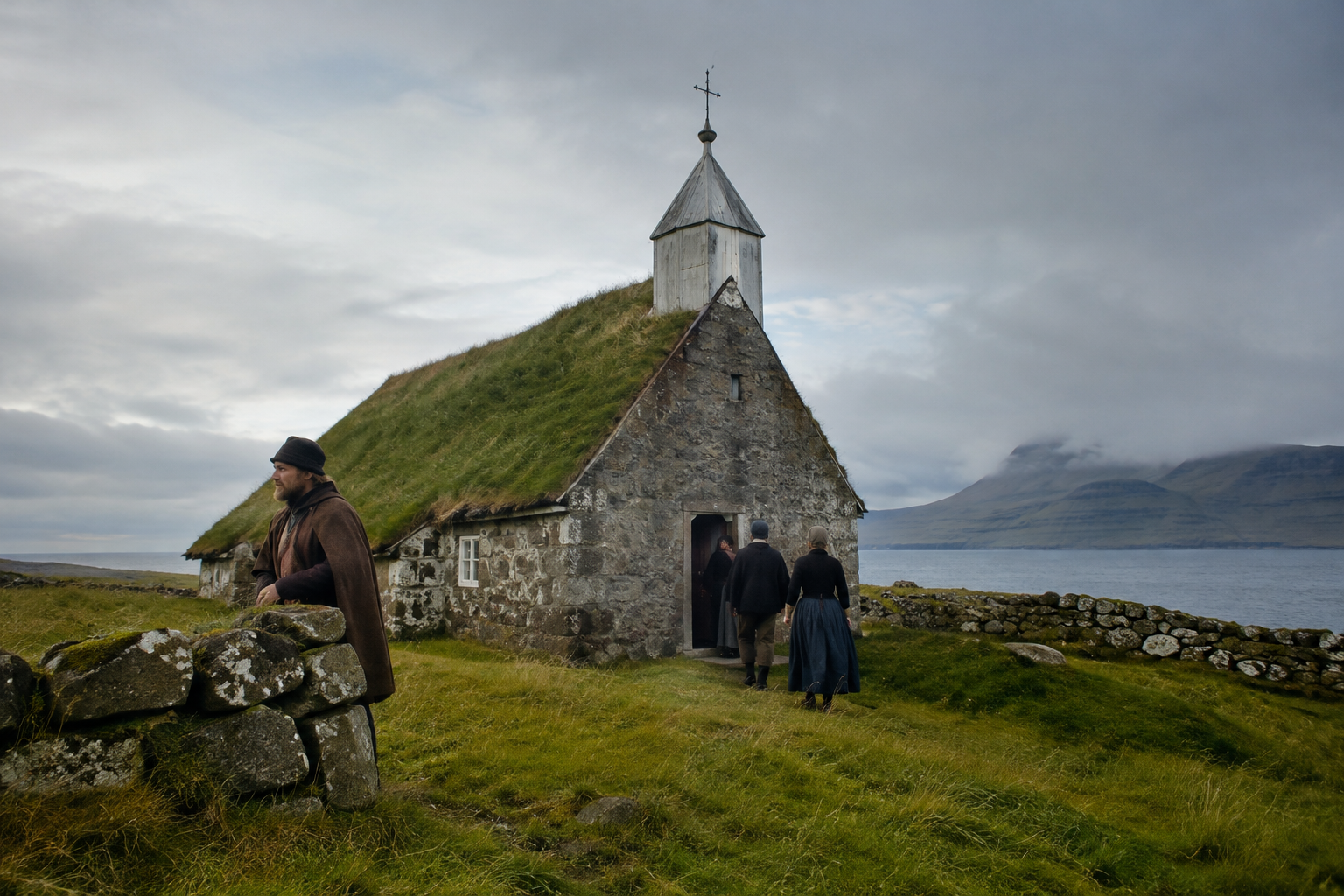
The most immediate ancient DNA anchor supplied here is VK242, described as Medieval Age Faroe Islands Sandoy Church Year:1600 AD ID:VK242. Strictly speaking, 1600 AD sits at the threshold of the early modern world rather than the high Middle Ages, but the setting still belongs to a society shaped by centuries of North Atlantic settlement and church life.
Sandoy Church places this individual not in the heroic mist of saga alone, but in a Christian burial landscape. That is important. A churchyard burial tells us we are dealing with an established community, one that had been integrated into the institutional life of the islands. By 1600, the Faroes had long been connected to the Scandinavian and North Atlantic sphere, yet also marked by local continuity and island conditions that could preserve older lineages in distinctive ways.
What does VK242 tell us? Not that he was the ancestor of some later clan chief, nor that one burial can define a whole island. But he gives us a real male individual, at a real named place, showing that this paternal branch - or its relevant placement in the haplogroup structure, depending on the dataset resolution - belongs in the lived history of the North Atlantic world. He is a reminder that haplogroups are not abstractions. They belonged to men who worshipped, worked, married, travelled, and were buried by their communities.
For readers who want to go deeper into the genetic history of the Faroes themselves, this related piece offers an excellent next step.
Discover Faroese Genetic History
The supplied clan and castle material shifts us south and east into the western and central Highlands of Scotland, but not away from the same maritime world. If anything, it sharpens it. Scotland's western seaways were historically bound to the same oceanic network as the Faroes. The route from Argyll to Skye and beyond was one of strategic narrows, sea lochs, and contested coastal authority.
Eilean Donan, associated here with Clan Logan, is a perfect example. Set on a small tidal island where three sea lochs meet, it was established as a fortified site in the 13th century, probably by the Mackenzie lords, to defend the region against Norse influence and to control movement through the lochs. There is a whole history of western Scotland in that sentence: not isolation, but traffic; not romantic solitude, but surveillance and power.
Later the castle became closely linked with Clan Mackenzie and then Clan Macrae, whose role as constables tied local kinship and military service to the management of a strategic stronghold. In 1719, during the Jacobite rising, Spanish troops used the castle as a base before it was attacked by Royal Navy ships and blown up. The ruin remained for roughly two centuries until Lieutenant Colonel John MacRae Gilstrap rebuilt it in the early 20th century in the romantic form familiar today.
None of this proves a genetic link to any one Y-line, of course. But it does show the sort of world in which paternal branches could persist: fortified, local, maritime, deeply entangled with clan service and regional power. A lineage like R1b1a1b1a1a2c1a1f1a1 makes historical sense in such settings because these were exactly the places where families held land, memory, and male-line identity over long periods, even as politics shifted overhead.
Readers curious about one of the key clans connected with Eilean Donan can continue with this community article.
The same point appears in very different form at Balquhidder, associated here with Clan MacLaren. This is not a sea fortress but a parish and glen in Perthshire, remembered today above all as the burial place of Rob Roy MacGregor in 1734. Yet the description rightly pushes us deeper. Balquhidder was shaped for centuries by farming, droving, church life, and the ties between local families such as the MacLarens, MacGregors, and Stewarts. Beside the largely 18th-century church stand earlier remains hinting at a longer sacred past.
That is a useful corrective to over-dramatic clan history. Not every paternal lineage is carried by conquerors on horseback or by warlords in towers. Many survive through parish communities, landholding routines, seasonal movement, and stubborn local continuity. A Y-line can be just as historically meaningful in a kirkyard as in a battlefield.
Then there is Castle Sween in Knapdale, tied here to Clan Mac Suibhne. Often described as the oldest standing stone castle in Scotland, it was probably built in the late 12th century by Suibhne, ancestor of Clan Sweeney. Here again the setting is the western seaways, and again the story is one of shifting control among Norse, Gaelic, and Scottish spheres, followed later by possession under families including the MacDonalds and Campbells. The castle was attacked, repaired, reused, and by the 17th century had become a ruin after civil war fighting.
Castle Sween is particularly evocative because it reminds us that castles were not simply family badges in stone. They were working mechanisms of control: over routes, resources, dependants, and maritime passage. If a paternal lineage became prominent in such a landscape, its history would have been shaped not by a single ethnicity or surname, but by overlapping Gaelic, Norse, and Scottish worlds.
For a wider look at how ancient DNA is illuminating Scotland's deeper population history, this article is a fine companion.
Explore Ancient Kinship in Scotland
So what should we make of R1b1a1b1a1a2c1a1f1a1? First, that it belongs to a paternal tradition nested within the broader R1b landscape of western Europe. Second, that the supplied evidence places it meaningfully within the North Atlantic and Highland historical setting, especially when read alongside the Sandoy Church individual VK242 and the clan geographies of western Scotland.
But caution is everything. Sharing a haplogroup does not prove shared surname, shared nobility, or recent common ancestry. A man buried at Sandoy Church in 1600 AD and a later member of a Scottish clan may belong to the same broad paternal branch without any traceable genealogical connection. Likewise, association between a haplogroup and a noble family in a historical database should be treated as context unless supported by direct genetic testing of a documented lineage.
What Y-DNA does offer is a framework for asking better historical questions. Why do certain paternal branches appear in maritime frontiers? How do lineages survive through conquest, conversion, and the adoption of new surnames? Why do some regions preserve old male-line diversity while others show more disruption? These are not small questions. They are precisely where genetics and history become most interesting together.
If you would like to explore whether your own DNA shows connections to ancient individuals, island populations, or historical regions like those discussed here, MyTrueAncestry can help place your results in a much wider human story. Those matches do not automatically prove direct descent from a particular ancient person or noble family, but they can open a remarkably vivid window onto your deeper past.






Comments