Haplogroup R1b1a1b1a1a2c1a1f1a

– 10 min read


Some Y-DNA haplogroups are famous because they are broad and common. Others are interesting precisely because they are so specific. R1b1a1b1a1a2c1a1f1a belongs firmly in that second category: a fine-grained branch on the immense R1b tree, the kind of lineage that reminds us how paternal history works in practice. Not as a single sweeping tale, but as a succession of smaller family lines, splitting, moving, settling, and surviving in particular places.
That matters because Y-DNA traces one direct paternal line only: father to son to son across time. It does not describe a person's whole ancestry, and it certainly does not confer automatic membership in a clan, kingdom, or noble house. But it can illuminate something wonderfully concrete: how one male line fits into the larger history of population movement. In this case, the supplied ancient evidence points us toward the North Atlantic and Scandinavian world, and toward the later historical landscapes of Scotland where castles, clans, and inherited lordship kept memory alive long after the men who first carried these lineages had vanished from the record.
At this depth in the tree, caution is essential. It is reasonable to place this haplogroup within the wider R1b family, one of the major Y-chromosome lineages in western Eurasia. It is also reasonable to discuss the later northern European and Atlantic settings suggested by the provided medieval and Viking-period samples. What would not be responsible is to claim that every story ever told about broad R1b applies neatly to this exact subclade. Specific branches have specific histories.
Learn How Ancient DNA Reconstructs the Past
The wider R1b family is deeply important in the study of European paternal ancestry, but a downstream branch such as R1b1a1b1a1a2c1a1f1a belongs to a much later chapter of that story. By the time we encounter such a lineage historically, we are no longer speaking about the first emergence of R1b itself, but about one twig among many on a much-branched tree. Its significance lies in where that twig turns up, and in what kinds of historical settings.
The evidence supplied here places that setting in the Scandinavian and North Atlantic world. That does not mean the branch was exclusive to Vikings, Norwegians, Faroese, or Scots. It does mean that, for this article, the most useful context is the network of movement linking Norway, the North Atlantic islands, and the British Isles in the Viking Age and after. These were not fringe zones. They were sea roads. Men, goods, languages, loyalties, and lineages moved along them.
That makes this haplogroup historically attractive. We can imagine its carriers not as abstract markers on a phylogenetic chart, but as participants in the maritime societies of the north: in farmsteads and warbands, in colonizing ventures across the Atlantic, and later in Christian communities that preserved bones beneath church floors and memory in place-names, estates, and family traditions. Ancient DNA does not tell us what language a man spoke or what banner he served under. It does, however, let us see that paternal lines could persist across the same regions where archaeology and written history describe intense contact.
The most vivid anchors for this haplogroup are the supplied ancient samples. They are modest in number, but useful precisely because they sit in meaningful places on the map.
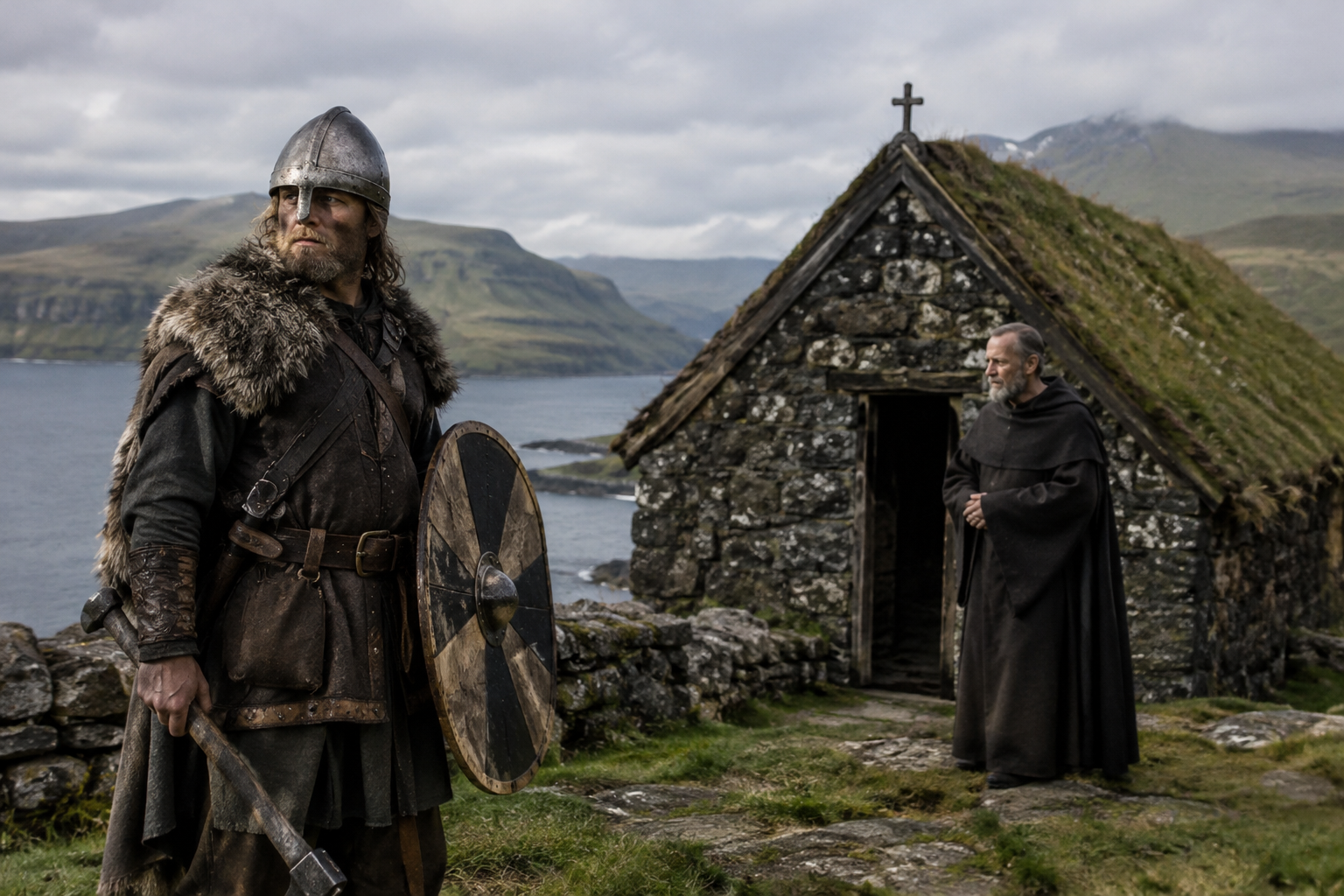
The first is VK386, identified as a Viking Age Warrior Oppland Norway, dated to 900 AD. Oppland lies in inland Norway, a reminder that the Viking world was not only coastal raiding and ocean travel. It was also rooted in regional power, kin networks, and the societies that produced the men who sailed outward. A lineage found in this setting fits naturally into the Scandinavian sphere from which so much North Atlantic expansion emerged.
The second is VK242, from Medieval Age Faroe Islands Sandoy Church, dated to 1600 AD. By then, of course, the Viking Age was long over. Yet the Faroe Islands remained one of the clearest examples of North Atlantic continuity: a settlement zone first shaped by seaborne migration, later folded into a Christian and post-medieval world. A paternal line in Sandoy across so many centuries suggests not a single dramatic event but long local endurance. That is often the real lesson of Y-DNA. Conquest and migration matter, but so does staying put.
Taken together, VK386 and VK242 do not prove direct descent from one individual to the other, nor do they prove that every carrier of this haplogroup followed the same route. What they do offer is a geographic and historical frame: Norway to the Faroes, Viking Age to early modern churchyard, maritime expansion to local continuity.
Explore Faroese Genetic History
If we want to understand why such a lineage matters for later British and Scottish history, the key is not to leap recklessly from haplogroup to surname. The key is geography. Scotland, especially its eastern and northern regions and its western seaways, was deeply entangled with the Scandinavian and North Atlantic world. That is true in archaeology, place-names, political history, and settlement patterns. A paternal lineage appearing in Norway and the Faroes belongs in that larger conversation.
It is perfectly possible that branches like this one entered or circulated around parts of Scotland through Viking Age and medieval movement across the North Sea and North Atlantic. It is also possible that some lines persisted locally for centuries once established. Those are historical possibilities grounded in regional history. What we must not do is convert them into unearned certainty about named medieval families.
Still, this is where genetics becomes such fun for historians. Written genealogy usually begins late and narrows quickly to elites. Ancient DNA does something rather different. It opens the side door and shows us lineages in ordinary and extraordinary contexts alike: a warrior in Norway, a burial in a Faroese church, and then, much later, historical landscapes in Scotland where lordship, war, inheritance, and memory clustered around stone strongholds.
Readers interested in the broader Scandinavian backdrop may also enjoy the community's work on Viking-period population history, especially as it shows how mobile and varied northern societies could be.
That later Scottish record cannot by itself identify the carriers of this exact subclade, but it does show the kinds of societies in which old paternal lines were remembered, claimed, and sometimes wrapped in clan tradition. In that spirit, several noble families and territorial houses have been associated with the broader historical landscape of this haplogroup.
The families supplied here are overwhelmingly Scottish, and together they sketch a map from East Lothian to Moray, Aberdeenshire, Argyll, and the Highlands. That spread is itself revealing. It places the haplogroup's later historical associations not in a single enclosed district but across regions deeply shaped by shifting lordship, coastal movement, and the long afterlife of medieval kin identities.
Clan Hepburn belongs to the eastern Lowland world of East Lothian, a region closely tied to the politics of the Scottish kingdom and to the North Sea. The Hepburns rose to considerable power in later medieval Scotland, and their prominence makes them a useful reminder that paternal-line history did not belong only to the Gaelic Highlands. It also mattered in the marcher and courtly society of the east.
Clan LaMont, by contrast, evokes the western seaways of Argyll and Bute, where kin groups and maritime connections shaped politics for centuries. In such regions, identities were formed not only by landholding but by access to coasts, inlets, and island routes, precisely the sort of settings that sit comfortably beside a broader North Atlantic historical frame.
Clan Macbean points us north into the Highland world, where older clan traditions remained especially tenacious in memory and genealogy. Clan Gray, associated here with the northeast, and Clan Brodie of Moray both carry us into another important Scottish zone: the eastern and northern lands where noble families balanced local authority with service to crown and region.
None of this means that every Hepburn, LaMont, Macbean, Gray, or Brodie male necessarily belonged to R1b1a1b1a1a2c1a1f1a. That would be far too strong. What can be said more responsibly is that these clans and families belong to the same later historical world in which a northern paternal lineage of this kind would feel entirely at home: a Scotland of inherited names, territorial influence, and remembered descent, but also of movement, mixture, and the usual complications that make real genealogy far more interesting than legend.
The associated castles make these later historical connections tangible. They are not genetic evidence in themselves, of course, but they are the places where the social life of lineage was staged in stone.
Hailes Castle in East Lothian, associated with Clan Hepburn, began in the 1200s under the de Gourlay family and later became a Hepburn seat as that family rose to great power in Scotland. Its later history is a distinctly Scottish mixture of strength and damage: battered during the rough wars of the 1500s, then left to decay after the defeat of the Jacobites in 1689. The ruin seen today is not merely picturesque. It tells the story of how noble authority could be built up over generations and then broken by war and politics.
For Clan LaMont, Castle Toward in Argyll and Bute represents a rather different sort of ancestral memory. Built in 1820 for Kirkman Finlay and later replaced in 1885 by a grand baronial house designed by David Bryce for James Coats, it belongs to the age when Scottish baronial architecture consciously revived older ideas of lordship and heritage. Its later use as a school and outdoor education centre, and its purchase by a community group in 2023, show how aristocratic landscapes can be continually repurposed.
Tulloch Castle, linked here with Clan Macbean, stands near Dingwall in the Highlands. Beginning as a 12th century tower associated with the Norse-influenced Muns and passing by the 16th century to Clan Davidson, it is exactly the sort of layered Highland site historians love: part medieval fortress, part later house, part modern legend, not least for its ghost stories.
In the northeast, Huntly Castle in Aberdeenshire, associated here with Clan Gray, began as a motte and bailey of the earls of Fife before becoming the great Gordon seat. Rebuilt in stone and later damaged in the Wars of the Three Kingdoms, it was finally abandoned after a fire in 1799. Brodie Castle in Moray, long home of Clan Brodie, preserves another side of the story: an ancestral house with medieval roots, largely dating in its present form from the 16th century, rebuilt after fires and later known for its art collections and gardens before passing to the National Trust for Scotland. Together these places do what castles do best. They pin family tradition to the ground and let us see the later historical settings in which old paternal identities were remembered, displayed, and contested.
The supplied noble associations take us into Scotland, and into a world where paternal memory mattered enormously, even if surviving documents and actual Y-DNA do not always line up neatly. Clan Hepburn brings us to Hailes Castle in East Lothian, begun in the 1200s as a stone tower of the de Gourlay family beside the River Tyne. Later expanded by the Hepburns into a courtyard castle and one of their main seats, it endured exactly the sort of rough political life one expects of late medieval Scotland: damage, faction, attack, and eventual ruin after the fall of the Hepburn earls and the assault of English forces under Protector Somerset in 1548. Roofless today, it remains a stark reminder that noble history is often a story of loss as much as power.
Farther west, Castle Toward on the Cowal peninsula is associated here with Clan LaMont. Its present grand form belongs largely to the 19th century, built for Kirkman Finlay and later enlarged into a baronial mansion with views over the Firth of Clyde. That later date is actually instructive. Not every "castle" connected to a clan is a medieval fortress frozen in time. Some are reinventions, expressions of memory and status in a later age. In the 20th century Castle Toward became an outdoor education centre, turning inherited aristocratic space into public experience.
Tulloch Castle, linked here with Clan Macbean and near Dingwall in Ross-shire, is another excellent Scottish example of historical layering. Probably beginning as a fortified tower house in the 12th century and long tied to Clan Davidson before passing through other owners, it was reshaped over centuries from defense to display, then to hotel. That is often how real castles behave: not as tidy museum pieces, but as patchworks of adaptation.
And then there are the great northern seats: Huntly Castle in Aberdeenshire, associated here with Clan Gray but historically one of the grandest Gordon strongholds, rebuilt in stone with Renaissance detail and caught in the violence of northern politics; and Brodie Castle in Moray, long seat of the Brodie family, transformed over generations from fortified residence to lairdly house and now preserved for the public. Between them they capture the arc from medieval fortification to early modern display and modern heritage.
None of these castles proves a specific Y-DNA claim. But all of them occupy the same broad Scottish world in which old paternal lineages, regional loyalties, and inherited identities mattered immensely. They are physical containers of memory, even when genetics and genealogy must be kept carefully distinct.
R1b1a1b1a1a2c1a1f1a is interesting not because it lets us make grandiose claims, but because it encourages a better sort of history. It asks us to think at human scale. A paternal line can be old, but the evidence we actually have may come from sharply defined moments: VK386 in Oppland Norway in 900 AD, and VK242 in Sandoy Church, Faroe Islands in 1600 AD. Those moments suggest movement within the northern maritime world and continuity within settled island communities.
Set beside the castles and clans of Scotland, the picture becomes richer rather than simpler. Ancient DNA gives us lineages without surnames. Medieval records give us surnames without genomes. Archaeology gives us places where the two can sometimes be placed in meaningful conversation. That is the real excitement here: not the fantasy of proving that one Viking warrior founded a Scottish house, but the more responsible and more interesting possibility of seeing how northern paternal lineages belonged to a historical world stretching from Norway to the Atlantic islands and into the lordly landscapes of Scotland.
For readers drawn to those Scottish continuities, the community's work on northern kinship and regional history offers another useful angle on how ancestry, place, and memory overlap without collapsing into one another.
Explore Kinship in Northern Scotland
If your Y-DNA falls on a rare or highly specific branch, that does not reduce its historical value. Quite the opposite. It may place your direct paternal line inside a story of regional survival, migration, and settlement that only ancient DNA can now begin to reveal. MyTrueAncestry lets you compare your DNA with ancient individuals and historical populations, offering clues about deep ancestry and old connections, while remembering that genetic similarity is not the same as proof of direct descent or noble membership.
Upload your DNA to MyTrueAncestry and see whether your results connect you with the Viking Age, the North Atlantic world, or other ancient populations that help bring your paternal history into focus.
Comments