Haplogroup R1b1a1b1a1a2c1a1b

– 7 min read


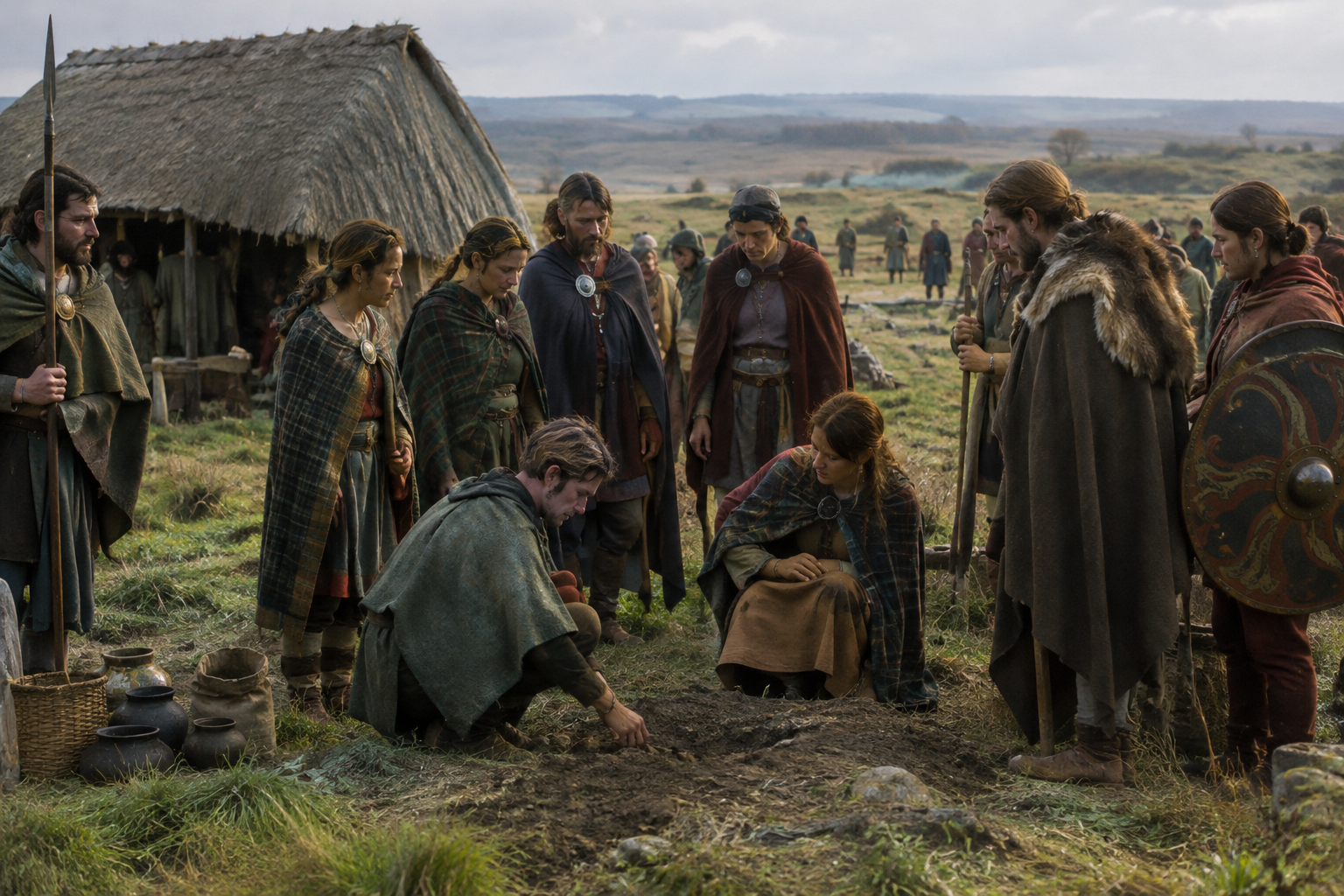
Some Y-chromosome lineages announce themselves with a map. Haplogroup R1b1a1b1a1a2c1a1b announces itself with a puzzle. Its ancient matches, drawn from the material supplied here, appear above all in Britain and Ireland's wider neighborhood, but also farther afield in places touched by Roman movement, Iron Age exchange, and later medieval reshaping. That makes it historically interesting not because it belongs neatly to one people, one kingdom, or one surname, but because it does not.
Like all Y-DNA haplogroups, this lineage traces one very narrow thread of ancestry: the direct paternal line, father to son to son across generations. It does not describe a person's whole ancestry, identity, or family history. Even so, paternal lineages can be unusually revealing. They sometimes preserve long regional continuities, sometimes expose migration, and sometimes show how archaeological populations and later historical communities occupied the same landscapes across astonishing stretches of time.
This haplogroup is a very specific downstream branch within the wider R1b family, one of the major Y-chromosome lineages in western Europe. For a branch this narrow, caution matters. We should not simply pour the entire history of broad R1b into it as though nothing changed along the way. Still, the supplied ancient DNA gives a strong sense that this paternal line belongs in the long story of later prehistoric and historic western Europe, especially Britain, with echoes in the Roman world and in Atlantic-facing regions.
The pattern in the sample list is striking. We see this lineage in Bronze Age Britain, Iron Age Britain, Roman-era Britain, post-Roman Britain, and related settings across nearby parts of Europe. That does not prove uninterrupted descent from any one burial to any later family. But it does suggest that this paternal branch, or very close neighboring branches, was present in the populations that shaped Britain from the Beaker and Bronze Age onward and continued into the worlds later described as Celtic, Romano-British, and medieval.
Explore Celtic Language Origins
The deepest anchors in the supplied material lie in the Bronze Age. Sample I4950, a Bell Beaker individual from Wiltshire Upavon in England dated to 2300 BC, is an important early signpost. Bell Beaker contexts matter in discussions of western European paternal history because they are often associated with major changes in ancestry and burial practice across large parts of Europe. One sample cannot carry an entire migration story on its shoulders, but I4950 places this branch, or something very close to it, in southern Britain at a formative moment.
Other early British examples reinforce that impression. I2417 from Bronze Age Amesbury Down, Wiltshire, also dated to 2300 BC, I3256 from Trumpington Meadows, Cambridge at 2100 BC, I5377 from Early Bronze Age England Thames at 1800 BC, and dfb002 from Cranborne Chase Down Farm Pond Barrow in Dorset at 1900 BC show this paternal signature appearing across southern and eastern Britain in different burial settings.
Then there is the northern edge. KD061 from Bronze Age Orkney, Westray Links of Noltland, dated to 1498 BC, suggests that closely related paternal lines had also reached far into the archipelagic north. I5473 from Boatbridge Quarry, South Lanarkshire, Scotland, dated to 2250 BC, adds another Scottish data point. And Rathlin2B from Copper Age Ireland at 1880 BC is especially notable, because it places this wider paternal thread in Ireland well before the medieval era of surnames and clans.
Outside Britain and Ireland, GMO015 from Bronze Age Calabria, Cosenza, Grotta della Monaca Sant Agata di Esaro, dated to 1300 BC, hints at a broader western and central European context. That does not mean a single tidy migration route from Italy to Britain or the reverse. It does mean this lineage was not confined to one island story.
By the Iron Age, the evidence becomes almost crowded. East Yorkshire in particular stands out. The supplied list includes a remarkable cluster from the Parisi and Arras Culture landscape around Wetwang Slack, Pocklington, Melton, and Burton Fleming. Among them are I36889, I36880, I36885, I36974, I37335, I37336, I37342, I37344, I36843, I36844, I36972, I21644, and the elite chariot burial I36995, most dated around 225 BC.
This concentration matters because it shows the lineage in an unmistakably Iron Age British setting, and not merely among one isolated burial. It appears among ordinary burials, barrows, and even an elite chariot burial. In other words, this was not a paternal line confined to one social rank. It was present in the living fabric of the community.
Other British Iron Age samples broaden the map: I21182 from Yarnton, Oxfordshire at 200 BC, I11991 from Worlebury, Somerset at 150 BC, I21309 from Battlesbury Bowl at 57 BC, and HI2 from Iron Age Hinxton at 45 BC. Taken together, they suggest regional breadth across Britain rather than one tiny eastern enclave.
The story does not end when Rome arrives. Quite the reverse. The large group of Durotriges samples from Duropolis, Winterborne Kingston in Dorset, all dated to 125 AD, shows this lineage still very much at home in southern Britain under Roman rule. The list includes WBK12, WBK20, WBK29, WBK41, WBK05, WBK30, WBK43, WBK06, WBK08, WBK18, and WBK191. There is something rather pleasingly stubborn about that: imperial government overhead, but local paternal lines continuing in the ground beneath Dorset.
Yet Rome also moved people. Sample I26776 from Imperial Roman Era Zadar, Croatia, dated to 200 AD, shows this paternal branch in the Adriatic world. So do R10656 from Late Roman Klosterneuburg in Lower Austria at 407 AD and R10488 from Late Roman Conimbriga in Portugal at 330 AD. These do not prove a single Roman military corridor for this haplogroup, but they fit the broader truth that the Roman Empire was a machine for moving men, families, traders, and soldiers across extraordinary distances.
The later British evidence is equally important. I11580 from Post Roman Era Worth Matravers, Dorset, dated to 600 AD, suggests that paternal continuity in southern Britain outlasted Rome itself. Elsewhere in early medieval Europe, IND013 from a Merovingian grave in Alt-Inden, North Rhine-Westphalia, and ST2025 and ST1308 from 900 AD Sint-Truiden in Belgium show this branch, or near kin to it, present in early medieval continental society too.
Discover Roman and Early Medieval Britain
This is the point where genetic enthusiasm needs the historian's raised eyebrow. The supplied family associations connect this haplogroup with Clan MacInnes in western Scotland and Clan Phelan in Ireland. That is interesting historical context, not proof that every man of either name belonged to exactly this Y-DNA branch, nor proof that any ancient sample above was a direct ancestor of a medieval clan founder.
Still, place matters. And the places here are excellent. For Clan MacInnes, the landscape is Morvern in western Scotland, and the stronghold is The Butter Castle at Kinlochaline. This 15th-century tower house is traditionally linked to Dubh-Chal an Ime, or Black Colin of the Butter, said to have financed it through cattle and butter profits after service in Ireland. That detail alone places the castle in the maritime economy of the western seaways, where Scotland and Ireland were not separate worlds but neighboring shores. The castle later became a MacInnes stronghold in a region shaped by clan rivalry, sea trade, and the power of the Lords of the Isles. In 1644, during the Wars of the Three Kingdoms, it was attacked and damaged by Alasdair Mac Colla. Later roofless, later restored, it still preserves the memory of a clan world built as much on movement by water as by land.
For Clan Phelan, the associated site is Foulksrath Castle in County Kilkenny. This late medieval tower house was probably built in the early 15th century by the Purcell family of Norman origin, before passing through other owners including the Morris family. Its history is a compact lesson in Irish complexity: Anglo-Norman settlement, local lordship, ruin, restoration, and modern heritage afterlives. As with many Irish castles, the stones tell a story of changing power more tangled than any single surname can capture.
These associations are especially intriguing because the ancient evidence includes Rathlin2B in Copper Age Ireland and I5473 in Bronze Age Scotland. Again, that is not a straight genealogical line to either clan. But it does mean that when we place MacInnes and Phelan in their regions, we are standing in landscapes where related paternal lineages had already existed for millennia.
The value of R1b1a1b1a1a2c1a1b is not that it hands us a fairy-tale pedigree. It does something better. It shows how one paternal line can be traced across very different historical worlds: Bell Beaker Wiltshire, Bronze Age Orkney, Iron Age East Yorkshire, Romano-British Dorset, post-Roman southern England, Roman Croatia, and early medieval Belgium and Germany. That is a serious historical range.
It also reminds us that castles and clans arrived very late in the story. Butter Castle and Foulksrath Castle belong to the medieval and early modern chapters; the paternal line itself is far older than either building. Ancient DNA lets us see beneath heraldry and written genealogy into the deeper population history of the same regions. Written records tell us who held the tower house. Genetics tells us something different: what kinds of paternal lines were already established in those landscapes long before anyone thought to build a keep or adopt a surname.
Readers interested in the Irish side of that story may also want to compare the broader family context in Clan Phelan, especially alongside the prehistoric Irish evidence discussed above.
If your Y-DNA belongs to haplogroup R1b1a1b1a1a2c1a1b, you may be looking at a paternal line with deep roots in the ancient populations of Britain and neighboring parts of Europe. MyTrueAncestry can help you explore whether your DNA shows similarities to ancient individuals such as I4950, KD061, Rathlin2B, the Wetwang Slack burials, or the Durotriges of Dorset. Those matches do not prove direct descent from any one ancient person or noble family, but they can offer a vivid new way of understanding where your paternal line fits in the human past.






Comments