Haplogroup R1b1a1b1a1a2c1a1a1a1a1c

– 6 min read


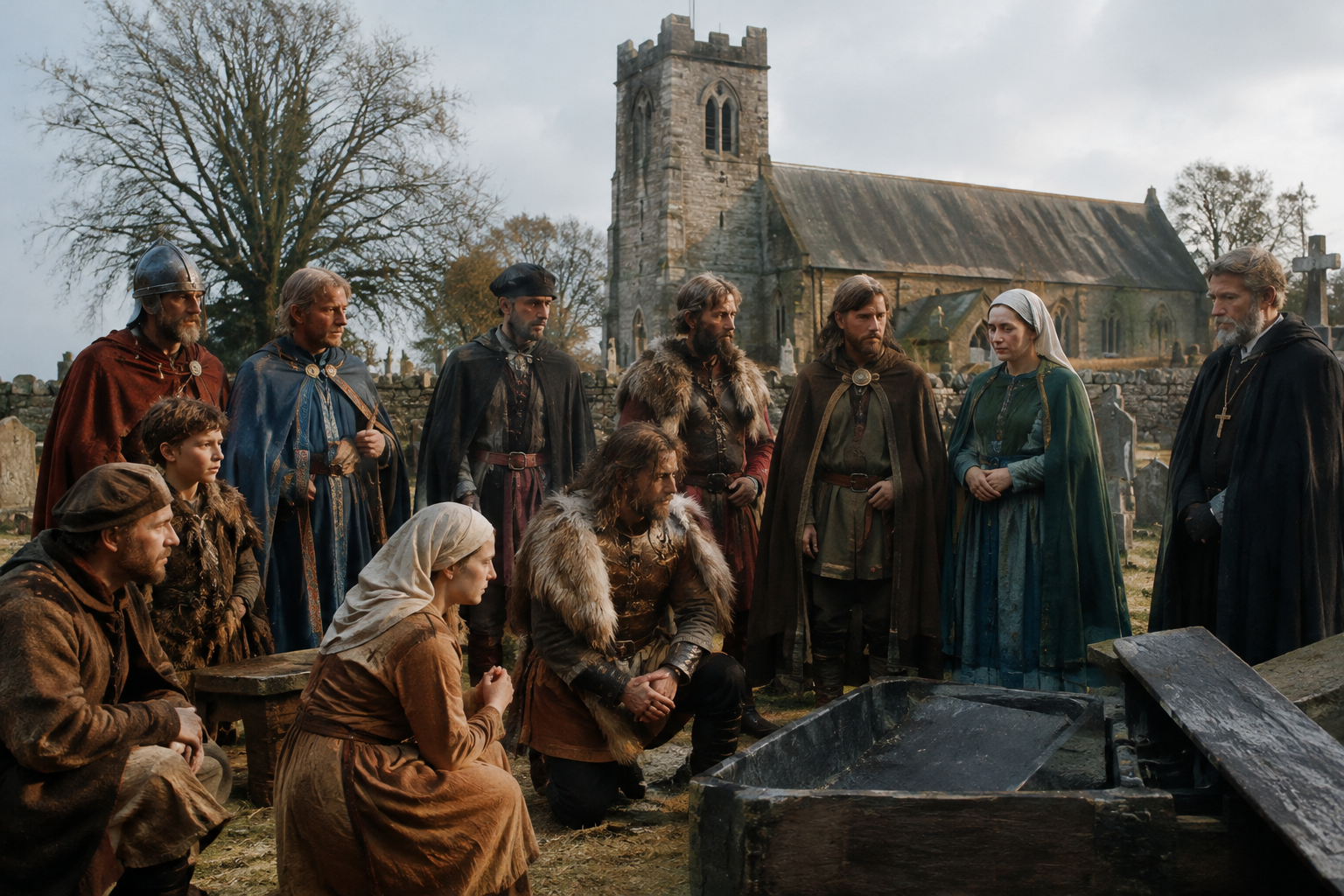
There are some Y-DNA lineages that turn up like a single dramatic royal signature, and others that are more interesting precisely because they do not. Haplogroup R1b1a1b1a1a2c1a1a1a1a1c belongs to that second category: a very specific paternal branch whose story, as far as the supplied evidence allows us to tell it, appears across a broad sweep of western and northern Europe and then into the Atlantic world. What makes it compelling is not that it can be reduced to one people, one kingdom, or one surname, but that it appears in archaeological settings ranging from Bronze Age Austria to Iron Age Britain, early medieval Germany, Ireland, England, Denmark, the Low Countries, and finally colonial Maryland.
That is exactly why Y-DNA matters. A Y-chromosome haplogroup traces one direct paternal line only: father to son to son across generations. It does not represent a person's whole ancestry, culture, or identity. But when ancient DNA places related paternal branches in graves, churchyards, and elite burials across centuries, it gives us a remarkable tool for following one thread through the wider historical fabric. In this case, the branch sits within the immense and historically important haplogroup R1b, especially associated in broad terms with many later western European paternal lineages, while the extremely narrow subclade here must be treated more cautiously. The deeper history of R1b is not automatically the history of this exact downstream branch. What we can say is that the evidence supplied places this lineage, or closely related paternal kin within its branch structure, in a long arc of European history.
The earliest anchor in the material provided is DSH008, from Drasenhofen, Austria, dated to 2000 BC. That matters because it places this paternal branch, or a very close relation within it, in Bronze Age Central Europe. We should be careful not to turn one burial into a sweeping migration map. Still, a Bronze Age presence in Austria fits a wider picture in which branches of R1b became important in many parts of Europe during and after the great population changes of the 3rd and 2nd millennia BC.
By the Iron Age, the evidence has shifted westward. PECH8, from Pech-Maho, France, dated to 350 BC, places the lineage in the far western Mediterranean sphere, in a region connected with the ancient Aquitani. Then I22060, an Iron Age Briton from Thornholme, East Riding of Yorkshire, dated to 180 BC, shows it in Britain before Rome. Those two burials alone are enough to make a simple ethnic label impossible. This was not, on the evidence here, a lineage confined to one neatly bounded tribe. It belonged to the messy, mobile, interconnected Europe of the later prehistoric centuries.
Readers interested in the broader archaeological background for such western European paternal movements may enjoy this related study of continental change and continuity:
Explore Late Bronze Age Central Europe
It is tempting, of course, to take a branch like this and declare it "Celtic" or "Germanic." That would be too neat. What the samples really suggest is a paternal line established in parts of Europe long before medieval ethnic names hardened into the categories familiar from textbooks. Later Celts, Britons, Anglo-Saxons, Franks, Irish church communities, and Scandinavian townsmen all lived in landscapes already carrying older paternal histories.
The early medieval evidence is especially revealing. In Deersheim, Saxony-Anhalt, sample DRH026 is associated with the Thuringii Tribe and dated to 500 AD. Not long after, IND007 comes from a Merovingian Grave in Alt-Inden, North Rhine-Westphalia, Germany, dated to 600 AD. These are not identical historical settings. One belongs to the shifting post-Roman world of central Germany, the other to the Frankish political sphere west of the Rhine. Yet the lineage appears in both.
Then there is SED005, an Anglo-Saxon burial from Sedgeford, Norfolk, also dated to 600 AD. This is precisely where ancient DNA becomes so useful. Written history tells us about migrations into post-Roman Britain; archaeology tells us about burial customs and settlement; Y-DNA adds another layer, showing that particular paternal branches found in continental Europe also appear in early medieval England. That is not proof that one named man crossed the North Sea and founded a dynasty. It is evidence that related male lines were part of the same broad North Sea world.
That world was not limited to England and Germany. KIL043, from Kilteasheen, Roscommon Bishops Seat in Ireland, dated to 650 AD, places the lineage in an early medieval Irish ecclesiastical setting. GRO005, from Groningen, Netherlands, dated to 1040 AD, carries it into the Carolingian and post-Carolingian Low Countries. And CGG100512, from Vor Frue Kirkegard, Aalborg, Jutland, Denmark, dated to 1336 AD, shows the branch still present in the medieval Scandinavian world.
If you want a wider look at how these North Sea and early English movements reshaped populations, this article is a natural companion:
Discover Anglo-Saxon Migration DNA
Put together, these burials sketch a geographic belt running from Central Europe to the Atlantic fringe and up into Scandinavia. That does not mean uninterrupted elite inheritance, nor a single unbroken social identity. It means something at once more modest and more impressive: some paternal lines endure through major historical upheavals, passing through changing languages, kingdoms, and religious worlds.
The latest supplied samples bring the story across the ocean. 2099, identified as Philip Calvert Coffin Maryland, dated to 1682 AD, and I2097, Son of Philip Calvert Lead Coffin Maryland, also dated to 1682 AD, are especially valuable because they place the paternal line in a documented early colonial family context. Unlike many prehistoric burials, these individuals belong to a world of names, offices, and paper records.
That does not mean they can be tied genealogically to every earlier European sample. Shared haplogroup is not the same thing as provable descent from any particular ancient burial. But the Maryland coffins vividly show how a paternal line present in prehistoric and medieval Europe could also be carried into the English colonial Atlantic. In other words, the Y chromosome here is not telling us a simple national story; it is showing the longevity of one branch through radically changing historical settings.
For readers who want to see how genetics illuminates that Chesapeake colonial world, this is the obvious next step:
The later historical association supplied here is Clan Newlands and Monklands House in Airdrie, North Lanarkshire. This is an excellent reminder that not every ancestral seat is a turreted ruin perched on a cliff. Monklands House began as a substantial country house linked to the old Monklands estate, whose name preserves the memory of medieval church lands once held by monks. Later, it stood in a district transformed by coal, iron, and rapid industrial growth.
That setting matters. Lanarkshire is one of those places where medieval landholding, ecclesiastical memory, agrarian estate culture, and industrial modernity all sit awkwardly on top of each other. Monklands House became associated with changing local landowners and with the wider history of Monklands itself, as a rural landscape was absorbed into one of Scotland's great industrial areas. Rather than a castle romance frozen in time, it survives in historical memory as part of a region where old landed identities were folded into the modern town.
Genetically, we must be exact. The association of Clan Newlands with this haplogroup in a MyTrueAncestry context does not prove that every historical Newlands male carried R1b1a1b1a1a2c1a1a1a1a1c, nor that the clan descends directly from any of the ancient men listed above. What it does provide is a historical landscape in which to think about paternal continuity: a Scottish family memory rooted in place, set against a much older pattern of related paternal lines found around Britain and the North Sea.
Readers who would like the fuller clan background can continue with:
Read the Story of Clan Newlands
So what does R1b1a1b1a1a2c1a1a1a1a1c reveal? First, it points to a paternal branch with a documented presence in multiple parts of Europe over a very long time span. Second, it shows how ancient DNA can connect worlds that historians usually study separately: Bronze Age Central Europe, Iron Age Britain and France, post-Roman Germanic and Insular settings, medieval Denmark and the Low Countries, and the colonial Chesapeake.
What it cannot do is hand us a ready-made identity card. A Y-DNA haplogroup does not prove that someone was "Celtic," "Anglo-Saxon," "Danish," or "Scottish" in any simple sense. It does not prove descent from a noble family because a surname or clan appears nearby in history. And it certainly does not turn an archaeological match into a documented family tree.
Still, that is hardly disappointing. In some ways it is better. The value of a lineage like this lies in seeing how one direct male line can pass through many different societies, all the while leaving only faint traces until archaeology, genetics, and history are read together.
If this kind of evidence-driven reconstruction interests you, MyTrueAncestry lets you compare your DNA with ancient individuals and historical populations from the archaeological record. Those matches can offer striking clues about deep ancestry and historical context, even when they do not prove direct descent from a particular ancient person or noble house.






Comments