Haplogroup R1b1a1b1a1a2c1a1a1a1a1a1a5

– 6 min read


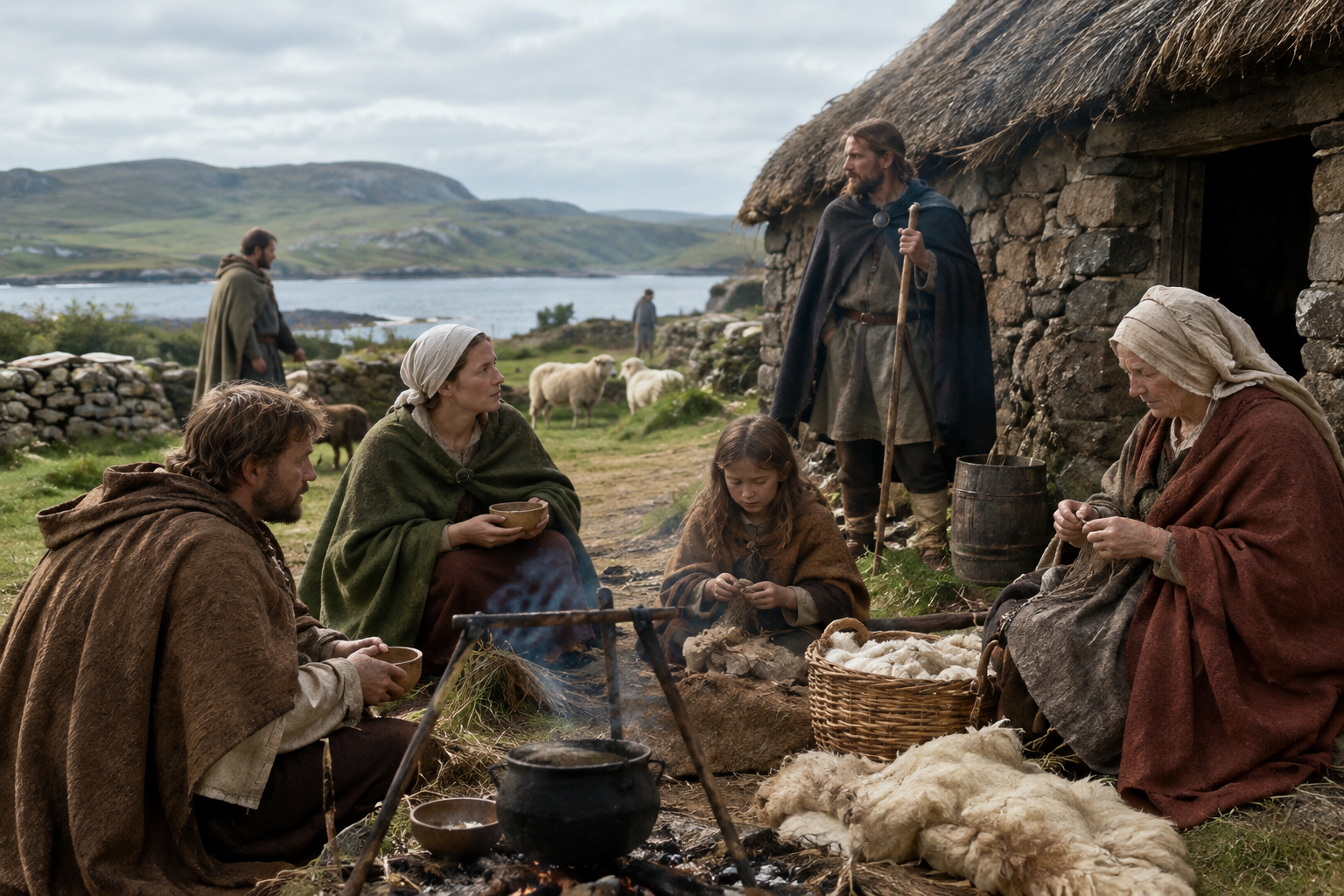
Some Y-chromosome lineages announce themselves with famous royal burials or sweeping continental distributions. Others are interesting for a subtler reason: they appear in the bones of ordinary medieval people, in churchyard communities, and in the later landscapes of clans and local lordship. The Y-DNA haplogroup R1b1a1b1a1a2c1a1a1a1a1a1a5 belongs to that second category. It sits deep within the very large R1b family, one of the major paternal lineages in western Europe, but this extremely specific branch matters precisely because it narrows the focus from broad prehistory to historically recognizable places.
That is worth pausing over. Y-DNA traces one direct paternal line only: father to son to son across generations. It does not describe a person's whole ancestry, and sharing a haplogroup does not by itself prove close kinship or descent from a named medieval family. Even so, when a narrow lineage turns up in medieval Ireland and later appears in historical settings linked to Ulster and the western British Isles, it gives us a useful way to think about continuity, mobility, and the stubborn persistence of paternal lines across centuries.
The broad parent haplogroup R1b is strongly associated with much of western Europe today, and ancient DNA has made clear that its history is tied to large-scale population changes in later prehistory, especially after the Neolithic. But one must be careful here. The deep history of R1b as a whole cannot simply be pasted onto a highly specific downstream branch like R1b1a1b1a1a2c1a1a1a1a1a1a5. What we can say responsibly is that this lineage belongs within that western European paternal framework and that the supplied evidence places it securely in medieval Irish and later northwest European contexts.
That makes the haplogroup historically interesting not because it solves everything, but because it narrows the question. Instead of asking only how R1b reached Europe in prehistory, we can ask how one particular paternal branch persisted in Gaelic Ireland, how it may have moved around the Irish Sea world, and how such lineages survived the upheavals of church reform, local kingship, plantation, and border warfare.
Explore Celtic origins in ancient DNA
The most striking feature of the evidence is how concentrated it is in medieval Ireland. A large number of supplied ancient samples come from Ballyhanna, County Donegal, Ireland, dated to 840 AD and 1209 AD. Ballyhanna is not some legendary royal mausoleum. That is precisely why it matters. It gives us access to a local burial population in the northwest of Ireland, in a region later associated with powerful Gaelic lordships and long-lived kin networks.
Among the many Ballyhanna identifiers are early medieval samples such as Sk197an, Sk197y, Sk197q, and HAN197x, all given as 840 AD, and later medieval burials such as HAN197aq, HAN197ar, HAN197as, and HAN197ba, dated 1209 AD. The sheer clustering of these samples in one place suggests that this paternal branch, or closely related branches within its neighborhood on the tree, was not an isolated curiosity. It belonged to a real community, living and dying in medieval Donegal over several centuries.
There is also a smaller but valuable Irish comparison from Kilteasheen, Roscommon, including KIL041, KIL044, KIL033, KIL037, KIL009, and KIL014, dated 650 AD. Kilteasheen was a bishop's seat, and that ecclesiastical setting matters. It reminds us that medieval Ireland was not simply a patchwork of war-bands and petty kings. It was also a world of monasteries, churches, learned families, and communities organized around religious foundations. If paternal lines related to this branch appear in such settings, that hints at lineages embedded not only in secular kin groups but in the social worlds around early Irish Christianity.
One should not overstate the point. These samples do not prove a single uninterrupted dynasty, and they do not demonstrate that every burial belonged to the exact same narrow terminal branch. But together they strongly anchor this haplogroup in medieval Ireland, especially the north and west.
Read about Irish kinship and ancient DNA
The supplied evidence also includes a late medieval cluster from St. Rombouts, Belgium: STR129, STR129a, STR129b, STR129c, and STR129d, all dated 1553 AD. That does not mean medieval Donegal suddenly became Belgium in disguise, nor does it prove a direct migration from one cemetery to the other. But it does remind us of something often forgotten in neat national histories: paternal lineages travel more easily than romantic origin stories would like.
By the later Middle Ages and early modern period, the North Sea and Irish Sea zones were thick with movement: soldiers, clerics, merchants, migrants, and political exiles. A narrow R1b branch appearing in both Ireland and the Low Countries fits perfectly well within that broader pattern of mobility. It is a useful corrective to the lazy assumption that every lineage stayed tidily at home until modern times.
If you want a wider view of how ancient DNA has transformed these kinds of questions, the broader field is well introduced in MyTrueAncestry's overview of archaeogenetics.
Discover how archaeogenetics reads the past
The historical associations supplied with this haplogroup pull us toward two very different but connected regions: the Scottish Borders and Ulster. In both, family, land, and memory were intensely local, and that makes them good places to think about how paternal lineages could endure.
Clann OMaolagain is linked here with Tirkeeran in County Londonderry. The place-name, derived from the Irish Tir Mhic Ceirin, preserves an older Gaelic world of kin groups and ecclesiastical influence. That matters because the Irish samples already suggest that this haplogroup belonged in exactly such a society: one where identity was rooted in territory, church foundations, and descent groups rather than modern surnames in their later fixed form. Tirkeeran, like so much of Ulster, was then reshaped by the Plantation, when older patterns of landholding were disrupted, overlaid, and sometimes obscured but not entirely erased.
There is a pleasing historical fit here, though not a proven genealogical one. A paternal lineage found repeatedly in medieval Irish contexts sits comfortably beside a clan tradition rooted in an old Ulster territorial landscape. That is context, not proof - but good context is half the work of history.
The other association, Clan Greer and Lag Tower in Dumfries and Galloway, shifts us across the water into the old Border country. Lag Tower was a sixteenth-century peel tower, linked first to the lairds of Dunbar of Mochrum and later to the Murrays of Broughton. This was not a fairy-tale castle with banners fluttering from romantic battlements. It was a fortified house in a hard landscape, built for watchfulness, refuge, and the daily politics of raiding and reprisal.
That setting is a gift to anyone thinking historically about DNA. The Borders were not static. They were places of movement, fosterage, feuding, marriage, service, religious division, and shifting loyalties. In the seventeenth century Lag Tower became entangled in the Covenanting troubles, and local tradition connected it with the persecution of dissenters under Sir Robert Grierson of Lag. The ruin that survives today preserves the memory of power exercised at close quarters: family power, practical power, and armed power.
Again, the genetics must be handled with care. A clan or noble family association does not prove that every man of that surname carried this haplogroup, nor that a medieval Irish burial was the ancestor of any named Border lineage. But the geography is suggestive. The same wider Irish Sea world that carried people between Ulster, Galloway, and the Borders also provided the stage on which paternal lines could spread, split, and reappear in new historical clothing.
Explore the history of Clan OMaolagain
R1b1a1b1a1a2c1a1a1a1a1a1a5 is a reminder that the most revealing genetic histories are often local before they are grand. The supplied evidence does not hand us a neat saga of one tribe marching across Europe under a single banner. What it gives instead is something more persuasive: a narrow paternal branch firmly present in medieval Ireland, visible in both Donegal and Roscommon, and later also represented in the Low Countries, while its associated historical traditions point toward Ulster and the Borderlands.
That is how ancient DNA works at its best. It does not replace archives, place-names, ruined towers, or clan histories. It sits beside them and asks sharper questions. How long did paternal lines persist in one region? When did they move? Which movements belonged to famous invasions, and which to the quieter traffic of ordinary lives? And how much of medieval history happened not in capitals and courts, but in parish landscapes like Tirkeeran and defended houses like Lag Tower?
For MyTrueAncestry users, that is the real excitement. A haplogroup this specific will never tell your whole story. But it may connect your direct paternal line to the same historical regions where medieval burials, Gaelic kin groups, and Border strongholds now give us glimpses of the men who carried related lineages long before surnames hardened into modern form.
If you want to explore the Scottish side of that world in more detail, MyTrueAncestry also has a dedicated article on Clan Greer.
Discover the story of Clan Greer
Ancient DNA cannot prove that you descend from a particular medieval clan or noble house simply because you share part of a Y-DNA branch. But it can place your paternal line into a much older historical landscape, alongside real archaeological individuals such as those from Ballyhanna, Kilteasheen, and St. Rombouts. Upload your DNA to MyTrueAncestry to see whether your results show links to ancient populations and historical regions like the ones explored here.






Comments