Haplogroup R1b1a1b1a1a2c1a1a1a1a1a1a2a1
– 4 min read


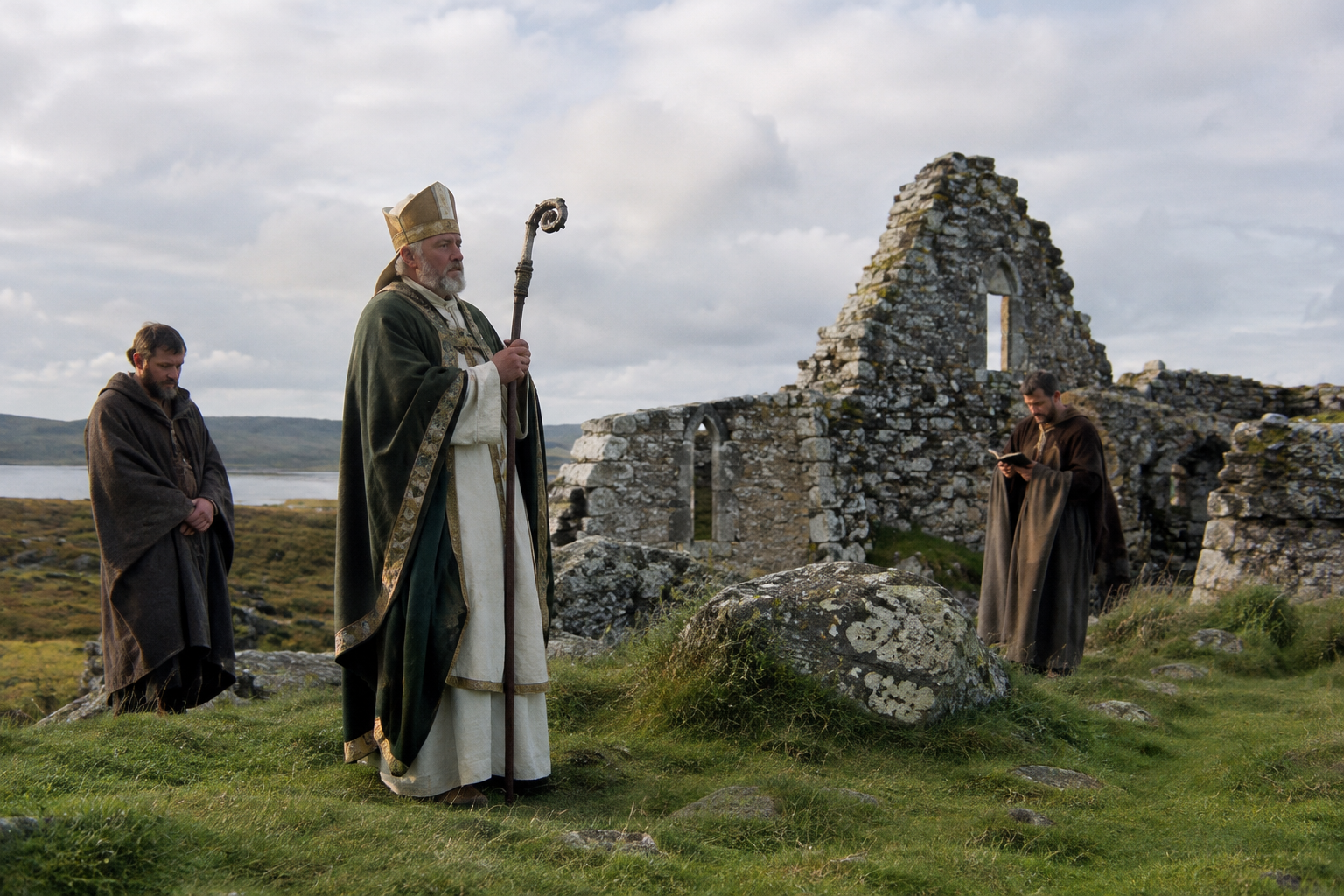
At Kilteasheen in County Roscommon, archaeologists uncovered an early medieval cemetery beside an important ecclesiastical site, and among the individuals recovered was KIL022, dated here to around AD 650. That is already enough to place him in a fascinating moment in Irish history: the centuries when monasteries were becoming major political as well as religious centres, and when burial grounds can show us ordinary continuity better than grand chronicles do.
KIL022 is associated here with the very specific Y-DNA lineage R1b1a1b1a1a2c1a1a1a1a1a1a2a1. Such a label is a deep paternal branch within the wider R1b family, tracing one direct male line only. It does not stand for an entire people, surname, or kingdom. What makes this sample valuable is not some invented dynastic glamour, but the fact that it anchors this paternal branch in a real excavated medieval Irish setting.
Kilteasheen is not famous in the way Tara or Clonmacnoise is famous, but that is part of its importance. Sites like this let us see how Christianity was lived on the ground in early medieval Ireland, beyond the great saints' Lives and later genealogies. A burial from around AD 650 belongs to a world of local churches, monastic enclosures, kin-groups, and shifting regional lordships, where communities were both intensely local and linked into wider religious networks.
For genetic history, that matters. If a paternal lineage appears in an excavated cemetery tied to an early church landscape, it shows the branch not in abstract distribution maps but in the fabric of a working community. KIL022 was not a floating label in a phylogenetic tree; he was part of a burial population in Roscommon during the centuries when post-Roman western Europe was being reorganised in very different ways from the former empire.
An ancient DNA study of early medieval Irish remains, including work associated with Kilteasheen, helped show how archaeogenetics can illuminate those communities without collapsing them into simplistic tribal categories. The relevant research can be found here: https://www.ncbi.nlm.nih.gov/pmc/articles/PMC6026117/.
The sheer length of R1b1a1b1a1a2c1a1a1a1a1a1a2a1 can give the impression of extraordinary certainty about the entire past of this line. In fact, the opposite is often the sensible view. The longer the branch name, the more careful we have to be about not projecting every big story attached to broader R1b onto one narrow descendant lineage.
At a broad level, R1b is one of the major paternal haplogroups in western Europe and is strongly represented in parts of the Atlantic world, including Ireland. But KIL022's value is much more specific. He tells us that this particular downstream paternal line, or an assignment associated with it in the testing framework used here, was present in medieval Ireland by the seventh century. That is a useful historical anchor. It is not, by itself, proof of where the branch first formed, how common it was, or which later families carried it.
This distinction matters because Y-DNA can tempt people into over-reading identity. A paternal line is one thread in a person's ancestry, not the whole garment. Still, one thread can be historically meaningful when it is tied to an excavated individual in a securely medieval Irish context.
Early medieval cemeteries in Ireland are especially revealing because they sit at the intersection of kinship and conversion. Church sites were not merely spiritual spaces; they were landholders, centres of learning, and places where communities buried their dead in ways that expressed belonging. A man like KIL022 belonged to that social world whether he was a local landholding farmer, a dependant, or part of a family with standing near the ecclesiastical foundation. The point is that the archaeology places him inside a functioning community, not in isolation.
That helps correct an old habit in popular history. Ireland's early Middle Ages are too often narrated only through kings, saints, and dynasties, as if everyone else had obligingly vanished. Ancient DNA from sites such as Kilteasheen lets us bring back the less trumpet-blasted majority: the people whose descendants may persist widely, even when their names do not.
There is also a broader British and Irish context here. Genetic work on the first millennium AD has increasingly shown that communities often combined continuity with mobility, rather than fitting neat invasion stories. That does not mean everyone stayed put, nor that all change came from outside. It means the ground truth was usually messier, and more interesting, than the old textbook caricatures.
County Roscommon sits in the Irish midlands, a region that was never peripheral to the island's medieval political life. Yet in genetic storytelling, there is always a risk of privileging spectacular burials over representative ones. KIL022 matters precisely because he is not introduced here as a king in a lavish tomb or a hero from saga. He is valuable because he fixes a paternal line in a real landscape of settlement, worship, and burial.
For members of the MyTrueAncestry community, this is often the most useful sort of evidence. It gives a branch geographical and chronological presence without wrapping it in myth. If your direct paternal line falls somewhere near this branch, the medieval Irish connection is historically tangible: a man buried at an ecclesiastical site in Roscommon around AD 650 carried that line, or a very closely related paternal signature as reported in the available classification.
It is also a reminder that Ireland's genetic history cannot be reduced to a single moment of origin. The island contains layers of Neolithic settlement, Bronze Age change, Iron Age developments, and medieval continuity and contact. A seventh-century sample captures one moment in that long sequence, not the whole film.
There is a special discipline in writing about a haplogroup from a single ancient sample: resisting the urge to inflate. With KIL022, the honest story is still a strong one. We have an early medieval burial from Kilteasheen, Roscommon, around AD 650, attached to the lineage R1b1a1b1a1a2c1a1a1a1a1a1a2a1. That places this paternal branch within the lived setting of Christianising Ireland, among communities whose identities were local, familial, and ecclesiastical all at once.
What it responsibly suggests to someone researching this Y-line is not a guaranteed link to famous surnames or royal pedigrees, but something better grounded: this branch was present in medieval Ireland, and not merely in legend or late genealogy, but in the bones of a man buried in Roscommon. Sometimes that is exactly what ancient DNA does best. It takes a forbiddingly technical string of letters and numbers and puts it back among actual people.






Comments