Haplogroup R1b1a1b1a1a2c1a1a1a1a1a1a1

– 9 min read


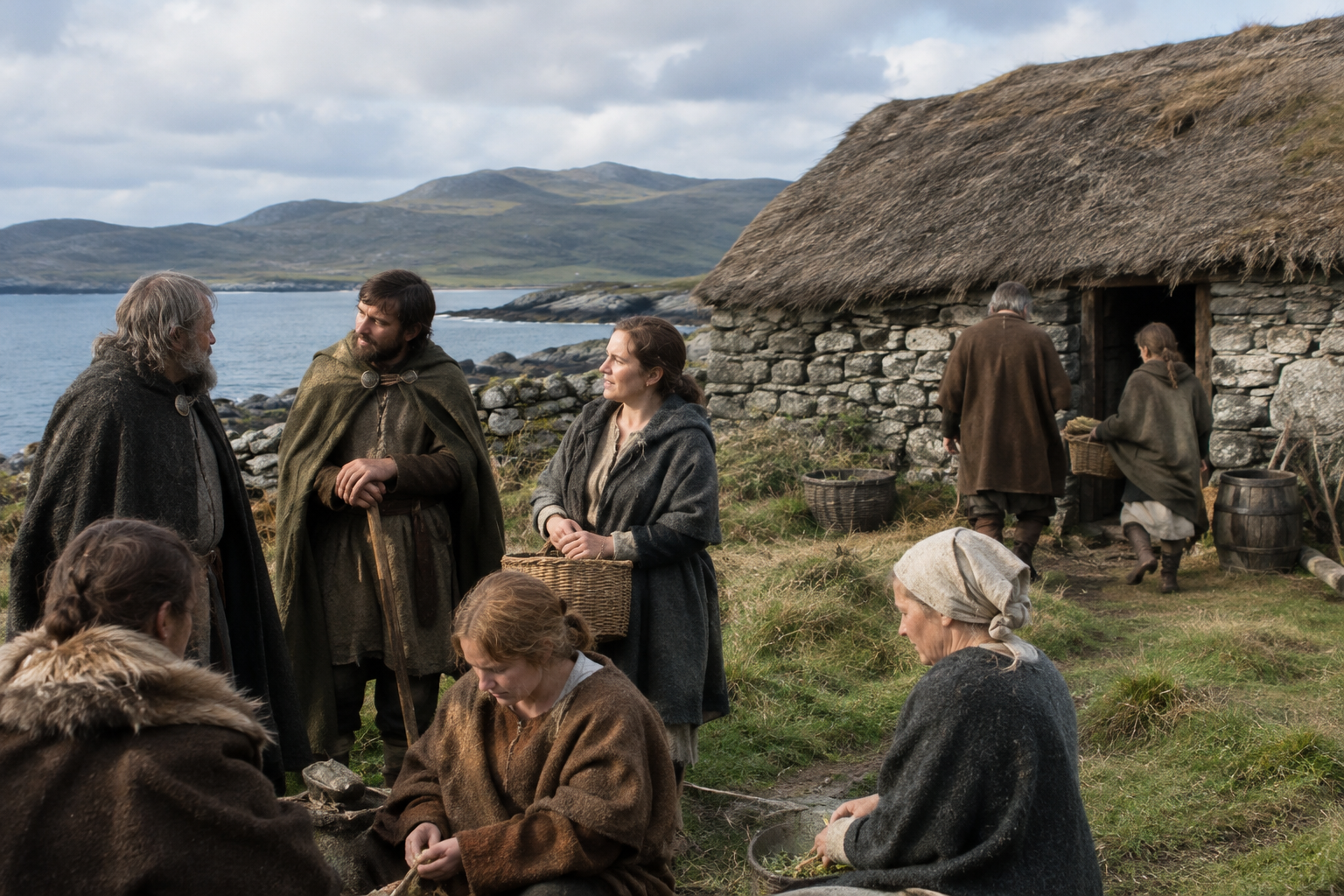
Some Y-chromosome lineages arrive in the historical record with trumpets and banners. Others slip in quietly, turning up not in royal pedigrees but in the bones of ordinary men buried in churchyards, monastery grounds, and town cemeteries. The very specific paternal branch R1b1a1b1a1a2c1a1a1a1a1a1a1 belongs to the second category. Its long string of letters and numbers may look forbidding, but it points to something very human: a direct male-line inheritance carried from father to son across many generations.
Like all Y-DNA haplogroups, this lineage tracks only one thread of ancestry, the strict paternal line. It does not describe a person's whole genetic background, still less a whole identity, clan, or nationality. But it can be historically revealing. In this case, the supplied ancient DNA evidence places this paternal branch in medieval Ireland with remarkable force, especially in County Donegal, and also in late medieval Belgium. That combination immediately makes the story interesting: here is a lineage rooted in the western Gaelic world, yet not confined to it.
This haplogroup is a very narrow downstream branch within the vast R1b family, one of the major Y-chromosome groupings found across western Europe. That broad fact matters, but with caution. The history of the large parent clade R1b cannot simply be pasted onto a much smaller descendant branch. Broad R1b lineages are often discussed in connection with later prehistoric movements in Europe, including Bell Beaker and Bronze Age expansions, but this particular subclade needs to be understood through the evidence actually in front of us.
And that evidence is medieval, insular, and strikingly local in one place above all: Ballyhanna, County Donegal. If we are looking for the historical landscape in which this lineage becomes visible, it is not first the steppe or a Bronze Age burial mound, but the churchyard of a Gaelic community in northwest Ireland.
Explore Celtic-language origins
The richest evidence supplied here comes from Ballyhanna in County Donegal, a medieval burial ground associated with the region later dominated by the O Donnells of Tir Chonaill. The chronology is important. Samples appear there in an earlier group dated 840 AD and again in a later concentration dated 1209 AD. That suggests not an isolated arrival, but continuing paternal presence across centuries in the same broad region.
Among the 840 AD group are individuals such as Sk197an, Sk197y, Sk197q, Sk197am, Sk197s, Sk197ab, Sk197u, and Sk197t, along with many others from the same Ballyhanna context, including HAN197x and HAN197. Even without inventing exact family ties between them, the clustering itself is revealing. We are looking at a medieval cemetery in which this paternal line was present repeatedly enough to leave a substantial archaeological footprint.
The later Ballyhanna phase, dated 1209 AD, is even more extensive. Samples including HAN197aq, HAN197ar, HAN197as, HAN197at, HAN197au, HAN197ba, HAN197bg, HAN197bh, HAN197bi, HAN197bj, HAN197bk, HAN197bl, and many more from the same site show that this was no passing episode. By the early 13th century, the lineage was still there in County Donegal, in a living community, not merely as a relic of some forgotten migration.
This is where ancient DNA is at its most useful. Written medieval genealogies tend to preserve the names of leading dynasties. Cemeteries preserve everybody else: the men who farmed, prayed, fought, traded, married, and died in the shadow of local churches and lordships. A Y-lineage appearing at Ballyhanna in both 840 AD and 1209 AD hints at regional continuity in paternal ancestry, even if it does not let us name a single dynasty with certainty.
The Irish evidence is complemented by earlier medieval material from Kilteasheen in Roscommon, including KIL041, KIL044, KIL033, KIL037, KIL009, and KIL014, dated 650 AD. Kilteasheen, described here as a bishop's seat, reminds us that the same broader paternal history may have been moving through ecclesiastical as well as secular landscapes. That matters in early medieval Ireland, where monasteries and church centers were major hubs of settlement, learning, burial, and regional power.
Read about Irish kinship and DNA
Then comes the small but intriguing continental clue: Late Medieval Belgium, St. Rombouts, 1553 AD, represented by STR129, STR129a, STR129b, STR129c, and STR129d. One must be careful here. These samples do not prove a direct link between Donegal and Belgium, nor do they prove one tidy migration story. But they do show that this paternal branch, or a very closely related one within the relevant classification, was not exclusively Irish.
That should not surprise us. Medieval and early modern Europe was mobile: clerics, merchants, soldiers, sailors, pilgrims, and settlers moved between coasts and towns more often than romantic nationalist history sometimes allows. Ireland, Scotland, the Irish Sea world, and the Low Countries were not sealed compartments. The presence of this lineage in both northwest Ireland and late medieval Belgium is best treated as evidence for a wider northwest European distribution rather than a single dramatic episode.
If you want the broader background to how archaeogenetics helps untangle such patterns, MyTrueAncestry's piece on Ancient DNA and the Rise of Archaeogenetics is well worth reading. It shows exactly why graveyards now matter as much to historians as chronicles once did.
Discover how archaeogenetics works
The movement from burial evidence to named families must be handled carefully. Ancient samples can show where a paternal line was present; later clan history shows the political societies that grew up in some of the same regions. The two are not the same thing. Still, once a lineage is so clearly anchored in medieval Donegal and the Gaelic west, it is worth looking at the noble houses and strongholds that belonged to that later historical landscape.
The clearest historical association in the supplied material is with Clann ODomhnaill, the O Donnells of Tir Chonaill. Their importance in late medieval and early modern Donegal scarcely needs exaggeration: they were one of the great Gaelic lordly families of northwest Ireland, ruling the territory in which Ballyhanna itself belongs. That does not mean the Ballyhanna men can be identified as O Donnells, nor that every bearer of the clan name shared this exact Y-line. It does mean that the haplogroup appears in the same regional world from which O Donnell power later emerged, a reminder that elite dynasties stood above wider local populations whose paternal lines also endured across centuries.
The Scottish names in the supplied material, Clan Ralston and Clan Lamont, widen that picture into the maritime Gaelic sphere of the western seaways. Clan Lamont is tied to Cowal in Argyll, one of those Highland districts where lordship, kinship, and sea travel mattered as much as roads or distant capitals. Clan Ralston, although better known as a Scottish surname group than as a great ruling dynasty, belongs to the same broad historical environment in which landed families, churchmen, and regional power-brokers shaped local society.
What links these names is not proof of one single pedigree stretching neatly from an excavated grave in Donegal to every later clan tradition. It is something more historically plausible and in its way more interesting: the recurrence of this paternal branch in a Gaelic and Irish Sea setting where communities were connected by coasts, lordships, monasteries, and seasonal movement across water. In that sense, the haplogroup sits comfortably within the world of Tir Chonaill, Argyll, and the western mainland and islands, even if genetics must stop short of crowning any one family as its exclusive representative.
The castles associated with these families make that later world tangible. For Clann ODomhnaill, Donegal Castle remains the most obvious landmark. Built in the 15th century by the O'Donnell clan who ruled Tir Chonaill, it later passed to Sir Basil Brooke after the English crown took control of the area. In the 17th century Brooke rebuilt much of it in a Jacobean style, so the structure now preserves both the Gaelic lordship that created it and the political transformation that followed conquest. For anyone interested in this haplogroup, Donegal Castle matters not because it proves descent, but because it stands in the same regional setting as the Ballyhanna burials where this paternal line is so strongly attested.
Further east along the seaways of the western Highlands, Saddell Castle on the east side of Kintyre in Argyll offers a rather different but equally revealing setting. Associated here with Clan Ralston, it was built in the early 1500s by David Hamilton, Bishop of Argyll, on the site of the old Cistercian abbey of Saddell. After passing through several hands and falling into ruin, it was restored in the 20th century by the architect and conservationist William Burrell. The result is a rare and handsome Scottish tower house rooted in the medieval history of the west coast, where ecclesiastical foundations, local lordship, and maritime movement all overlapped.
Castle Toward, linked here with Clan Lamont, shows how ancestral places can survive even when their present form is later than the medieval clan age. On the Cowal peninsula in Argyll and Bute, the site began as the seat of the Campbells of Toward, and in the nineteenth century a grand baronial house was built there for Kirkman Finlay. In the twentieth century it became a school and outdoor education centre, and after years of closure and debate over its future it was bought by the community for redevelopment. Its interest lies partly in that long afterlife: Highland places associated with clan memory were repeatedly adapted rather than simply abandoned.
Taken together, Donegal Castle, Saddell Castle, and Castle Toward map the kind of world in which later bearers of this haplogroup may have lived: not an abstract genetic zone, but a chain of real coastal territories where lordship, church influence, language, and local identity met one another across generations.
The most obvious historical family connection here is Clann ODomhnaill, the O Donnells of Donegal. Donegal Castle in Donegal Town was first built in the late 15th century by Red Hugh O Donnell, one of the great Gaelic lords of Ireland. It stood as a statement of power in Tir Chonaill, and later became a witness to catastrophe when the O Donnells fled in the Flight of the Earls in 1607. After that, Sir Basil Brooke reshaped much of the castle in Jacobean style, giving the building its mixed Gaelic and planter character.
The geographical connection is the key point. Ballyhanna lies in the same Donegal world as O Donnell lordship. That does not prove that the men buried at Ballyhanna were O Donnells, still less that this haplogroup can be assigned to the dynasty itself. But it does place the lineage in the same historical landscape from which O Donnell power later emerged. Genetics here provides context, not a titled pedigree.
Across the water in western Scotland, the supplied clan material points to a related Gaelic maritime zone rather than a separate universe. Saddell Castle in Kintyre, associated here with Clan Ralston, was built in the early 1500s by David Hamilton, bishop of Argyll, near the old Cistercian abbey of Saddell. Later it passed to the MacDonalds of Dunnyveg and became entangled in the fierce Campbell rivalries of the western Highlands. The story is pure Atlantic fringe politics: church power, sea routes, clan contest, and the long afterlife of tower houses after the old clan order waned.
Castle Toward, linked here with Clan Lamont on the Cowal peninsula, belongs to a later architectural age in its present form, with the grand mansion built in 1820 for Kirkman Finlay and enlarged in baronial style. Yet its site preserves memory of earlier Lamont associations and of the Highland west coast as a region where kinship, landholding, education, and reinvention all layered themselves on older foundations.
What joins Donegal, Kintyre, and Cowal is not a claim of one proven bloodline, but a shared seaboard history. These are places shaped by Gaelic lordship, clerical influence, maritime communication, and enduring local memory. A paternal lineage found repeatedly in medieval Donegal belongs comfortably in that world.
R1b1a1b1a1a2c1a1a1a1a1a1a1 is historically interesting not because it can be turned into a simplistic badge of identity, but because it shows how a direct paternal line can persist within a region across centuries while also appearing in a wider European setting. The Ballyhanna samples from 840 AD and 1209 AD make a particularly strong case for continuity in northwest Ireland. The Kilteasheen material broadens the Irish frame. The St. Rombouts samples remind us that lineages travel, intermingle, and refuse to stay inside the neat borders later historians draw on maps.
That is also why castles matter in this story. Donegal Castle, Saddell Castle, and Castle Toward do not prove anyone's haplogroup. What they do preserve is the political and cultural scenery in which paternal lineages lived on: lordships rose, churches held land, clans fought, plantations remade towns, and old strongholds became ruins and then monuments. Ancient DNA adds one more kind of evidence to that landscape, quiet but stubborn.
Readers interested in the Scottish side of that world may also enjoy the MyTrueAncestry article on Clan Lamont, which helps place Cowal and its later estates into the broader history of western Scotland.
Discover the history of Clan Lamont
If your Y-DNA falls on a branch like this one, ancient DNA comparisons can open a remarkable window onto the past, whether that past leads to medieval Donegal churchyards, Irish ecclesiastical centers, or the broader seaways of northwest Europe. Such matches do not by themselves prove direct descent from a particular ancient individual or noble family. But they can place your paternal line in a real historical setting populated by real people.
Upload your DNA to MyTrueAncestry and see whether your results connect you with ancient individuals such as HAN197aq, Sk197an, KIL041, or STR129, and with the wider historical landscapes their remains help illuminate.






Comments