Haplogroup R1b1a1b1a1a2c

– 6 min read


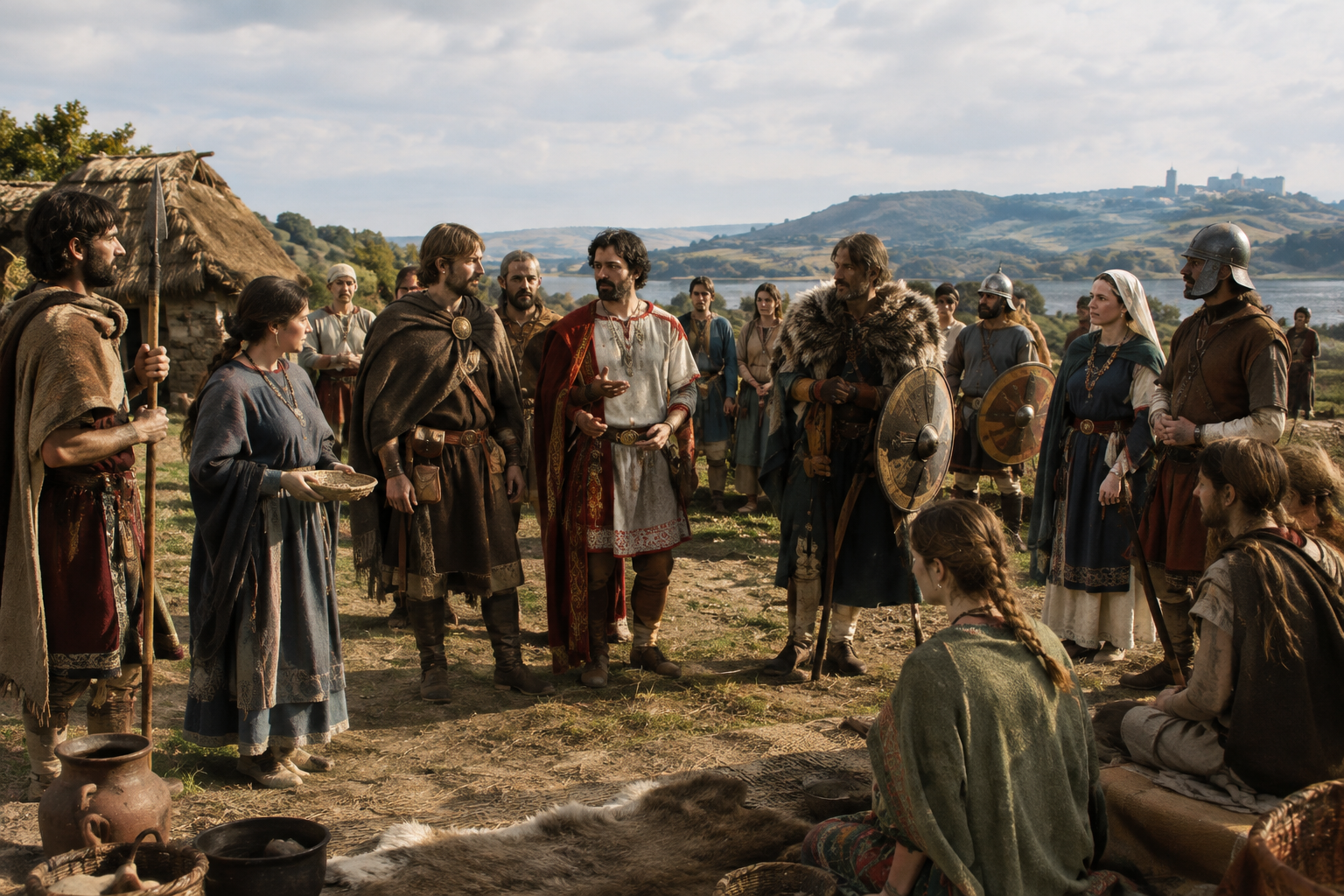
Some Y-chromosome lineages announce themselves with neat, simple stories. R1b1a1b1a1a2c does not. What makes it interesting is precisely that it turns up in a remarkable spread of ancient settings: an Early Bronze Age Yamnaya-associated burial in Hungary, Iron Age and Roman-period Britain, elite Celtic graves in Germany, northern Spain in the Visigothic and medieval periods, Pictish and later Scottish contexts, and even among later medieval and early modern Europeans. That is not the history of one tribe marching in a straight line. It is the history of a paternal branch moving through many worlds.
As always with Y-DNA, a small note of discipline is needed at the start. A Y-haplogroup traces one direct paternal line only: father to father to father. It does not represent a person's whole ancestry, still less their identity, language, class, or nationality. But used carefully, it can be extraordinarily revealing. In the case of R1b1a1b1a1a2c, the ancient DNA record places this paternal line within a wider western Eurasian and especially European story, one that touches Bronze Age mobility, Iron Age societies, Roman frontiers, and the medieval landscapes later dominated by kings, castles, and noble houses.
This haplogroup sits within the broad and historically important R1b family, a major Y-chromosome lineage in western Eurasia. For very specific branches such as R1b1a1b1a1a2c, however, one must be careful not to dump the entire history of all R1b lineages onto it. What the supplied evidence does support is that this branch was present across a belt stretching from Central Europe to Atlantic Europe over a very long period, with especially strong appearances in Britain, Gaul, Iberia, and adjacent regions.
One especially early clue is I3525, from Early Bronze Age Hungary Yamnaya Sarretudvari-Orhalom, dated 2450 BC. That does not prove this exact branch was "born" on the steppe, but it does place it in a world shaped by steppe-derived movements into Europe. From there, the picture becomes more recognizably European. Early Bronze Age samples in France such as SMGB54 from Saint-Martin-la-Garenne, Yvelines, Ile-de-France (2139 BC) and BRE445FK from les Pointes et les Grevottes, Greviandes, Aube (2339 BC) suggest that this paternal line, or very close kin branches, had already spread deep into western Europe.
That is the sort of pattern readers may want to compare with broader discussions of Bell Beaker and post-steppe movements in the Low Countries and neighboring regions.
By the Iron Age, R1b1a1b1a1a2c appears in contexts that would have looked very different on the ground, even if they were linked by long-term population history. In southern Germany, it appears in striking elite Celtic settings: APG001, APG001c, and APG003 from Asperg-Grafenbuehl (450 BC), and LWB001 and related entries from Ludwigsburg Roemerhuegel (450 BC). These are not anonymous peasants in the record. They belong to the archaeological world of high-status burials, where power was displayed in earth, timber, metalwork, and ceremony.
The same broad branch also turns up among communities around the Channel and North Sea. In Gaul and Belgica we find I21059 from Gallic Belgium Gallia Belgica Tongeren (35 AD), along with several Belgic and Gallic finds in France, such as CGG022464 from Bucy-le-Long (225 BC) and UN85 from the Gallic Venelli Tribe, Normandy Urville-Nacqueville (100 BC). In Britain the list becomes positively crowded: East Yorkshire Arras culture and Parisi burials, Durotriges burials in Dorset, and sites in Kent, Somerset, Oxfordshire, Cornwall, and Scotland.
That concentration matters. It suggests not an isolated intrusion but substantial local establishment in Iron Age Britain. The East Yorkshire evidence is particularly vivid: I36995, an Elite Celtic Parisi Chariot Burial at Wetwang Slack (225 BC), I5502 from High Status Parisi Nunburnholme Wold (100 BC), and a long series of Wetwang Slack, Pocklington, and Melton individuals. In southern Britain, Dorset contributes a cluster from the Durotriges world at Duropolis Winterborne Kingston, including WBK106, WBK12, and WBK41, all dated 125 AD.
This is where genetics helps correct old habits of thought. Iron Age Britain was not a frozen mosaic of "tribes" with fixed bloodlines. It was a lived landscape of related yet varied communities. A paternal branch can appear in elite graves, ordinary cemeteries, and later Roman-period burials without implying one single political identity.
For readers interested in the larger argument about how ancient genomics reshapes our understanding of Celtic-speaking Europe, this is worth following up.
The Roman and post-Roman evidence shows the lineage moving through an empire and surviving beyond it. In Roman Britain, we see FEN008 from Fenstanton, Cambridgeshire (100 AD) and VIC016 from Cambridge Vicars Farm (200 AD). On the continent there are Gallo-Roman and late antique finds such as the R2055a-e cluster from Metz Lunette Sablon (432 AD) and DNA031 from an Alemanni Grave, Basel-Waisenhaus (376 AD).
But perhaps the most striking long-duration regional cluster lies in northern Spain. At Las Gobas, the haplogroup appears repeatedly across centuries: ldo062 (620 AD), ldo039 (650 AD), and a substantial medieval group including ldo066, ldo037, ldo052, ldo242, ldo040 (all 1000 AD), and ldo046 and ldo048 (1025 AD). Whatever happened politically in Iberia - late Roman change, Visigothic rule, Islamic expansion, Christian frontier society - this paternal line clearly persisted in that northern region.
Other Iberian samples broaden the setting: I20382 from Early Visigothic Spain Girona Sarria de Ter Pla de lHorta (611 AD), I23276 from Late Roman Early Migration Spain Extremadura Merida Corralon de los Blanes (450 AD), and I30592 from Early Medieval Spain Zaragoza Epila Las Lomas del Molino (600 AD). Taken together, they show that this paternal branch belonged comfortably to the mixed, mobile, and regionally varied populations of late antique and medieval Iberia.
If that Iberian story catches your attention, there are obvious neighboring themes to explore in the community's work on Roman and post-Roman Spain.
The British and Scottish record gives this haplogroup an unusually long local horizon. There are Bronze Age finds such as I2565 from Amesbury Down, Wiltshire (2287 BC), KD061 from Bronze Age Orkney Westray Links of Noltland (1498 BC), and KD041 from West Heslerton, North Yorkshire (1800 BC). Later come Iron Age and Pictish-era examples in Scotland, including KD001 and related entries from Rosemarkie Cave, Black Isle (541 AD) and CGG018915 from Pict Era Scotland Orkney Mine Howe (115 AD).
This does not prove an unbroken father-to-son line from Bronze Age Westray to medieval Scottish royalty - that would be absurdly overconfident. But it does provide deep regional context for why a paternal lineage of this sort could later be part of Scotland's medieval population landscape.
That is where Dundonald Castle becomes evocative. Standing in South Ayrshire on a hill already marked by an Iron Age fort and later a Norman motte, the great stone castle was built in the late 1300s for Robert Stewart, later King Robert II of Scots. Its significance lies not in offering genetic proof, but in showing how later dynasties occupied landscapes already thick with much older human history. The Stewarts did not build in a vacuum; they built on ground where power had been staged for centuries.
Something similar may be said, in a different register, for Hampton Court Palace. Begun by Cardinal Thomas Wolsey in the early 1500s and transformed by Henry VIII into a grand Tudor residence before later Baroque rebuilding under William III and Mary II, it represents the mature monarchy of England rather than its prehistoric roots. Yet the men who walked its courts, staffed its kitchens, and served its kings belonged to populations whose paternal lines often reach far deeper into Britain than any written pedigree. Y-DNA reminds us that beneath Tudor spectacle there are older, humbler, and more durable histories.
Readers drawn to the Scottish dynastic angle may enjoy comparing this broader regional picture with one of the community's house and clan studies.
What, then, does this haplogroup reveal? First, it points to a paternal line with a long and well-attested presence across parts of Europe, especially in regions tied to Bronze Age expansions, Iron Age Celtic societies, Roman provincial life, and medieval western Europe. Second, it shows how one lineage can persist through enormous cultural change: chariot burials, Roman farms, Visigothic communities, Pictish caves, monasteries, castles, and courts.
What it cannot do, on its own, is assign you to a tribe, prove descent from a king, or certify membership in a noble family. Sharing a haplogroup with an ancient individual such as I3525, I36995, or ldo066 means you share a paternal branch somewhere in the deeper past. It does not mean they were your direct genealogical ancestor in any simple sense.
That, in the end, is why this evidence is so compelling. Ancient DNA does not replace history; it sits beside archaeology, documents, landscapes, and family tradition, sometimes confirming, sometimes complicating, always enlarging the picture.
If you want to see whether your own DNA connects you with ancient individuals from Bronze Age Britain, Iron Age Celtic Europe, Roman Iberia, or medieval Scotland and Spain, MyTrueAncestry can help you explore those links. The results may not prove descent from a castle-building dynasty, but they can open a much older and often more interesting window onto your past.






Comments