Haplogroup R1b1a1b1a1a2b3a

– 4 min read


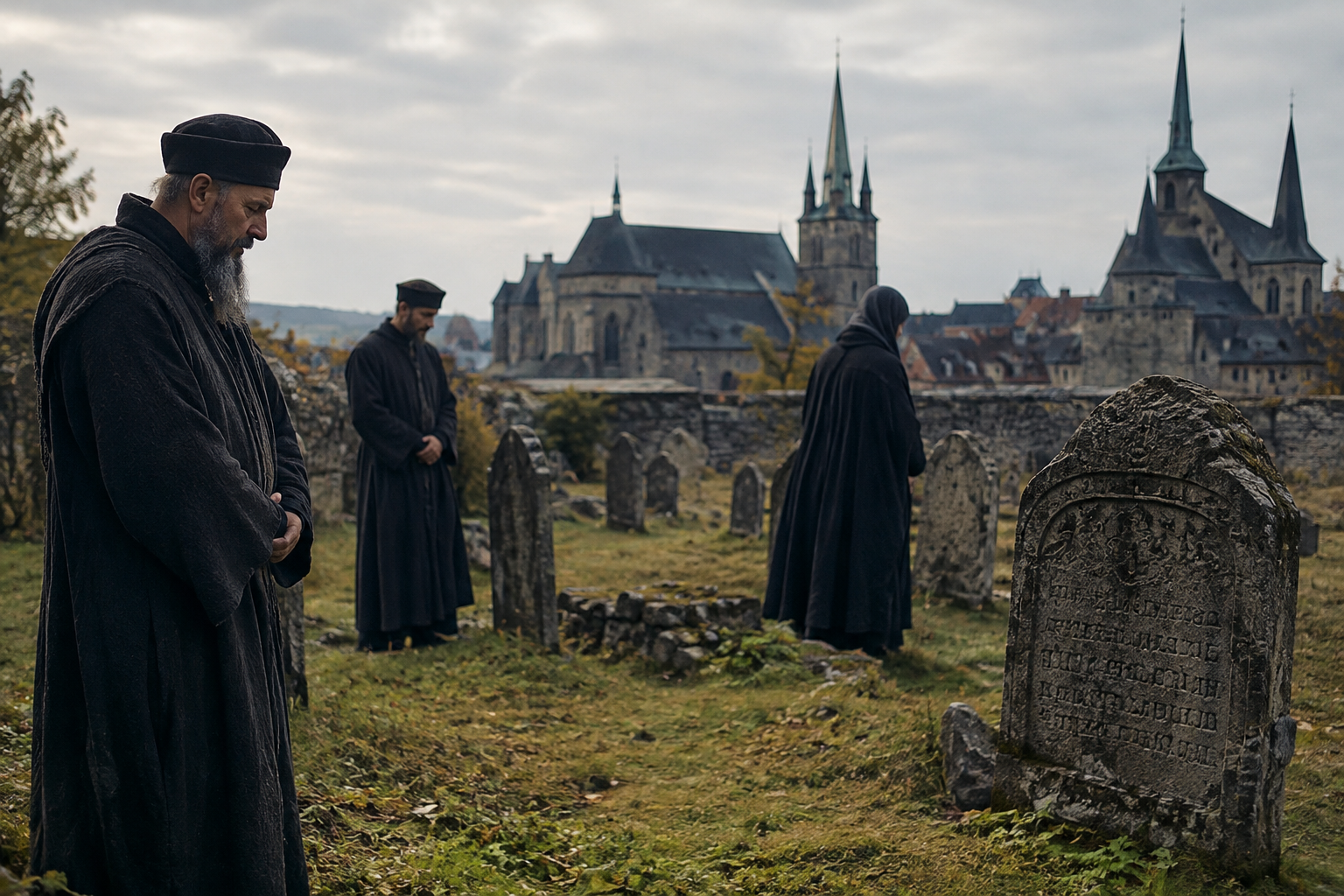
In about AD 1350, a man identified as I13868 was buried in the Jewish cemetery at Erfurt in central Germany. He is the only ancient individual supplied here for the Y-DNA haplogroup R1b1a1b1a1a2b3a, and that immediately makes him interesting: not as a lone "founder" of anything grand, but as a rare fixed point where a very specific paternal line meets a historically documented medieval community.
Erfurt was no marginal place. In the later Middle Ages it was a busy commercial city, tied into the routes of central Europe, and home to one of the most important Ashkenazi Jewish communities in the German lands. A direct paternal lineage like Y-DNA traces only one line of descent, father to son, rather than a person's whole ancestry, but even that single line can be revealing when it turns up in a well-dated cemetery with a known historical setting.
The sample I13868 comes from the late medieval Ashkenazi cemetery at Erfurt, dated here to around AD 1350. That date places him in a period of extraordinary strain for Jewish communities across Europe: the age of plague, accusation, expulsion, and violence, but also of established scholarship, trade, and urban life. Erfurt's Jewish history is especially poignant because archaeology and written sources together show both a flourishing community and its abrupt ruptures.
What makes this cemetery so important is that it gives ancient DNA a proper historical frame. We are not dealing with a vague "medieval central European" male pulled from an uncertain context. We are dealing with a burial from a specifically Ashkenazi setting in a major German city, which lets the haplogroup be discussed where it belongs: inside the social history of medieval Jewry, not outside it.
An ancient DNA study on the Erfurt community, available at https://www.biorxiv.org/content/10.1101/2022.05.13.491805v1, helped bring this cemetery into the wider conversation about Ashkenazi population history. Even without overstating any one individual's importance, the broader value of such work is clear: it anchors genetic patterns in named places and real communities rather than in modern assumptions.
Medieval Jewish DNA in Tàrrega
The designation R1b1a1b1a1a2b3a is a very narrow branch within the much larger Y-DNA macro-lineage commonly called R1b. That wider family is widespread in western Eurasia, but one must be careful here: the history of the big parent branch is not automatically the history of this exact subclade. A medieval man in Erfurt carrying R1b1a1b1a1a2b3a does not, by himself, tell us when this precise branch entered Jewish populations, where it first formed, or whether it was common or rare among Ashkenazim.
Still, the finding matters. Jewish communities in medieval Europe were never genetically isolated in some timeless or simplistic sense. They were shaped by earlier Near Eastern roots, European admixture, bottlenecks, local founder effects, and the complicated demographic history of diaspora life. A lineage like R1b1a1b1a1a2b3a sitting in an Ashkenazi cemetery reminds us that paternal ancestry within Jewish populations, too, could be varied and historically layered.
By the 13th and 14th centuries, Ashkenazi communities in the Holy Roman Empire had already developed a distinctive religious, linguistic, and communal identity. Cities such as Erfurt were part of that world: places of residence, commerce, rabbinic learning, taxation, negotiation, and periodic danger. Archaeology gives us the material traces of these lives; genetics gives us another, narrower form of continuity.
In that sense, I13868 is valuable precisely because he is not presented as a prince, a warrior, or a legend. He is a member of a medieval urban community whose descendants, in cultural if not direct genealogical terms, helped shape later Ashkenazi history across central and eastern Europe. The paternal line R1b1a1b1a1a2b3a is therefore best understood here as one strand within that communal history, not as a badge of ethnicity on its own.
Readers sometimes assume that a single ancient sample can do only a little. In one sense that is true: one burial cannot stand for all Ashkenazi men, all medieval Germans, or all carriers of R1b1a1b1a1a2b3a. But in another sense, a single well-contextualized burial can do quite a lot. It can show that a specific paternal branch was present in a specific community at a specific time, and that is already a solid historical claim.
For genealogists, this matters because medieval Jewish history is often difficult to reconstruct through documents alone. Wars, expulsions, massacres, later migrations, and the patchiness of records all break the trail. Ancient DNA from cemeteries such as Erfurt cannot fill every gap, but it can provide hard evidence that certain lineages were part of Ashkenazi life in central Europe before the great later dispersals eastward and beyond.
It also places personal ancestry in a less romantic, more interesting frame. The real story is not that a haplogroup "belongs" to one people forever. The real story is that lineages travel through households, congregations, cities, and crises, picking up history as they go.
Kinship and marriage in ancient genomes
Placed against the wider medieval map, Erfurt sits in a zone where trade, language, religion, and movement overlapped constantly. Central Europe was not merely a corridor for armies and rulers; it was also a landscape of market towns, learned communities, minority quarters, and long-distance family networks. Jewish communities were part of that world, at once rooted and mobile.
That wider setting is important for interpreting R1b1a1b1a1a2b3a. A paternal lineage found in Erfurt may reflect much older population processes, but the evidence in hand ties it firmly to late medieval Jewish central Europe. The cautious historian stops there unless more ancient or medieval samples appear. The exciting part is not pretending to know too much; it is recognising how much one securely dated burial can add to the map.
How archaeogenetics reads history
For someone researching the haplogroup R1b1a1b1a1a2b3a today, the clearest ancient anchor supplied here is late medieval Erfurt and sample I13868. That does not prove a modern family line descends from this man, nor does it reduce a whole ancestry to one paternal branch. But it does show that this lineage was present in a documented Ashkenazi community in Germany around AD 1350, which is a historically meaningful clue and a rather vivid one.
In other words, this haplogroup enters the historical record not in mythic prehistory or aristocratic pageantry, but in a real cemetery belonging to a literate, urban, vulnerable, resilient community of medieval Europe. That is quite enough to make it worth attention.






Comments