Haplogroup R1b1a1b1a1a2b3

– 5 min read


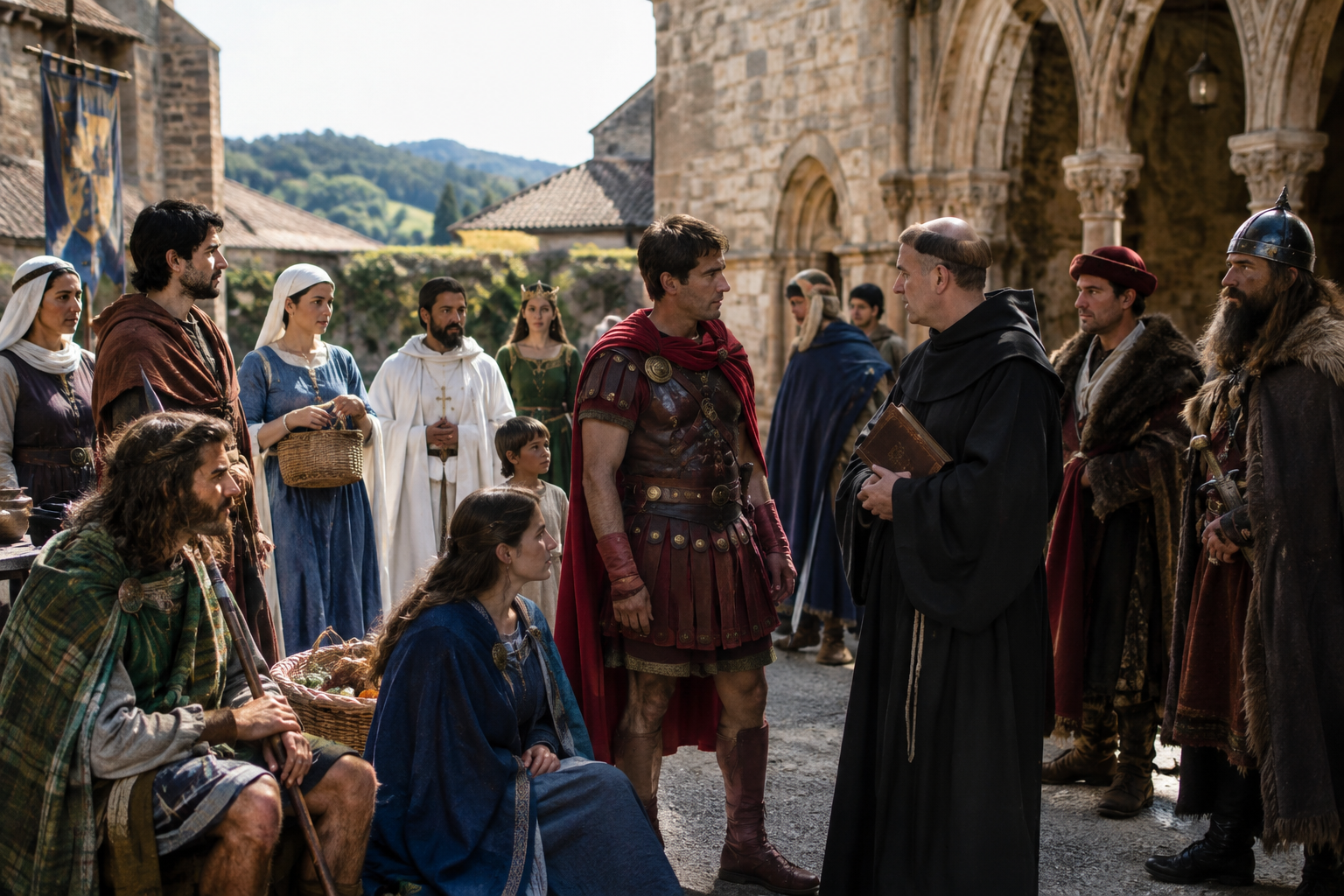
Some Y-chromosome lineages announce themselves with a neat, single historical label. This one does not. Haplogroup R1b1a1b1a1a2b3 appears instead like a trail of footprints across a great deal of Europe: Bronze Age central Europe, Iron Age Celtic contexts, Roman and post-Roman mobility, medieval Iberia, and even later elite burials. That is precisely what makes it interesting. Rather than belonging to one tidy people or one famous kingdom, it seems to sit inside a much broader western Eurasian paternal story.
As always, a caution worth making early: Y-DNA traces only one direct paternal line, father to father to father. It does not describe a person's whole ancestry, culture, language, or identity. And with a subclade as specific as R1b1a1b1a1a2b3, we should be especially careful not to pour the entire history of broad R1b straight into this narrower branch. Still, ancient DNA lets us do something marvellous. It allows us to watch related paternal lines appear in real graves, in real landscapes, over thousands of years.
The larger haplogroup R1b is one of the major paternal lineages of western Europe today, and ancient DNA has shown that branches of it became widespread in many parts of Europe after prehistoric population shifts connected with the later Neolithic, Copper Age, and Bronze Age. For a downstream branch such as R1b1a1b1a1a2b3, the safest approach is not to assign a single origin story too confidently, but to look at where its ancient occurrences cluster.
Here the pattern is suggestive. We find relevant ancient samples in central Europe during the Bronze Age, then in Iron Age Celtic settings in Germany, Bohemia, France, and Britain, and later in Roman, post-Roman, and medieval contexts stretching from Iberia to Hungary. That does not prove one continuous elite bloodline marching through history. What it does suggest is that this paternal branch belonged to populations deeply involved in the making of later European societies, especially those tied to the broad cultural zones of central and western Europe.
Explore Celtic origins in ancient DNA
Some of the earliest signposts come from Bronze Age central Europe. Samples LEU024 and LEU025 from Unetice-era Leubingen-Sommerda in Thuringia, dated to 1950 BC, place this lineage's wider story in one of the formative regions of Bronze Age Europe. There are also early central European appearances in Bohemia, such as MIB054 and MIB054d dated to 2500 BC, and Bell Beaker or early Bronze Age material from the Netherlands including I4073, I4074, I4069, and I13028. These do not all prove the exact same narrow branch was already fixed everywhere, but they show the paternal world in which such lineages flourished.
By the Iron Age, the evidence becomes especially vivid. At Asperg-Grafenbuehl in Germany, elite Celtic burials dated to 450 BC include APG001, APG001c, and APG003. Nearby Ludwigsburg Roemerhuegel produced LWB001, LWB001_ss, and LWB001_ss_b, also dated to 450 BC. These are exactly the sort of burials that remind us how much of early European history survives not in chronicles but in mounds, grave goods, and now chromosomes.
The pattern continues across the La Tene world and its neighbours: CGG021735, CGG021736, CGG021839, and CGG021846 from Iron Age Bohemia and Radovesice; CGG022421, CGG022464, and CGG022458 from Gallic and Belgic France; and a remarkable cluster in Iron Age Yorkshire, where Parisi and related burials such as I36965, I36968, I37333, I21861, I21864, and I5502 show this paternal signature in eastern Britain. One begins to see not a single tribe but a belt of connected worlds across temperate Europe.
Discover Iron Age Britain through DNA
Then comes the Roman and post-Roman complication, which is to say, people moving everywhere. Sample FEN008 from Roman-era Fenstanton, Cambridgeshire, dated to 100 AD, and the Durotriges individuals WBK35, WBK36, and WBK39 from Winterborne Kingston, dated to 125 AD, show the lineage in Roman Britain. On the continent, Gallo-Roman Metz offers a small cluster - R2055a, R2055b, R2055c, R2055d, and R2055e, all dated to 432 AD - while DNA031 from an Alemanni grave at Basel-Waisenhaus dated to 376 AD hints at its place in frontier populations of late antiquity.
Italy is no less interesting. There are Etruscan and Italic-context samples such as R10344 from Tarquinii dated to 460 BC, several individuals from archaic Felsina in Bologna including I37267, I37268, and I37290, and later samples like COL_098b from Lombard-era Collegno dated to 580 AD. None of this means the haplogroup was "Etruscan" or "Lombard" in some essential sense. It means paternal lineages of this family could be found in very different cultural settings, which is exactly what long-term continuity and mobility often look like.
Iberia deserves special notice. There are Bronze Age examples from Murcia and surrounding regions - ALM040, ALM047, ALM069, ALM078, ALM080, MDP003, and even earlier southeastern Iberian material such as BAS002 and BAS026. Later, we find I20382 in early Visigothic Girona dated to 611 AD, I23276 in late Roman to early Migration-period Merida dated to 450 AD, and I30592 in early medieval Zaragoza dated to 600 AD. Most striking of all is Las Gobas in northern Spain, where ldo062 dated to 620 AD, ldo066 and ldo037 dated to 1000 AD, and ldo048 dated to 1025 AD suggest a real thread of regional continuity across centuries.
Read about Roman Hispania's genetic legacy
The medieval and early modern record gives this haplogroup a particularly human dimension. In Hungary, the Royal House of Aba appears in two samples from a Benedictine monastery: HUASper81, dated to 1405 AD, and HUASper55B, dated to 1500 AD. Nearby in the wider Carpathian Basin are related post-Roman and migration-period samples such as RKO001, RKF253, SZL025, SZL032, SZL072, and GHD023. These finds are a useful reminder that paternal lineages can pass through royal and noble environments without becoming exclusive to them.
The same caution applies to later dynasties. The supplied noble association here is the Spanish House of Bourbon. That does not, by itself, prove that every Bourbon king carried this exact Y-DNA branch, nor that the haplogroup defines the dynasty. But it does give us a fascinating historical stage on which to think about Iberian paternal history. The Royal Palace of Madrid stands on a site layered with power: first a 9th-century Muslim fortress, then a Castilian royal stronghold, then the Habsburg Alcazar, destroyed by fire in 1734. Philip V, the first Bourbon king of Spain, ordered a new stone palace in 1738, designed by architects including Filippo Juvarra, Giovanni Battista Sacchetti, and Francesco Sabatini. The result was not simply a residence but an argument in masonry about dynastic permanence.
And yet, from the perspective of ancient DNA, permanence is never quite what it seems. Beneath Bourbon ceremony lies a much older Iberian story, visible in sites like Las Gobas, Merida, Girona, and Bronze Age Murcia. The palace preserves the history of Spanish kingship; the graves preserve the deeper demographic history of the peninsula.
Explore the Spanish House of Bourbon
If there is a lesson in R1b1a1b1a1a2b3, it is that paternal ancestry is best understood geographically and historically, not romantically. This lineage appears in Bronze Age central Europe, in elite Celtic burials, in Roman provincial cemeteries, in post-Roman frontier zones, in medieval Spain, and in later noble contexts. That spread points to durability, mobility, and integration into many different societies.
It does not prove that everyone with this haplogroup descends from a Celtic prince, a Visigoth, a Bourbon, or a Hungarian noble house. Shared haplogroups can unite men separated by vast stretches of time, place, and social status. What ancient DNA offers is something subtler and, in truth, more interesting: the chance to place one paternal line within the great untidy history of real populations.
If Madrid and northern Spain especially catch your eye, there is more to explore in the community's coverage of early medieval Iberia and urban diversity.
See 7th-century Madrid through ancient DNA
MyTrueAncestry lets you compare your DNA with ancient individuals like ldo062 from Las Gobas, APG001 from Iron Age Germany, or FEN008 from Roman Britain, and with the wider populations that shaped Europe. Those matches do not automatically prove direct descent or membership in a royal house, but they can offer a vivid new perspective on where parts of your ancestry may fit in the long human story.






Comments