Haplogroup R1b1a1b1a1a2b2

– 6 min read


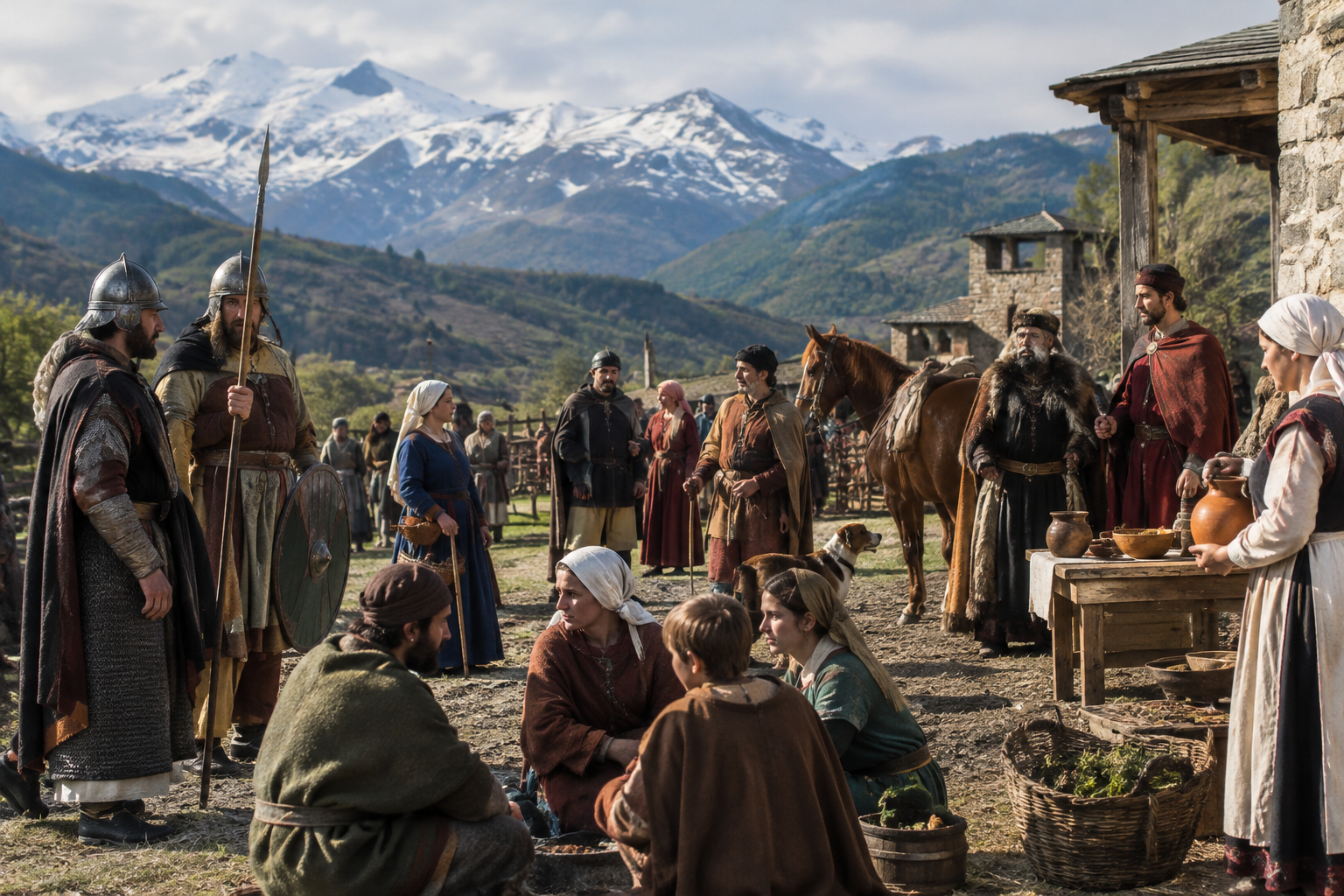
Some Y-DNA haplogroups are known from a handful of places and periods. Others seem to turn up almost maddeningly everywhere: in Bronze Age central Europe, among Iron Age communities in Britain and Gaul, in Roman and post-Roman burials, in medieval Spain, Italy, Ireland, and beyond. Haplogroup R1b1a1b1a1a2b2 belongs to that second sort of story. Not because one narrow branch can be made to stand for all of Europe - it cannot - but because the ancient samples associated with this lineage point to a paternal history spread across a remarkably wide historical landscape.
That is exactly what makes it interesting. Y-DNA traces only one line of descent: father to son to son. It does not describe a person's full ancestry, culture, language, or identity. But when the same paternal branch, or closely related branches, appear in graves from different centuries and regions, they give us a way to watch male-line continuity and movement through time. In this case, the evidence suggests a lineage deeply tied to western and central Europe, later visible in Celtic, Roman, early medieval, and noble contexts.
This subclade sits within the large and historically important haplogroup R1b, one of the best-studied paternal lineages in Europe. The broad history of R1b includes major prehistoric expansions, especially during the later Neolithic and Bronze Age, but one must be careful here: the sweeping story of all R1b is not automatically the story of every much narrower descendant branch.
What the sample set does allow us to say is that lineages connected to R1b1a1b1a1a2b2 appear across a long arc of European history. Some of the earliest relevant signals in the list come from Bronze Age contexts in central and western Europe: MIB054 and MIB054d from Bronze Age Bohemia, dated 2500 BC; LEU024 and LEU025 from Bronze Age Unetice Thuringia Leubingen Sommerda Germany, dated 1950 BC; and Bell Beaker-associated or closely related contexts such as I4073, I4069, and I4074 from De Tuithoorn in North Holland, dated 2080 BC.
That spread matters. It places this paternal story in regions strongly associated with the demographic changes of later prehistoric Europe, especially those connected with Bell Beaker and early Bronze Age societies. That does not prove a single tidy migration route for this exact branch, but it does suggest that its deeper roots belong in the reshaping of European paternal ancestry that followed those transformations.
Explore Celtic origins in ancient DNA
By the Iron Age, the trail becomes especially vivid. In southern Germany, several elite Celtic burials stand out: APG001, APG001c, and APG003 from Asperg-Grafenbuehl, all dated 450 BC, along with LWB001, LWB001_ss, and LWB001_ss_b from Ludwigsburg Roemerhuegel, also 450 BC. These are not anonymous dots on a map. They come from high-status La Tene world contexts, where burial display, warrior identity, and aristocratic power were written into the landscape.
The same broad paternal thread appears again in Iron Age Britain. East Yorkshire alone offers a formidable cluster: I37333, I36965, I36968, I36761, I21861, I21864, I21642, I21259, I21613, and others from Wetwang Slack, Pocklington, and Melton, mostly around 225 BC to 127 BC. Add to these I5502, a high-status Parisi burial from Nunburnholme Wold dated 100 BC, and I50137, an elite Celtic chariot burial from Ferry Fryston dated 237 BC, and we begin to see something more than scattered coincidence. This paternal lineage, or near relatives of it, was present in the male lines of Iron Age communities from central Europe to Britain.
That does not mean "this is the Celtic haplogroup" - history is never so obliging. But the archaeological settings do suggest that branches of this paternal family were well established in regions shaped by Celtic-speaking societies and La Tene cultural influence.
The Mediterranean evidence is equally intriguing. In Italy, the lineage appears in Archaic Etruscan Felsina at Bologna through samples including I38924, I35799, I37267, and I37403, dated roughly 650 BC to 500 BC, and in Gallic Cenomani burials at Verona through 3206n, 3217n, and 3298, dated 300 BC. So this was not a paternal line confined to one language family or one political sphere. It moved through a Europe of overlapping worlds: Etruscan, Gallic, Brittonic, and later Roman.
The Roman period and its aftermath often complicate paternal history, because empires move men around. Here too the evidence is strikingly broad. We see FEN008 in Roman Era Fenstanton Cambridgeshire, dated 100 AD; WBK36 in a Celtic Durotriges context at Duropolis Winterborne Kingston, dated 125 AD; R2055a through R2055e in Gallo-Roman Metz Lunette Sablon, dated 432 AD; and DNA031 from an Alemanni grave in Basel-Waisenhaus, dated 376 AD.
Then comes the churn of late antiquity and the early medieval centuries. In Pannonia and neighboring regions, samples such as SZL025, SZL072, GHD023, RKO001, and RKF253 show the lineage in post-Roman and Longobard-era settings. In Italy, it appears in Lombard or dark-age contexts like COL_098b from Collegno, dated 580 AD, and Bard_T2, Bard_T8, Bard_T12, and Bard_T7A from Bardonecchia, dated 650 AD.
Iberia offers one of the clearest signs of continuity. At Las Gobas in northern Spain, the branch appears repeatedly across centuries: ldo062 dated 620 AD, ldo066 and ldo037 dated 1000 AD, and ldo048 dated 1025 AD. That sequence does not prove the same family line endured unchanged on one farm or in one village, but it strongly suggests that this paternal lineage had become embedded in local medieval populations. Other Iberian samples, such as I20382 from early Visigothic Girona dated 611 AD, I23276 from Merida dated 450 AD, I30592 from Zaragoza Epila dated 600 AD, and I19990 from Late Iron Age Cantabrian Spain dated 80 BC, show how varied the Iberian record really is.
Explore Roman Hispania's legacy
The British and Irish evidence is especially useful for readers interested in later regional history. Early medieval and medieval Britain includes CRG008 from Cambridge Croft Gardens, dated 600 AD; I14535 from Bishopstone in Sussex, dated 600 AD; I20607 from Apple Down near Chichester, dated 550 AD; LAK003 from Lakenheath, dated 650 AD; S17277 from Hartlepool, dated 750 AD; and later medieval individuals such as ATP_PSN_1155 from Cherry Hinton, dated 1300 AD, and ATP_PSN_1217 from Clopton, dated 1561 AD.
In Ireland, a notable cluster comes from Kilteasheen in County Roscommon: KIL047, KIL032, KIL035, KIL024, KIL002, and KIL004, all dated around 650 AD. Such a concentration reminds us that paternal lineages can become strongly localized, recurring within the same district over generations.
This is where castles and clan memory enter the picture - not as genetic proof, but as later historical frameworks layered over older landscapes. Near Athleague in County Roscommon, Castlestrange House, associated here with Clan Strange, belongs to the later story of landed estates. But the place is famous above all for the Castlestrange Stone, an Iron Age boulder carved in swirling La Tene style. It is a splendid reminder that long before estate houses and surnames, this Roscommon landscape already belonged to a world of status, symbolism, and display. For a haplogroup with clear Iron Age and early medieval Irish presence, that is a tantalising geographical echo - contextual, not genealogical, but meaningful all the same.
In Scotland, Alloa Tower in Clackmannanshire, seat of Clan Erskine, carries the story forward into the later medieval and early modern age. Begun around the 14th century and enlarged in the 15th, it became bound up with the Erskines' rise and their role in royal politics, especially when Mary Queen of Scots entrusted the infant James VI to the Earl of Mar. The tower's survival through later fires and decline makes it a fine metaphor for historical continuity itself. A Y-DNA lineage may persist quietly in the male line while dynasties rise, fortunes fall, and buildings are altered, burned, restored, and reimagined.
Still, caution is essential. The appearance of this haplogroup in ancient Britain and Ireland does not prove that the Erskines, the Stranges, or every man in those kindreds carried it. Noble families are historical associations here, not genetically certified conclusions.
Discover the story of Clan Erskine
R1b1a1b1a1a2b2 is a good example of how ancient DNA changes the way we think about ancestry. Traditional genealogy works from documents backward, often stopping in the late medieval period if one is unlucky, or the early modern period if one is fortunate. Ancient DNA works differently. It shows that paternal lineages can be tracked in broad outline across far deeper time, through Bronze Age cemeteries, Iron Age chariot burials, Roman provincial towns, post-Roman frontier zones, and medieval villages.
The real lesson is not that one haplogroup "belongs" to Celts, Romans, Visigoths, Lombards, Scots, or Irish nobles. Rather, it is that paternal lines survive political upheavals and cultural changes. Men carrying related branches of this lineage could be found in Unetice Germany, La Tene Germany, Parisi Yorkshire, Etruscan and Cisalpine Italy, Visigothic and medieval Spain, and monastic or settlement contexts in Ireland. That is a historical fact far more interesting than any crude ethnic label.
If this is your haplogroup, or one close to it, MyTrueAncestry may help you place your direct paternal line into that wider human story. Ancient DNA matches do not prove direct descent from a named warrior, monk, nobleman, or castle lord. But they can show that your line belongs to the same long historical landscape.
Upload your DNA to MyTrueAncestry and see whether your ancestry connects you with ancient individuals like APG001, I5502, ldo062, or the men of Kilteasheen and Las Gobas - real people from the archaeological record, whose remains now help illuminate Europe's paternal past.






Comments