Haplogroup R1b1a1b1a1a2b1d1

– 6 min read


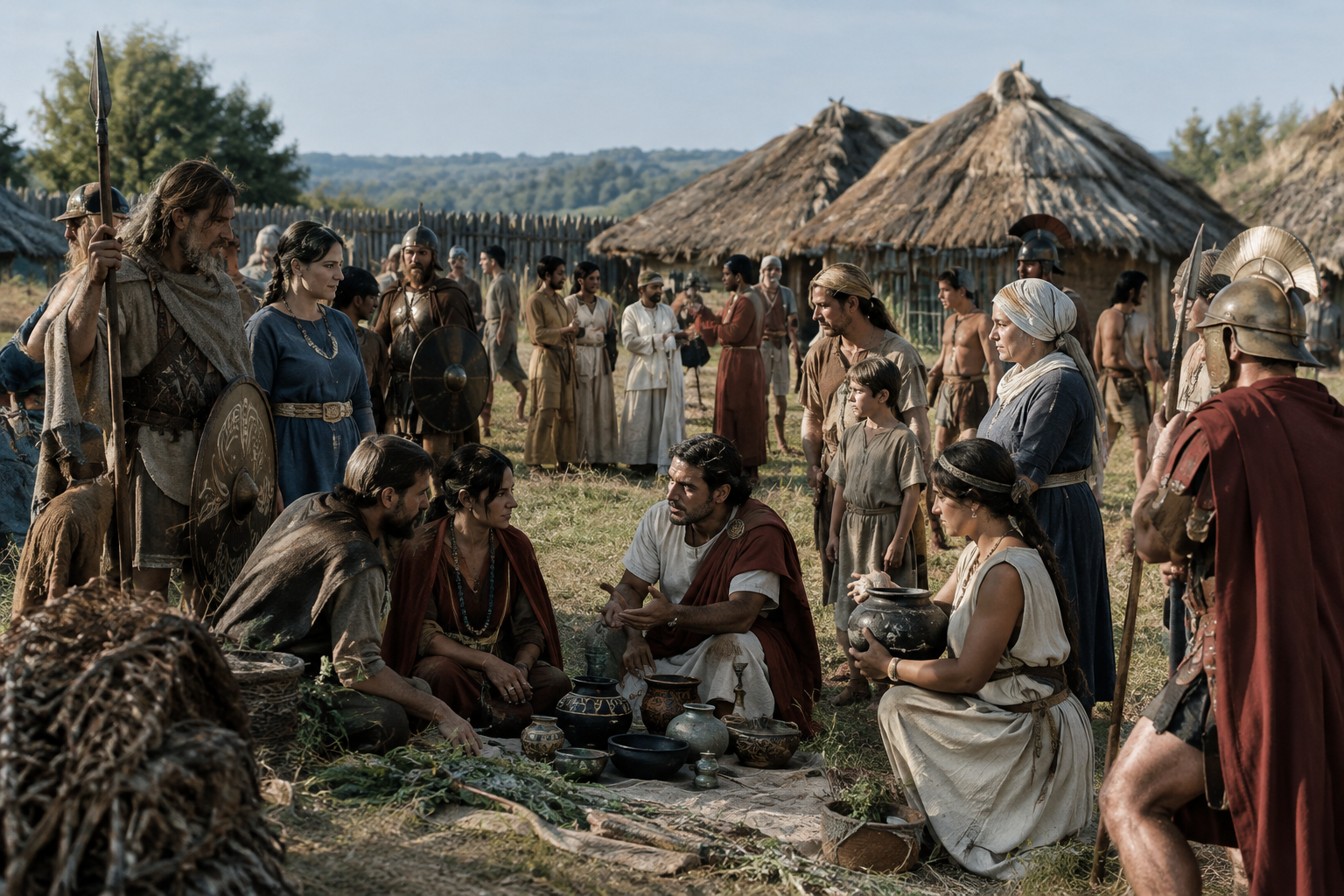
Some Y-chromosome lineages announce themselves with a neat, tidy story. Haplogroup R1b1a1b1a1a2b1d1 does not. What makes it interesting is precisely that it appears across a remarkably wide historical stage: Copper Age and Bronze Age central Europe, Iron Age Celtic settings, Etruscan and Roman Italy, parts of the Balkans, Britain, and even later medieval contexts. That does not mean one simple people, one kingdom, or one ethnicity. It means that one paternal branch, or close related branches around it, was carried by men who lived in very different worlds.
That is worth pausing over. A Y-DNA haplogroup traces one direct paternal line only: father to father to father. It is not your whole ancestry, nor a shortcut to a full historical identity. But it can be extraordinarily useful. In the case of R1b1a1b1a1a2b1d1, the ancient DNA record points us toward a story rooted broadly in the long expansion of R1b lineages in later prehistoric Europe, then reshaped by Bronze Age mobility, Iron Age regional societies, and the dense traffic of the Roman and medieval worlds.
This very specific subclade sits deep within the wider R1b tree, one of the major paternal lineages of western Eurasia and especially important in later prehistoric and historic Europe. For a branch as narrow as R1b1a1b1a1a2b1d1, caution is essential. We should not lazily pour the entire history of all R1b into it as if nothing changed along the way. Still, the supplied ancient samples do suggest that closely related paternal lines were already well established in central Europe by the Copper and Early Bronze Age.
Bell Beaker and related Copper Age contexts are an obvious starting point. Samples from Brandysek in Czechia, such as I7249, I7249x, I7278, I7278x, I7271, I7251, I7269, I7276, and I7275, place this lineage cluster in one of the key zones of later 3rd millennium BC Europe. Nearby Copper Age finds from Radovesice, Prague Jinonice, Lochenice, and Velke Prifelpy reinforce that central European setting. These are not merely dots on a map; they belong to the period when new burial customs, metalworking networks, and far-reaching social ties were remaking much of Europe.
Explore Central European Celtic Origins
By the Early Bronze Age, the pattern becomes even denser. Unetice-associated burials from Leubingen Sommerda in Thuringia, including LEU055, LEU056, LEU051, LEU060, LEU015, LEU012, LEU041, and LEU026, sit in one of the classic heartlands of Bronze Age central Europe. Add I11160 from Praha-Jinonice, I4885, I4887, I4888, I4889, and I4891 from Kobylisy, and the Lower Austrian and Bavarian samples such as UZH012, UZH029, DSH023, DSH026, POST_44, and POST_50, and a picture emerges of strong Early Bronze Age presence in the middle Danube and adjacent zones.
One of the pleasures of ancient DNA is that it does not deal in abstractions alone. It gives us individuals. Consider WEZ54 from the Tollense Valley battlefield in Mecklenburg-Vorpommern, dated to 1250 BC. Here the haplogroup appears in a context of organized violence on a large scale. Whatever else we say about this paternal line, it was present among the men caught up in one of Bronze Age Europe's most striking conflicts.
The same is true in quieter settings. SNPRA63 from Early Bronze Age Bad Zurzach in Switzerland, MX252, MX257, MX275, MX283, MX286, and MX288 from Singen am Hohentwiel, and WEHR_1192SkA from Wehringen all place this lineage among communities linked by exchange, status display, and local continuity across the Alpine and north Alpine worlds.
Then comes the Iron Age, where the map widens again. In Celtic-associated contexts we find 3439 at Pont de Cornaux-Les-Sauges in Switzerland, I15954 at La Tene-period Teplice, I20519 the Iron Age elite warrior from Prague, and several individuals from Hungary and Slovakia including I18489, I18490, I18492, I18530, I5288, and I12103. In Britain the lineage appears in Iron Age and Romano-British settings too: I37322, I28777, I28923, I28924, I13758, I14097, I16422, and later WBK13 from Durotriges territory at Duropolis Winterborne Kingston, dated 125 AD.
What does that prove? Not that "this was the Celtic haplogroup" in some crude sense. Rather, it shows that this paternal branch was comfortably at home in regions later associated with Celtic-speaking populations and Iron Age societies from Bohemia to Yorkshire.
Italy is especially revealing because it shows the lineage crossing cultural boundaries that older histories liked to keep separate. At Tarquinii we have a cluster: TAQ018, TAQ018A, TAQ018B, TAQ018x, and TAQ005, dated around 199-198 BC. There are also earlier Etruscan-linked samples such as VEU001 from Vetulonia, PRZ002 from Poggio Renzo in Siena, and CSN006 from Casenovole. Add VOL001 from Volterra and we are looking at a paternal line present in Etruscan and Romanizing central Italy alike.
North of there, Gallic Cenomani individuals from Verona, 3220, 3220s, and US3159, show the same broader lineage in a community usually described as Celtic within northern Italy. Sicily adds still more complexity: I7225, an Ancient Greek warrior from Himera dated 409 BC, and I24555 from Roman-era Birgi. Sardinia contributes I22117 from Phoenician-era Tharros. In other words, the paternal trail runs through Etruscan cities, Gallic settlements in Italy, Greek warfare in Sicily, and Punic-influenced Sardinia. That is exactly the sort of untidy reality that ancient DNA is so good at exposing.
The Roman and post-Roman worlds continue the story rather than ending it. CGG107756 from the Batavi at Valkenburg Marktveld in the Netherlands, dated 107 AD, suggests presence on the northwestern frontier. R33 from the Mausoleo Augusto at Imperial Rome, I26897 from post-Roman Gardun in Croatia, R3542 from Beli Manastir, I41198 from an Ostrogoth grave in Bulgaria, IND017 from a Merovingian grave in North Rhine-Westphalia, and SZ27 from a Frankish-Gallic Lombard grave all point to survival of related paternal lines through the dislocations of late antiquity.
Even the medieval evidence hints at continuity across changing political orders: POP001 from Poggio Pelliccia in Italy, PCA0391 from a Piast Dynasty context at Santok, and the much later 258_1_L1, a 1941 war victim from Crete, remind us that a Y-line does not belong to one civilization. It persists while empires, languages, and loyalties change around it.
That long continuity brings us, carefully, to later aristocratic history. The supplied noble connection here is the House de Alba and its association with the Palacio de las Duenas in Seville. We must be clear: the presence of this haplogroup in ancient Europe does not prove that the Alba line carried exactly this branch, nor that any particular ancient sample was an ancestor of that family. Genetics is not a magician's wand for noble genealogy.
But historically the connection is still suggestive and worthwhile. The House of Alba became one of the great aristocratic houses of Spain, and Palacio de las Duenas preserves the sort of layered memory that DNA alone cannot. Built by the Pineda family in the late 15th century in Gothic Mudejar style, it passed to the Alba family through marriage in the 17th century. Over time it accumulated Renaissance and later additions while remaining an intimate noble residence rather than a stark fortress. It was also the birthplace of Antonio Machado in 1875, giving the palace a second place in Spain's cultural history.
If the ancient DNA samples show us paternal lines moving through central Europe, Britain, Italy, and the Balkans over millennia, places like Palacio de las Duenas show where historical memory eventually settles: in marriage alliances, courtyards, inherited titles, and family houses opened to the public long after the political world that created them has changed.
R1b1a1b1a1a2b1d1 is historically interesting because it refuses simplification. The ancient record places related paternal lines in Bell Beaker and Copper Age central Europe, among Bronze Age elites and battlefield dead, in Iron Age Celtic regions, in Etruscan and Roman Italy, on imperial frontiers, and in medieval settings far from its earlier cores. That pattern suggests durability, mobility, and regional adaptation rather than one narrow ethnic tale.
For anyone who carries this haplogroup today, the lesson is not "you are descended from Celts" or "you belong to a noble house." The better lesson is richer than that. Your direct paternal line may be part of a very old European story that crossed cultural frontiers again and again, leaving traces in graves, hillforts, battlefields, cities, and courts. Ancient DNA cannot replace genealogy, but it can give genealogy a much deeper stage.
If you want to explore whether your own DNA shows links to ancient individuals like I7249, LEU055, TAQ018, WBK13, or later historical populations across Europe, MyTrueAncestry can help you compare your results with the archaeological record. Those matches do not prove direct descent from a king, a Celt, or the House of Alba, but they can open a fascinating window onto the older human past behind your family line.






Comments