Haplogroup R1b1a1b1a1a2b1c1a1a2a

– 5 min read


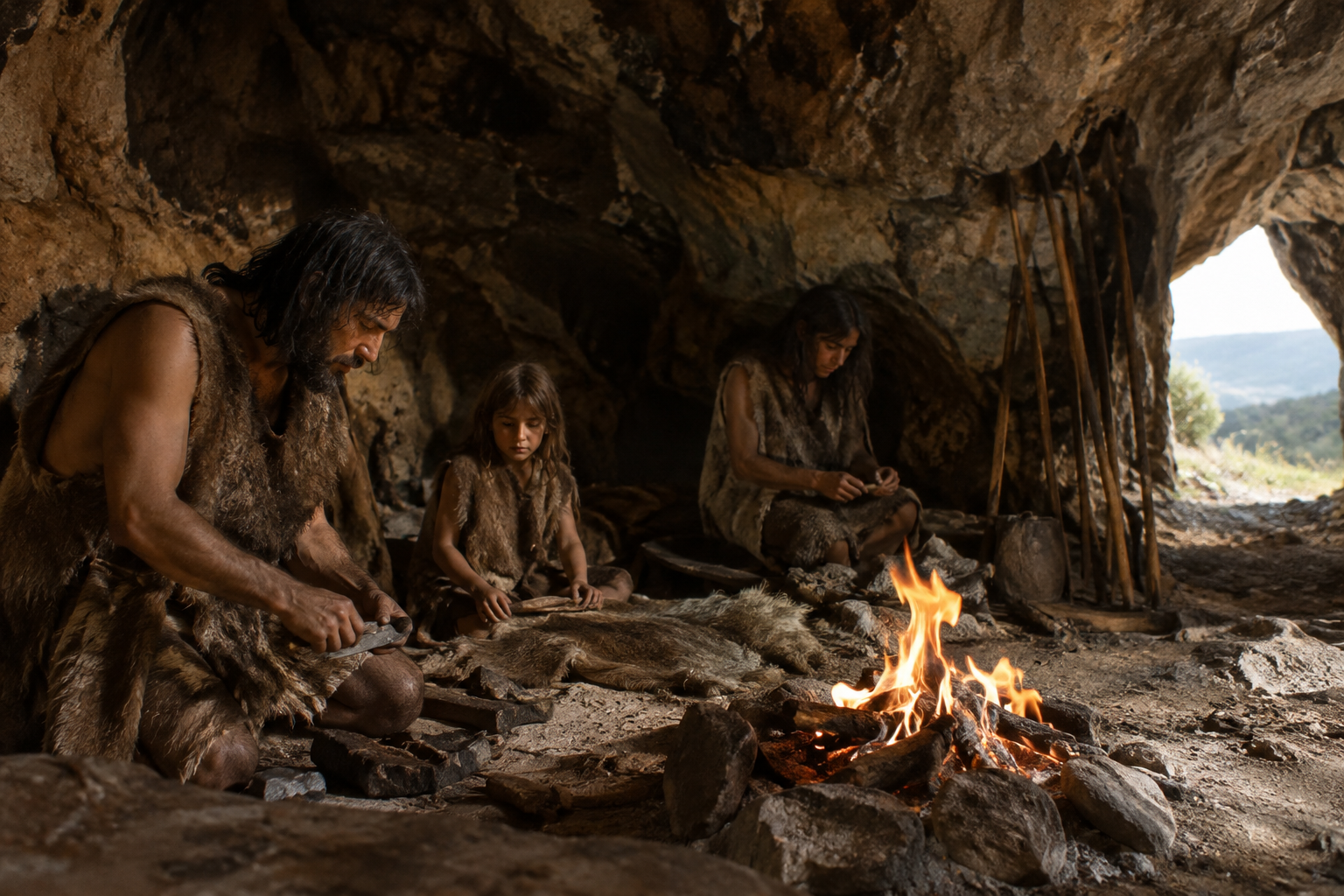
In Bezdanjaca Cave in Bronze Age Croatia, one male individual identified as I18729 offers a rare and rather evocative glimpse of the paternal line assigned here as R1b1a1b1a1a2b1c1a1a2a. The date attached to him, around 1150 BC, places him in the late Bronze Age, in a period when the eastern Adriatic and inland Balkans were full of local communities tied into wider worlds of exchange, metalworking, mobility, and changing burial customs.
That matters because cave burials in this region are not just picturesque archaeological footnotes. They belong to a specific landscape of memory and ritual. When a Y-chromosome lineage appears in such a context, it does not tell us a person's whole ancestry, language, or identity, but it does trace one direct paternal line through a setting that is unmistakably local and historically important.
Bezdanjaca Cave, in what is now Croatia, is one of those sites that reminds us how misleading our modern expectations can be. We tend to imagine the Bronze Age dead laid out in neat cemeteries, under barrows, or in formal stone tombs. But across parts of the western Balkans and the eastern Adriatic, caves could serve as enduring places for the dead as well as for the living memory of a community.
The sample I18729, described as Proto-Illyrian Bronze Age Croatia Bezdanjaca Cave, belongs to that archaeological horizon. The term "Proto-Illyrian" should be used carefully: it is a cultural-historical label for populations in a region later associated with Illyrian-speaking groups, not proof that one excavated man in 1150 BC can be neatly assigned a later ethnic name. Still, the label is useful insofar as it places him in the prehistory of the western Balkans, before classical authors began writing about Illyrian peoples.
Research on ancient populations of the region, including the broad study published in Science, has helped place Bronze and Iron Age individuals from Croatia into a much longer story of continuity and change. The significance of I18729 is not that he stands alone, but that he anchors this very specific paternal branch in a real late Bronze Age Balkan context.
Bronze and Iron Age Croatia DNA
The haplogroup name here, R1b1a1b1a1a2b1c1a1a2a, is a very narrow twig on the much larger Y-DNA tree of R1b, one of the major paternal lineages in western Eurasia. That larger family has a long and complicated prehistoric history stretching across many regions and periods. But that is exactly why caution matters: the history of a broad parent branch cannot simply be copied onto a much narrower subclade.
What we can say, on the evidence provided, is modest but valuable. This branch is represented by at least one ancient male from late Bronze Age Croatia, at Bezdanjaca Cave, around 1150 BC. That places the lineage in the western Balkans during a formative period of local social development, long before Roman rule and long before medieval ethnic maps.
For family historians, that is often the interesting part. A lineage like this is not merely "European" in the abstract. It appears in a specific place, among communities whose funerary practices and regional ties belonged to the late Bronze Age Adriatic-Balkan world.
There is another reason Bezdanjaca Cave deserves more than a passing glance. Cave burial sites often accumulate meaning over time. They can be reused, revisited, or folded into local traditions in ways that differ from flat cemeteries. That does not automatically mean elite ritual or secret cults; archaeologists have learned, sometimes painfully, not to romanticize caves. But it does mean the placement of the dead in such places was deliberate and socially meaningful.
In the late Bronze Age Balkans, communities were part of a landscape shaped by uplands, river valleys, and routes linking the Adriatic coast to the interior. Metal objects, styles, and ideas moved through these networks. So did people. A paternal lineage found in Croatia during this period sits within that broader movement, though one sample alone cannot map the exact path.
This is where ancient DNA is at its best when kept tethered to archaeology. It does not replace the cave, the bones, the dating, or the regional history. It adds one more layer: the ability to say that a direct male line now known in modern testers was also present in a late Bronze Age man in this particular part of Croatia.
Deep Balkan Genetic Background
One temptation with Balkan prehistory is to draw a straight line from Bronze Age graves to historically named peoples. The reality is more awkward, and more interesting. The western Balkans saw long-term local continuity in some respects, but also shifts in political organization, contact zones, and social identities across the late Bronze Age, Iron Age, Roman, and medieval periods.
So it would be too much to say that I18729 was "Illyrian" in the full historical sense known from first-millennium BC and classical sources. Yet it would be equally wrong to detach him from that deeper regional background. He belonged to one of the populations out of which later Balkan groups emerged. In that measured sense, this haplogroup's appearance in Bezdanjaca Cave contributes to the prehistory of the peoples of the eastern Adriatic hinterland.
That is also why later studies of Balkan population history matter. They show that the region was neither frozen in place nor endlessly replaced. Instead, it was a zone of persistence, mixture, and adaptation. Readers interested in how ancient DNA is being used to examine those longer Balkan continuities may find a useful comparison in work on Albanian population history.
Some haplogroup articles can range across many cemeteries and centuries. This one cannot, and should not pretend otherwise. The evidence here is concentrated in a single ancient individual, I18729, and that narrowness is part of the point. When the documented evidence is limited, the responsible task is not to inflate it but to read it properly.
Properly read, Bezdanjaca Cave gives this lineage a firm archaeological foothold: late Bronze Age, inland Croatia, within the western Balkan sphere often described as Proto-Illyrian. That is already a meaningful result. It ties a modern paternal signature to a real man from a real place, in a period when local communities were shaping the cultural landscape that classical antiquity would later encounter in altered form.
It also hints at how much remains to be done. As more ancient males from Croatia and neighboring regions are sequenced at high resolution, lineages like R1b1a1b1a1a2b1c1a1a2a may turn out to have deeper local clusters, wider Adriatic links, or unexpected connections inland. For now, Bezdanjaca Cave is the anchor point.
Albanian Ancestry and Language
The most distinctive thing we can say about R1b1a1b1a1a2b1c1a1a2a on present evidence is that it appears in late Bronze Age Croatia at Bezdanjaca Cave, in the archaeological world of the western Balkans around 1150 BC. That does not make every modern carrier "Illyrian," nor does it supply a neat unbroken tribal label. What it does offer is something better grounded: a direct paternal line with a documented foothold in the prehistoric Adriatic-Balkan zone, among communities whose dead were placed in caves and whose world stood on the threshold of later Iron Age transformations.






Comments