Haplogroup R1b1a1b1a1a2b1c1a1a2
– 5 min read


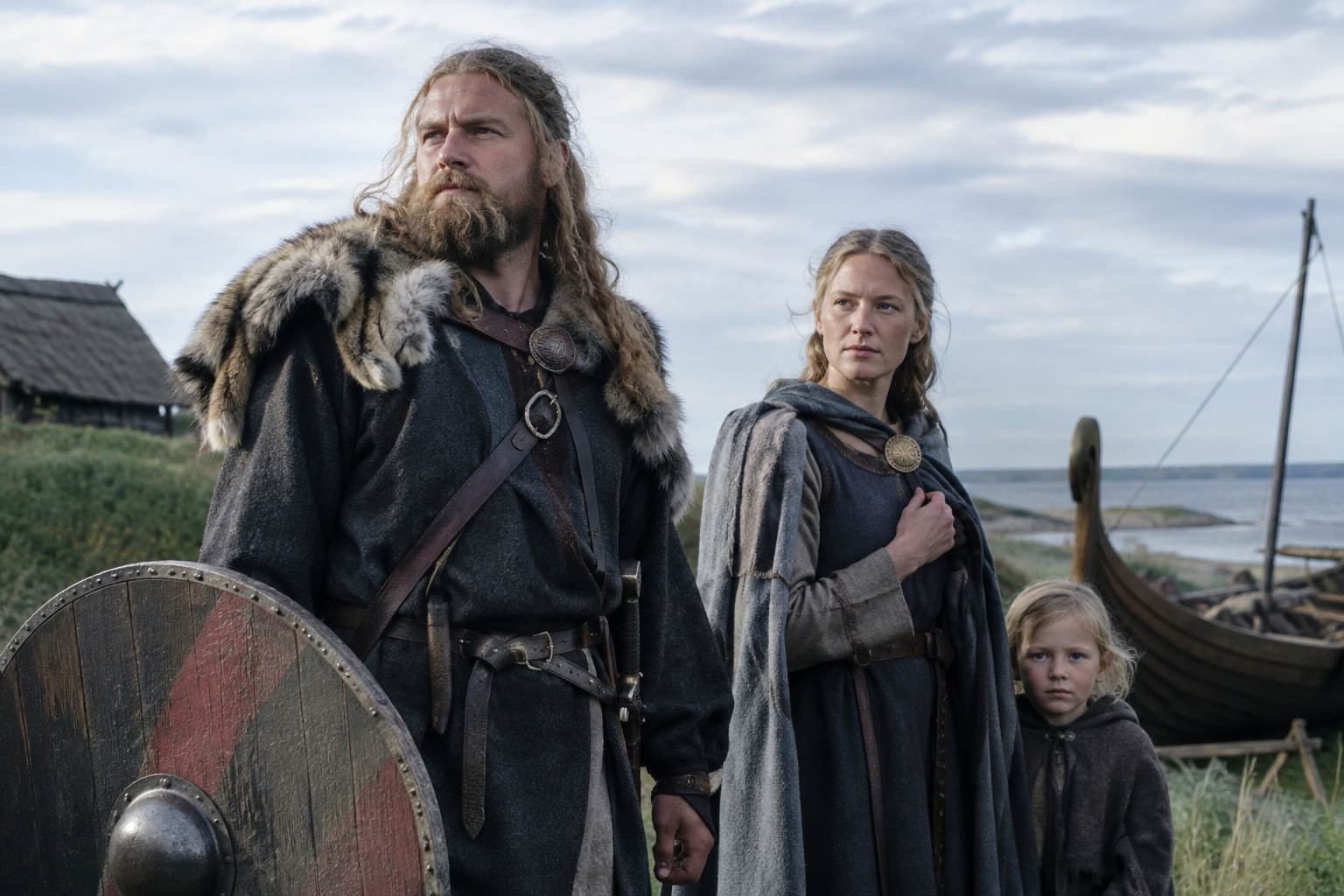
At Galgedil on the Danish island of Funen, one Viking Age man has become a useful marker for tracing a very specific paternal line. He is known simply as VK138, dated to around AD 925, and he is associated here with the Y-DNA haplogroup R1b1a1b1a1a2b1c1a1a2. That string of letters and numbers is narrow, technical, and easy to overlook. But in archaeological terms it places one direct male line inside a very recognisable world: late Viking Age Denmark, in the generations when Scandinavian society was trading, raiding, settling, and consolidating power across the North Sea and Baltic.
The important thing to say at once is that Y-DNA tracks only one line of descent: father to son to son, across many generations. It does not describe the whole ancestry, culture, or identity of VK138. Still, a lineage this specific matters because it gives a fixed point. Instead of speaking vaguely about "the Vikings," we can begin with one excavated individual from one place in Denmark and ask what his paternal branch may tell us about the wider population of the Viking world.
Funen sits in the middle of Denmark, between Jutland and Zealand, and that geography matters. In the Viking Age it was not a remote outpost but part of the busy Danish heartland, tied into sea routes, local lordship, and the political landscape that would eventually cohere into a medieval kingdom. A man buried there around AD 925 lived in a period when Denmark was increasingly visible in both archaeology and written history.
Sample VK138 is therefore valuable not because he can be made into a saga hero, but because he anchors this haplogroup in a real Scandinavian context. The branch named in this article, R1b1a1b1a1a2b1c1a1a2, is a very fine subdivision within the far larger R1b family. That larger family has a broad and complex history across western Eurasia, but it would be careless to project all of that history directly onto this one sub-branch. What we can say more responsibly is that this lineage appears here in Viking Age Denmark, in an individual from a region central to Scandinavian interaction and expansion.
A large ancient DNA study of Viking Age populations helped place burials like these into a wider Scandinavian frame, showing just how mobile and mixed Viking Age communities could be while still preserving local continuities in places such as Denmark. For readers wanting the broader research setting around finds like VK138, the relevant study can be found here.
There is a habit in popular ancestry writing of treating R1b as if it automatically means one simple story: Celts, or Atlantic Europe, or Bronze Age warriors, or something equally neat. Archaeology is much less tidy than that. By the Viking Age, branches of R1b had long since become part of many different European populations, and a Danish example should not surprise us.
What is useful about VK138 is precisely that he reminds us how old lineages become historical lineages in new settings. A paternal branch can endure across huge changes in language, religion, and political organisation. By AD 925, the world of this Funen burial was not the world in which the deeper ancestors of R1b first expanded. It was a maritime Scandinavian society of farms, ports, warbands, alliances, and conversion-era transformations.
That distinction is crucial for anyone researching a modern paternal line. If you match this haplogroup or a nearby branch, the strongest historically grounded association in the present evidence is not some sweeping claim about a single ancient "people," but a documented appearance in Viking Age Denmark. That is narrower, but it is also far more useful.
By the early 10th century, Denmark was in the midst of political change. Royal power was becoming more visible, monumental building would soon intensify in some regions, and Christian influence was growing even while older customs still persisted. Funen was well placed within these developments. It sat along routes that connected the Danish islands to Jutland, Scania, the Baltic, and the North Sea world beyond.
So VK138 should be imagined not as an isolated "tribal" relic, but as a man from a thoroughly connected society. The archaeology of Viking Age Denmark shows movement of objects, styles, and people across short and long distances. Genetics adds another layer: not a simple ethnic badge, but evidence that the men and women of this period could belong to lineages with deeper roots in different parts of Europe while participating fully in Scandinavian culture.
That is one reason Viking Age genetic studies have been so important. They show that the old contrast between "locals" and "outsiders" is often too blunt. In many cemeteries and settlements, ancestry, language, and cultural affiliation do not line up in easy, one-to-one ways.
Germanic languages and genomics
One sample cannot tell the whole backstory of a paternal branch, but Danish prehistory gives us the necessary backdrop. Long before the Viking Age, the region had already seen repeated population shifts: Mesolithic foragers, incoming farmers in the Neolithic, and later Bronze Age and Iron Age transformations tied to wider northern European networks. Any Viking Age Danish lineage sits on top of that much deeper stratigraphy of movement and mixture.
That is why it is unwise to claim that a specific late subclade such as R1b1a1b1a1a2b1c1a1a2 "arrived" with one dramatic migration unless the evidence truly shows it. What the archaeological record does show is continuity of settlement in Denmark alongside major cultural change. Over thousands of years, lineages were absorbed, reshaped, and redistributed through marriage, migration, and social mobility.
Seen in that light, VK138 is not just a Viking. He is also the end point, for our purposes, of many older northern European histories that had already converged in Denmark by the 10th century.
Quite a lot, if we ask the right question. VK138 does not prove that this entire haplogroup was "Viking" in any exclusive sense, nor that every later carrier descends from Denmark in the historical period. But he does provide a secure archaeological association: this direct paternal line, or a reported placement very close to it, appears in a man buried in Viking Age Funen around AD 925.
That matters because ancient DNA works best when it narrows possibilities. A modern tester with this branch is not being handed a fantasy pedigree. Instead, they are being shown a documented point where their wider paternal line intersects with the real historical landscape of Denmark during the Viking Age. That is modest, but it is also exactly the kind of claim ancient DNA is best at supporting.
Readers interested in how later Scandinavian and North Atlantic populations preserve traces of these older northern connections may also find the Faroe Islands especially interesting, since they were shaped in part by Viking Age migration and settlement.
Faroese ancestry and settlement
The most distinctive thing about R1b1a1b1a1a2b1c1a1a2 here is not grand antiquity in the abstract, but its appearance in a named ancient individual: VK138 from Galgedil, Funen, around AD 925. That places this paternal line within the lived world of Viking Age Denmark, a region central to Scandinavian history and to the movements that reshaped much of northern Europe. For anyone exploring this branch today, that is the real value of the evidence: one direct male line, one excavated man, and one firmly historical setting.





Comments