Haplogroup R1b1a1b1a1a2a6

– 6 min read


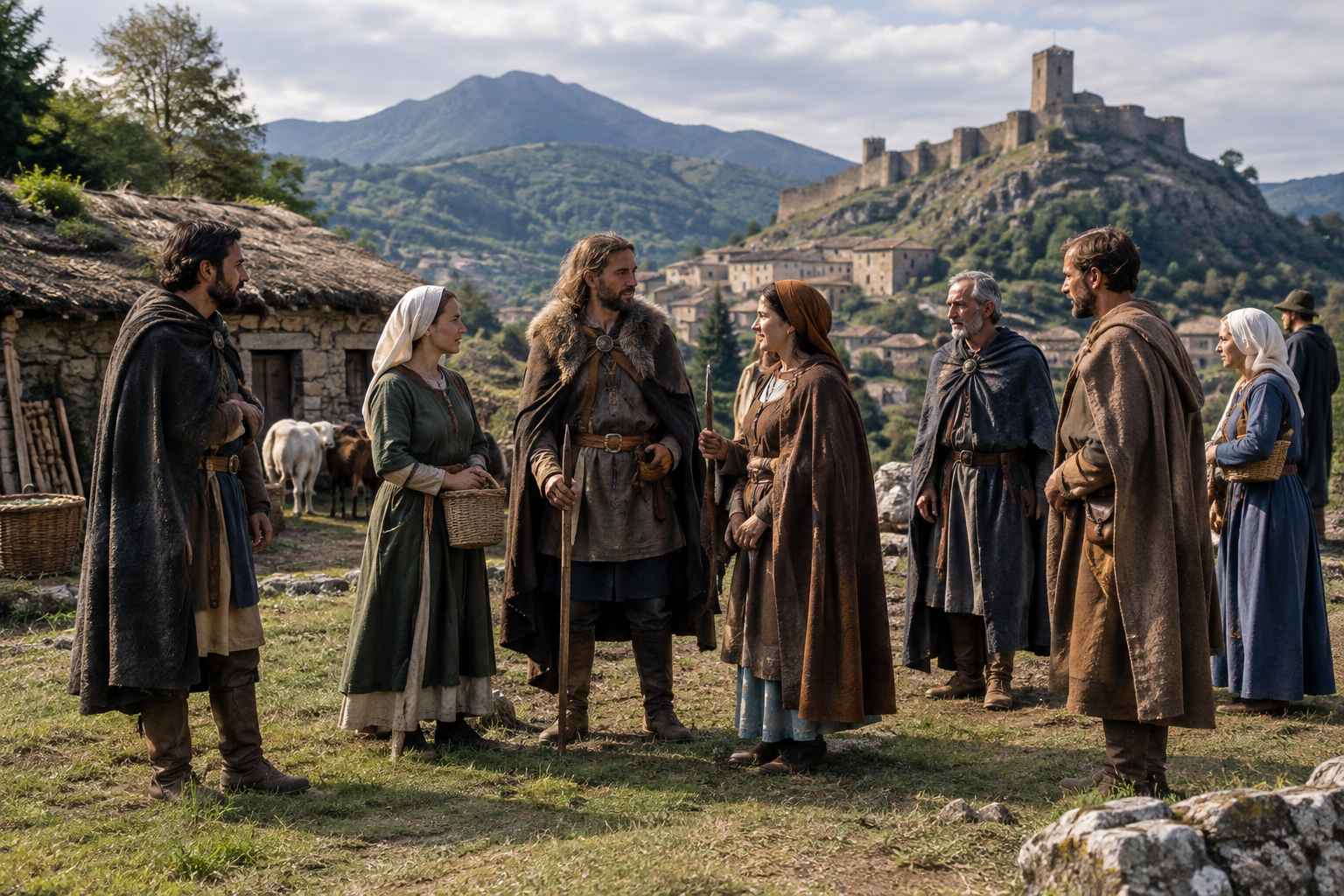
Some Y-chromosome lineages appear in the ancient DNA record like a neat royal pedigree. This one does not. Haplogroup R1b1a1b1a1a2a6 turns up instead across a strikingly wide stretch of Europe: Bronze Age central Europe, Iron Age Britain and Gaul, Roman and post-Roman frontier zones, early medieval Iberia, and later medieval communities farther north. That makes it historically interesting, because it suggests not a single dramatic episode but a long story of movement, settlement, and survival.
As ever with Y-DNA, a warning is part of the fascination. A haplogroup traces only one line of descent: the direct paternal line, father to father to father. It is not a person's whole ancestry, still less a ready-made ethnic label. For a specific branch as narrow as R1b1a1b1a1a2a6, we should also be careful not to pour the entire history of the broad R1b family into it. Still, the ancient samples supplied here show that this paternal line belonged to real men buried in very different worlds, from Bell Beaker and Bronze Age communities to Celtic elites, Roman provinces, early medieval monasteries, and Highland clan country many centuries later.
In the broadest terms, this haplogroup sits inside the immense R1b family, one of the major Y-chromosome groupings in western Europe. But broad family membership is only the beginning. What matters for historical interpretation is that the narrower branch represented here appears repeatedly in western and central European contexts, especially from later prehistory onward. The supplied evidence points not to a single homeland that can be declared with confidence, but to a distribution strongly tied to the European Bronze Age and to the societies that followed it.
Some of the earliest signposts come from central and northwestern Europe. We see MIB054 and MIB054d in Bronze Age Bohemia, dated to 2500 BC; LEU024 from Bronze Age Unetice Thuringia Leubingen Sommerda Germany, dated to 1950 BC; and Bell Beaker related finds in the Low Countries such as I4073, I4074, and I4069 from De Tuithoorn, North Holland, dated to 2080 BC. These do not prove that the exact narrow branch "belonged" to Bell Beaker or Unetice as exclusive identities. But they do place closely related paternal ancestry in the world of early metalworking Europe, where male lineages could spread with changing social networks, prestige systems, and mobility.
By the Iron Age, this paternal line is no longer peeping out only from early Bronze Age graves. It appears in some of Europe's most evocative archaeological settings. A cluster of elite burials in southwest Germany is particularly revealing: APG001, APG001c, and APG003 from the elite Celtic burial at Asperg-Grafenbuehl, dated to 450 BC, alongside LWB001, LWB001_ss, and LWB001_ss_b from Ludwigsburg Roemerhuegel, also dated to 450 BC. These are not just anonymous skeletons. They come from high-status La Tene era contexts in the wider Celtic world of central Europe.
Then there is Britain, where the evidence is unusually rich. The long series from East Yorkshire includes many individuals from Wetwang Slack and nearby Parisi sites: I36879, I37333, I36965, I36968, I36761, I21699, I21861, I5502, and others dated broadly between 295 BC and 100 BC. Add I50137, the elite Celtic chariot burial from Ferry Fryston in West Yorkshire, dated to 237 BC, and the picture becomes hard to ignore. This branch, or very near kin to it, was embedded in Iron Age Britain across both ordinary and high-status settings.
That matters because it reminds us that paternal continuity can persist through changing archaeology. A haplogroup does not equal "the Celts" in some simplistic sense, but these finds do show that men bearing this lineage were present in communities we identify archaeologically as Celtic in central Europe, Gaul, and Britain.
The Roman and post-Roman periods make the story even more interesting, because the lineage turns up in places shaped by soldiers, settlers, trade, and migration. In Britain, there is FEN008 from Roman Era Fenstanton, Cambridgeshire, dated to 100 AD, and WBK36 from Celtic Durotriges England Duropolis Winterborne Kingston, dated to 125 AD. These samples sit in a province where local Iron Age ancestry and imperial mobility were constantly meeting.
On the continent the same pattern appears along old Roman zones and new early medieval ones: DNA031 from an Alemanni grave at Basel-Waisenhaus in Switzerland, dated to 376 AD; the group R2055a to R2055e from Gallo Roman France Metz Lunette Sablon, dated to 432 AD; and COL_098b from Lombard Era Collegno, Northern Italy, dated to 580 AD. These contexts span the crumbling Roman frontier and the successor kingdoms that inherited it. The line is there in Gaul, the Alpine world, and northern Italy, which strongly suggests durability through the political chaos of late antiquity.
Iberia is especially well represented. We have I23276 from Late Roman Early Migration Spain Extremadura Merida Corralon de los Blanes, dated to 450 AD; I23764 from Late Roman Iberia Merida Necropolis Blanes, also 450 AD; I20382 from Early Visigothic Spain Girona Sarria de Ter Pla de lHorta, dated to 611 AD; I19670 from Early Medieval Spain Guadalajara Cubillejo de la Sierra, dated to 601 AD; and I30592 from Early Medieval Spain Zaragoza Epila Las Lomas del Molino, dated to 600 AD. Then come the remarkable Las Gobas burials in northern Spain: ldo062 at 620 AD, ldo066 and ldo037 at 1000 AD, and ldo048 at 1025 AD.
Las Gobas is the sort of place that makes historians sit up. Here, in one region, across centuries, the same paternal branch appears again and again. That does not prove a single family line continuing neatly unchanged. But it does suggest local male-line persistence through the transition from late antiquity into medieval Christian northern Spain.
Explore Roman Hispania's DNA Legacy
What, then, has any of this to do with Clan MacAulay and Ardencaple Castle near Helensburgh in Argyll and Bute? The answer is not that an Iron Age man in Yorkshire or a burial at Las Gobas can be declared the ancestor of the MacAulays. We simply cannot say that. But the geography of this lineage across Britain and Atlantic Europe gives a useful historical backdrop for later clan regions.
Clan MacAulay emerges in the medieval west of Scotland, with Ardencaple Castle as the seat of the chiefs, probably from the 12th century. The site began as a fortified tower house and later grew into a larger mansion. It lent its name to the local barony, and the family remained significant in the area for centuries. In the 18th and 19th centuries the castle was remodelled into a grand country house, before wartime naval use and 20th-century demolition left only part of the later structure standing.
That architectural story is rather like the genetic one. Ardencaple is not a pristine medieval fossil; it is a place altered by fashion, conflict, and decline, yet still carrying memory of the older clan seat beneath. Haplogroups work similarly. A paternal line may persist while languages change, kingdoms rise and fall, castles are rebuilt, and entire political worlds disappear. The line survives; the social meaning wrapped around it changes.
For readers interested in how Scottish historical identities sit alongside genetic evidence, the MacAulays belong in a wider clan landscape, not as a genetic certainty but as part of the long historical afterlife of paternal lines in the British Isles.
The most striking lesson of R1b1a1b1a1a2a6 is continuity with movement. The supplied samples place it in Bronze Age Bohemia and Germany, Iron Age Celtic elite burials, Roman Britain, Gaul, Iberia, Lombard Italy, early medieval Spain, and later medieval communities in Belgium and England such as ATP_PSN_1217 from Clopton, Cambridgeshire, dated to 1561 AD, and STR067 and STR091 from St. Rombouts in Belgium, dated to 1652 AD and 1558 AD. This is not the pattern of an isolated or short-lived paternal branch. It is the pattern of one woven into the demographic history of western Europe for a very long time.
Ancient DNA also shows the limits of written genealogy. Castles, surnames, and clan traditions usually take us back a few centuries if we are lucky. A Y-chromosome branch can connect the medieval world to far older archaeological landscapes, though only in a broad paternal sense. It gives context, not a ready-made family tree.
If your own paternal line falls somewhere near this branch, the real thrill is not claiming a chariot warrior, a Visigoth, or a Highland chief as a proven ancestor. It is seeing how one line of descent could pass through Celtic Europe, Roman provinces, early medieval kingdoms, and clan territories, leaving traces in graves long before surnames were ever written down.
Upload your DNA to MyTrueAncestry and explore whether your results show connections to ancient individuals, archaeological cultures, and historic populations like those discussed here. Such matches can open a remarkable window onto your deep ancestry, even when they do not prove direct descent from any particular ancient person or noble family.






Comments