Haplogroup R1b1a1b1a1a2a1b2

– 6 min read


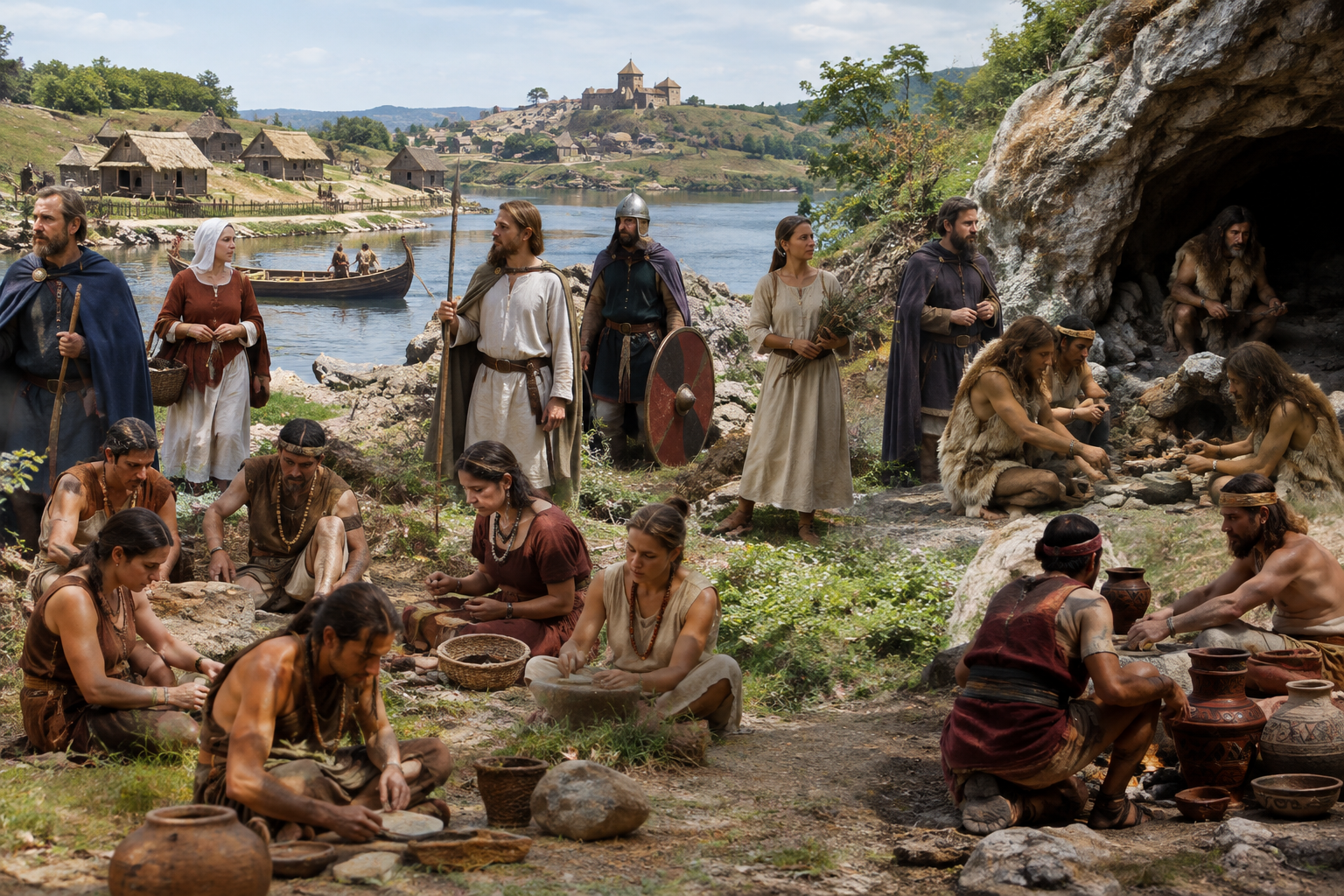
Some Y-chromosome lineages are famous because they turn up in royal pedigrees or in modern surname projects. Others are interesting for a more archaeological reason: they keep appearing in unexpectedly different places, and they force us to think about long male-line continuity across very different worlds. Haplogroup R1b1a1b1a1a2a1b2 belongs in that second category.
This is a very specific branch within the wider R1b family, one of the major Y-DNA groupings in western Eurasia. But a Y-DNA haplogroup is only one line of descent: your direct paternal line, father to father to father. It does not describe your whole ancestry, your culture, your identity, or your family story in full. What it can do, though, is give us a remarkable narrow beam of light into the deep past, especially when ancient DNA allows us to see related paternal lines turning up in burials from Neolithic caves, Bronze Age settlements, and medieval communities.
The wider R1b tree has a long and complicated history across Eurasia, and many of its branches became especially important in later prehistoric and historic western Europe. For a narrow lineage like R1b1a1b1a1a2a1b2, it is important not to lazily assign the whole grand saga of R1b to this exact branch. Still, the ancient sample pattern supplied here does suggest something valuable: this lineage, or closely related paternal lines, belongs to a western and central European historical setting that becomes especially visible in later prehistory and the early medieval world.
The sample spread is striking. We see evidence in Neolithic Germany, Bronze Age Iberia, Bronze Age France and Sicily, then later in Merovingian Germany, medieval Austria, and medieval England. That does not prove a single uninterrupted chain from one named person to another. What it does suggest is that this paternal branch was part of the male-line landscape of Europe for a very long time, with especially clear visibility in the west and center of the continent.
Explore Celtic-era DNA findings
The earliest supplied individual is I1593 from Blatterhohle Cave, Germany, dated to 3577 BC. That alone should make us pause. A paternal line associated here with a very specific modern-style haplogroup label was already present in a Neolithic context in central Europe. Blatterhohle is one of those sites that reminds us how untidy prehistory really was: farmers and foragers, local continuity and mixture, all meeting in ways that refuse to fit simple schoolbook categories.
Then the evidence shifts southwest. The cluster from Almoloya, Pliego, Murcia is especially notable: ALM036, ALM039, ALM041, ALM050, and ALM052, all dated to 1875 BC, followed by ALM058, ALM063, ALM064, ALM070, and ALM081, dated to 1650 BC. That is not an isolated appearance. It looks like repeated male-line presence in Bronze Age southeastern Spain.
And Almoloya matters archaeologically. This was no random hillside. Bronze Age Murcia formed part of a socially complex world, often discussed in connection with El Argar and neighboring societies, with fortified settlements, hierarchy, and regional power. When the same paternal branch appears in multiple individuals from that setting, we begin to see not just a lineage but a durable social presence.
The Iberian picture is strengthened by PUC002 from Puntal de los Carniceros, Alicante Villena, dated to 1653 BC, and I3997 from Lloma de Betxi, Valencia, dated to 1841 BC. Add GBVPK from Grotte Basse de la Vigne Perdue, France, dated to 2380 BC, and we are looking at a western Mediterranean arc rather than a single local anomaly.
Sicily adds another fascinating layer. I3123 from Buffa II, Sicily, dated to 2150 BC, and I8561 from Abisso del Vento, Sicily, dated to 2073 BC, place the lineage within an island world that was never isolated in the romantic sense. Sicily was a corridor, a maritime hinge, where movements from the Italian mainland, the western Mediterranean, and beyond could intersect. A paternal lineage turning up there in the Early Bronze Age fits a history of movement, contact, and local establishment rather than simple ethnic labels.
What makes this haplogroup especially attractive to historians is that it does not vanish with prehistory. It turns up again in clearly historical settings. EV8 from Merovingian Period Frankish Eltville, Germany, dated to 660 AD, places the lineage in the post-Roman world of the Franks, where old provincial populations, military elites, and new political identities were being sorted out across the Rhine regions and beyond.
Then there is GAT004 from the Gars-Thunau Riverine Settlement, Austria, dated to 900 AD. A riverine settlement is exactly the sort of place where continuity and mobility meet: trade, frontier politics, local agriculture, and long-distance contacts all in one landscape. By this point, central Europe was a patchwork of lordships, Christian expansion, and shifting power centers. A paternal line surviving there is not evidence of an unbroken noble dynasty, but it is evidence that this branch remained part of the male population through major historical change.
Finally, ATP_PSN_920 from Cherry Hinton, England, dated to 1055 AD, brings the story to England on the eve of the Norman Conquest. That date matters. It sits almost exactly at the hinge between late Anglo-Saxon England and the Norman world that followed 1066. A haplogroup found in England just before that upheaval is a reminder that medieval populations were already layered long before famous invasions acquired their tidy labels.
Read about Norman Conquest DNA
This is where genetics and family history begin to eye one another warily across the table. The supplied noble associations do not prove that every member of these families carried R1b1a1b1a1a2a1b2. Nor do they prove direct descent from any ancient sample above. But they do place the haplogroup in some highly suggestive historical landscapes.
The House of Arsenault is associated here with Normandy, and Normandy is one of those regions where every layer of European history seems to have been deposited on top of the last. Prehistoric communities, Celtic Gauls, Roman rule, Viking settlement under Rollo in 911, the rise of the duchy, and then the conquest of England in 1066. If a paternal lineage such as this one appears in western and central Europe before the high Middle Ages, Normandy is precisely the kind of place where such lines could be absorbed into a new political identity without needing to have originated there.
Scotland offers a rather different sort of memory. The Clan MacNeil association leads us to Castle Sween on the east side of Loch Sween in Knapdale, Argyll. It is one of the oldest stone castles in Scotland, probably built in the late twelfth century by Suibhne, ancestor of the MacSweens. Later it was caught up in the fierce politics of the western seaboard, passed into Campbell hands, and was damaged in the seventeenth century during the Wars of the Three Kingdoms before falling into ruin. What survives is a powerful shell of walls, towers, and halls above the loch. Castles like this are not genetic evidence. But they are monuments to the way male-line memory was staged in medieval Europe: through land, lordship, and stone.
The Clan Carmichael connection points to Carmichael House in South Lanarkshire, near the old kirk and burial ground on lands long held by the family. The family rose to prominence in medieval Scotland and gave its name to the district itself. The original tower and later mansion expressed the old feudal habit of translating lineage into architecture. Much is now lost after fire and demolition, but the churchyard still preserves the outline of a once-important noble seat.
These places matter because haplogroups are not biographies. Written genealogy gives us named fathers and sons where records survive. Ancient DNA gives us older, deeper patterns, often anonymous. Castles, estates, and regional family traditions sit between the two: not proof of shared Y-DNA, but historical settings in which paternal descent was politically meaningful.
Explore the history of Clan MacNeil
R1b1a1b1a1a2a1b2 is interesting not because it can be turned into a simplistic badge of identity, but because it seems to link very distant archaeological horizons: Neolithic Germany, Bronze Age Iberia, Bronze Age Sicily, Merovingian Germany, medieval Austria, and pre-Conquest England. That is a serious span of time and geography.
The lesson is not that one ancient man founded half of western Europe, nor that a modern tester with this haplogroup can claim a castle in Argyll or a seat in Normandy. The better lesson is subtler. Paternal lines can persist through enormous cultural change. Languages change, kingdoms rise and fall, churches are built over older burial grounds, and families reinvent themselves under new rulers. Yet a direct male line may continue quietly through all of it.
If you want a wider view of Iberian background to some of these Bronze Age samples, especially the long afterlife of ancient populations in the peninsula, there is more to explore in related work on Roman and post-Roman Spain as well.
Explore Roman Hispania's legacy
That is one of the pleasures of MyTrueAncestry. Ancient DNA comparisons can place your results beside real archaeological individuals such as I1593, ALM036, EV8, GAT004, or ATP_PSN_920, and they can help you think about where your direct paternal line fits into the much larger human story. They do not prove descent from a specific ancient person or noble house. But they can open the door to a more grounded, more intriguing understanding of ancestry.
Upload your DNA to MyTrueAncestry and see whether your paternal history connects with the ancient worlds of Neolithic caves, Bronze Age strongholds, medieval settlements, and the historic regions where later clans and noble families made their mark.






Comments