Haplogroup R1b1a1b1a1a2a1b1a1a

– 6 min read


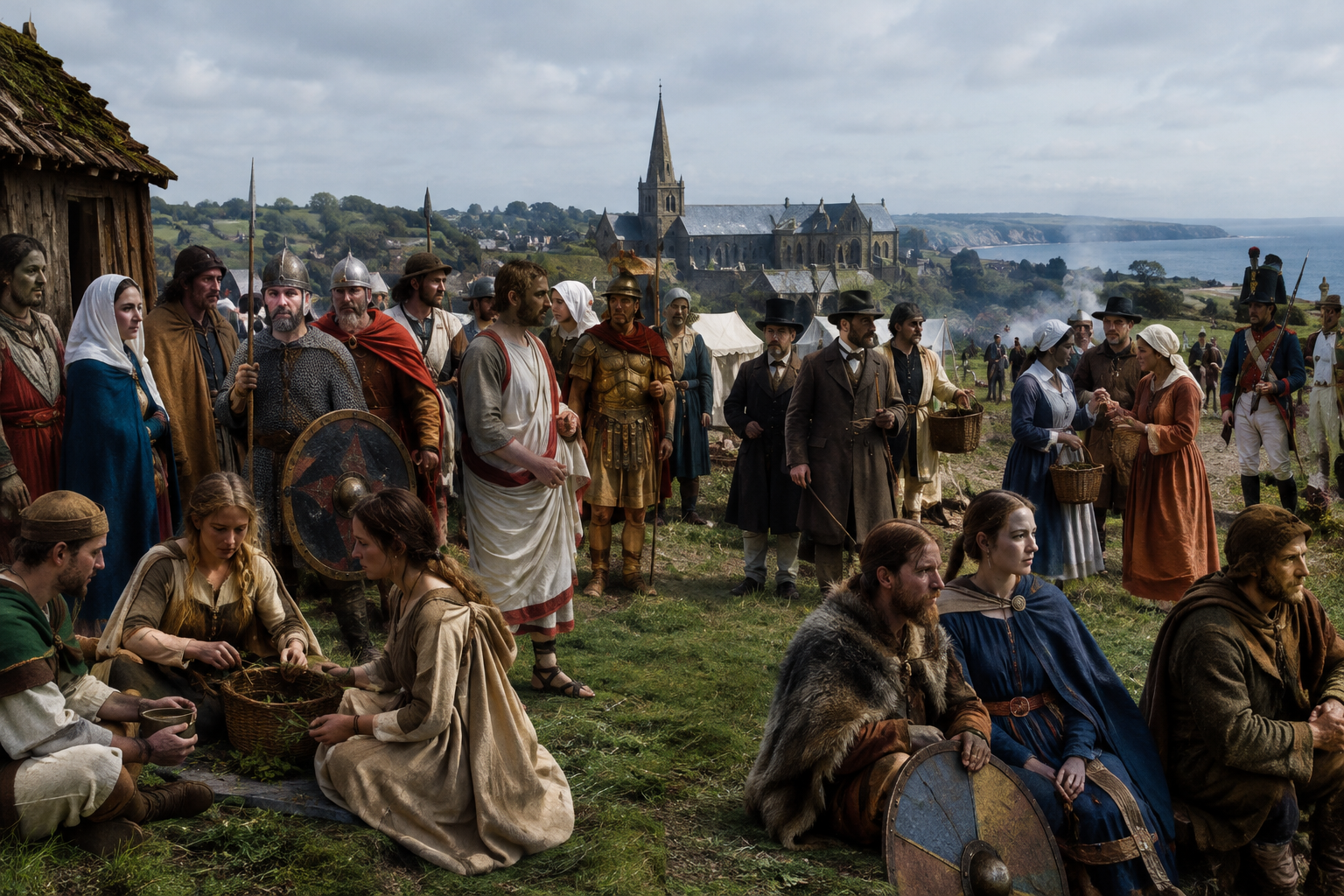
Some Y-chromosome lineages announce themselves with a neat, simple story. This one does not. Haplogroup R1b1a1b1a1a2a1b1a1a sits deep within the sprawling R1b family, a paternal branch that appears again and again in the archaeology of western Europe. But when we narrow down to a highly specific subclade like this, the proper task is not to pretend we can see everything clearly. It is to ask a better question: what sort of historical landscape does this lineage belong to?
That landscape, judging by the ancient DNA linked here, is unmistakably western and northwestern European, with striking appearances in Iron Age Britain, Roman and post-Roman Iberia, the Low Countries, Scandinavia, and even the colonial Atlantic world. Y-DNA traces one direct paternal line only, not a person's total ancestry, but that single line can still tell us something powerful about continuity, mobility, and the long afterlife of male lineages in history.
R1b is one of the major Y-chromosome families in Europe, especially common in its western half. That broad family has a deep and complicated history tied to prehistoric population change, including later prehistoric expansions that reshaped much of Europe. But we must be careful: the history of all R1b is not automatically the history of the much narrower branch R1b1a1b1a1a2a1b1a1a.
What the sample list does allow us to say is that this lineage belongs to a cluster of paternal lines that had a strong presence in western Europe across many centuries. It appears in contexts that are Celtic, Roman provincial, post-Roman, Carolingian, Viking Age, medieval, and early modern. That does not mean the haplogroup "was Celtic" or "was Viking." Haplogroups do not belong to ethnic labels. Rather, they move through societies, languages, and kingdoms, carried by men whose descendants may later have spoken quite different tongues and served quite different rulers.
For readers interested in the larger archaeological background to how ancient DNA changed these debates, MyTrueAncestry has a useful overview here:
The earlier samples in this set already suggest that this paternal line, or very near relatives of it, was present in several parts of western Europe before the Middle Ages. Two particularly telling cases come from Iron Age Britain: I36774 and I36777, both from the Celtic Parisi context at Wetwang Slack in East Yorkshire, dated to 225 BC. They place this lineage in an unmistakably Iron Age British setting.
Another Iron Age British sample, I20982 from Suddern Farm, Hampshire, dated to 250 BC, widens the picture geographically. This is not one isolated pocket. It hints at a paternal presence in different parts of southern Britain before Rome arrived. Across the Channel, I21399 from Chemin de Coupetz in Marne, France, also dated to 250 BC, shows the same broader western European horizon.
Then there is the Mediterranean surprise: I24674, a 550 BC individual from Punic western Sicily, at Marsala. That does not mean this haplogroup was somehow "Punic" in origin. It means that by the first millennium BC, paternal lines of this wider western European kind could appear in the mixed and mobile world of Sicily, where Phoenician, local, and other Mediterranean populations met.
The Roman world sharpens that point. KNF014, from Knobbs Farm, Somersham in England, dated to 200 AD, shows the lineage in Roman-era Britain. Rome did not erase local paternal histories; nor did local lineages remain frozen. Roman provinces were full of soldiers, traders, farmers, and families on the move, and Y-DNA often preserves that muddled human reality better than tidy textbook categories.
For a wider look at how Iberia and the Roman world interacted genetically, see this related read:
Read Roman Hispania's DNA Story
If one region stands out in this sample set, it is northern Spain. At Las Gobas we find ldo057 from 620 AD, ldo055 from 860 AD, and ldo058 from 1000 AD. That is a remarkable sequence. It does not prove direct descent from one man to another, but it does suggest that closely related paternal lineages were present in the same broad region across several centuries of enormous political change.
Nearby in the Ebro world we also have I30932 from Zaragoza Epila Las Lomas del Molino, dated to 600 AD, and I7672 from a Carolingian settlement in Barcelona, dated to 790 AD. These sites belong to a period when Spain was anything but static: Visigothic legacies, regional Christian communities, Islamic rule in much of the peninsula, frontier movement, monastery networks, and local survival all overlapped. A Y-lineage appearing repeatedly in such settings is less a badge of ethnicity than a sign of durable male ancestry moving through changing political worlds.
This makes Iberia especially valuable for understanding how paternal lines outlast kingdoms. The men in these graves did not know they were samples in a genetic dataset. They knew villages, farms, war bands, churches, kin, obligations, and routes through mountains and plains. Ancient DNA restores some of that lost continuity.
Readers interested in related Iberian population complexity may enjoy this article on early medieval central Spain:
Discover 7th-Century Iberian Diversity
The later medieval and early modern samples show just how widely this paternal branch, or close relatives within its narrow family, could appear. In the Low Countries there is ST2964 from Carolingian Sint-Truiden, dated to 795 AD, and ST2666 from medieval Sint-Truiden, dated to 1090 AD. In the Netherlands, GRO024 from Groningen, also dated to 1090 AD, extends that North Sea zone.
Scandinavia contributes several more pieces: VK87 from Viking Hesselbjergmarken in Denmark, dated to 875 AD; VK166 from the St. Brice Massacre in Oxford, dated to 1002 AD; and VK403 from Viking Age Skara Varnhem in Sweden, dated to 1050 AD. Add medieval Denmark through CGG100678 from Tj rby, Randers Municipality, 1325 AD, and CGG101873 from Zeeland Ahlgade Holbaek, 1400 AD, and the picture becomes one of a paternal line well at home in the North Sea and Scandinavian worlds too.
By the early modern period, the same broad lineage network reaches still further. The St. Rombouts material in Belgium includes STR016, STR016c, and STR016d, all dated 1821 AD. YYY084B, a soldier of Napoleon's Grande Armee in the Vilnius mass grave, dated to 1812 AD, reminds us that paternal lineages can turn up in contexts created by state armies rather than settlement. And across the Atlantic, I15286, I35265, I15304, and I15319 from St. Mary City Chapel Field Cemetery in Maryland, dated between 1634 AD and 1704 AD, show how such European paternal lines entered the colonial world.
If you want to follow one of those Atlantic-era case studies further, this companion article is particularly apt:
How does all this connect to later noble families? Carefully, and with restraint. A haplogroup association in a historical or genealogical setting does not prove that every member of a named family carried that lineage, nor does it turn an ancient skeleton into an ancestor of a medieval lord. But family territories and castles do give us a way to think about how old paternal lines survived into documented history.
Clan Gillon is linked here to Tyrconnell, or Tir Chonaill, the old heartland of the Cenel Conaill in what is now mainly County Donegal. Tradition connected the region with Conall Gulban, son of Niall of the Nine Hostages, and from the early medieval period it became one of the major Gaelic lordships of Ireland. Above all, it was shaped by the O Donnell dynasty, whose power rested not on romance but on the practical things that matter in history: warfare, alliances, patronage of the church, and command of routes by land and sea. After the Tudor conquest, the Nine Years War, and the Flight of the Earls in 1607, that Gaelic order broke apart. Yet Tyrconnell endured as memory, place, and identity.
The other great setting is very different: House Carew and Carew Castle in Pembrokeshire. Here the story is Norman and Marcher rather than Gaelic. The castle began as a Norman stronghold after the conquest of south Wales in the late 11th century, perhaps on a site of earlier Welsh importance. It later became a major stone castle and then an Elizabethan mansion, its very fabric displaying a shift from frontier defense to elite residence. During the Civil War it was held for the Royalists, later slighted, and then left as one of Wales's great ruins, with the nearby tidal mill underlining how lordship depended on landscape as much as walls.
These two places - Tyrconnell and Carew - are not evidence of a single family tree. They are evidence of something more historically interesting: western European male lineages persisted through very different political worlds, from Gaelic lordship to Norman conquest, from kin-based territories to castle-centered rule.
For readers who want to stay with the Welsh side of that story, this related family article fits naturally here:
Haplogroup R1b1a1b1a1a2a1b1a1a is interesting not because it hands us a simple label, but because it refuses to. Its associated ancient samples span Iron Age Britain, Gaul, Roman England, post-Roman and medieval Spain, the Carolingian Low Countries, Viking and medieval Scandinavia, Napoleonic warfare, and colonial Maryland. That is precisely what long-lived paternal lineages do: they pass through new languages, states, and identities while retaining a biological thread that genetics can still detect.
So if this is your Y-DNA branch, what you inherit is not a ready-made claim to a tribe, a kingdom, or a castle. You inherit a direct paternal line that appears well rooted in the history of western Europe and unusually visible across many periods of its recorded and archaeological past. Ancient DNA gives that line depth. History gives it setting. Neither one, on its own, is enough.
If you want to see whether your own DNA shows links to ancient individuals, archaeological cultures, or historical populations like those discussed here, MyTrueAncestry can help you explore those connections. The results can offer remarkable clues about deep ancestry and historical context, even when they do not prove direct descent from any specific ancient person or noble house.






Comments