Haplogroup R1b1a1b1a1a2a1b1a1

– 7 min read


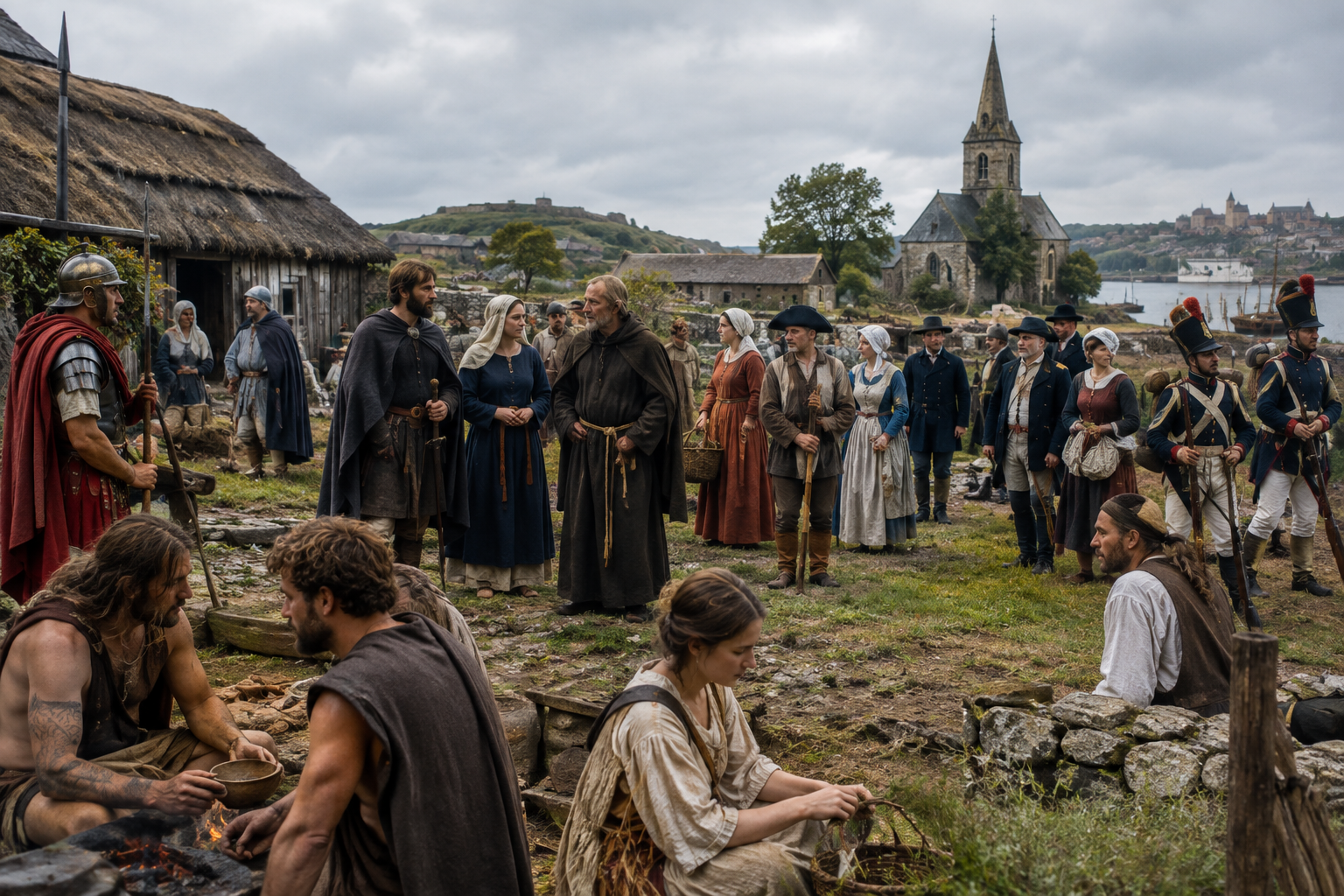
Some Y-DNA branches announce themselves with a flourish across famous royal pedigrees. Others emerge more intriguingly from the ground: a man in Iron Age Yorkshire, another in Punic Sicily, several in early medieval Spain, a victim of the St. Brice massacre, a burial in Viking Age Scandinavia, and even men carried into the colonial world of Maryland. Haplogroup R1b1a1b1a1a2a1b1a1 belongs to that second category. It is a very specific paternal branch, and what makes it historically interesting is not a single neat origin story, but its appearance across western and northern Europe over many centuries of upheaval.
As ever with Y-DNA, a warning is part of the excitement. This kind of lineage traces only one direct paternal line: father to father to father. It does not describe a person's whole ancestry, culture, language, or identity. And with a subclade this specific, we must be especially careful not to hand it the entire history of broader R1b. Still, ancient DNA allows us to watch one paternal thread appear in remarkably varied settings, from Iron Age tribal landscapes to Roman and post-Roman mobility, and then onward into the medieval worlds of castles, lordship, and migration.
This haplogroup sits within the great R1b family, a major Y-chromosome lineage widely found in western Eurasia and especially important in the paternal history of much of Atlantic and western Europe. But the branch here, R1b1a1b1a1a2a1b1a1, is much narrower. That matters. We should not simply pour the entire prehistory of R1b into it as if nothing changed along the way.
What the sample list does suggest, however, is that this branch or closely related paternal lineages were established across parts of western Europe by later prehistory and remained in circulation through the Iron Age, Roman, medieval, and early modern periods. The geography is striking: England, France, Spain, the Low Countries, Denmark, Sweden, Sicily, and later colonial North America. That pattern fits a lineage moving not through one dramatic migration alone, but through repeated episodes of settlement, military service, trade, marriage, colonization, and local continuity.
For readers interested in how archaeogenetics turns such fragmentary clues into historical interpretation, MyTrueAncestry has a good wider introduction in Ancient DNA and the Rise of Archaeogenetics.
The earliest supplied appearances are already enough to spoil any overly tidy national story. Two men from Celtic Parisi Iron Age England East Yorkshire Wetwang Slack Year:225 BC, IDs I36774 and I36777, place this paternal line in Iron Age eastern Britain. Another appears at Iron Age Hill Fort Suddern Farm Hampshire England Year:250 BC, ID I20982. Yet another turns up in Gallic Chemin de Coupetz Marne France Year:250 BC, ID I21399. That is a useful cluster: Britain and Gaul, both before Rome, both within worlds usually labelled Celtic, though genetics never maps perfectly onto language or tribal identity.
Then comes one of the more arresting samples: I24674, from Carthaginian Punic Western Sicily Italy Marsala Lad Year:550 BC. This does not mean the haplogroup was somehow "Punic" in essence. What it does show is that men carrying this paternal branch could be found in the complex Mediterranean contact zone of western Sicily, where Phoenician, Punic, local, and other influences overlapped. Ancient ports have a habit of ruining simple origin myths.
By the Roman period, the branch appears in Roman Era England Knobbs Farm Somersham Year:200 AD ID:KNF014. One should resist turning a single burial into a grand theory. But placed beside the Iron Age English samples, KNF014 hints that some paternal lines remained in Britain across the transition into Roman rule, even as the empire also brought newcomers, soldiers, merchants, and administrators from far beyond the island.
Readers wanting a broader look at Iberia under Rome and after it may enjoy Roman Hispania's Lasting Genetic Legacy, which helps frame the western European mobility seen in these lineages.
If there is one region in this dataset that really holds the eye, it is northern Spain. At Las Gobas we find ldo057 from Dark Ages Northern Spain Las Gobas Year:620 AD, ldo055 from Medieval Northern Spain Las Gobas Year:860 AD, and ldo058 from Medieval Northern Spain Las Gobas Year:1000 AD. Add I30932 from Post Roman Spain Zaragoza Epila Las Lomas del Molino Year:600 AD and I7672 from Carolingian Settlement Barcelona Year:790 AD, and we begin to see this paternal lineage persisting across centuries of enormous political change in Iberia.
That does not prove one uninterrupted family line from 620 to 1000. But it does show that related paternal ancestry was present repeatedly in the region through late antique and medieval transitions. In historical terms, these were centuries of Visigothic collapse, Islamic expansion, Christian frontier formation, monastic settlement, and shifting local communities. A Y-lineage surviving through such times is less like a royal standard planted in one place than like a surname appearing in one archive after another, never quite disappearing.
The same branch also surfaces farther north in the Carolingian and medieval Low Countries: ST2964 from Carolingian Belgium Sint-Truiden Groenmarkt Year:795 AD and ST2666 from Medieval Belgium Sint-Truiden Groenmarkt Year:1090 AD, as well as GRO024 from Carolingian Era Groningen Netherlands Year:1090 AD. In Scandinavia it appears in VK87 from Viking Hesselbjergmarken Denmark Year:875 AD, VK403 from Viking Age Skara Varnhem Sweden Year:1050 AD, and VK166 from Viking St. Brice Massacre Oxford Year:1002 AD.
That range does not make the lineage uniquely Viking, Norman, Iberian, or Frankish. It suggests something both simpler and more interesting: by the early medieval period, this paternal branch was part of the population mix of several interconnected European regions. Trade across the North Sea, warfare, ecclesiastical networks, dynastic expansion, and ordinary household migration all helped carry such lineages about.
For a close look at one of those northern settings, see Exploring Viking Age Genetics: Insights from Population Genomics and Ancient DNA.
This is where genetics and medieval history meet, but should not be forced into a marriage they cannot sustain. The associated families here, the House of Tosney, Clan Boyle, and House de Lugny, belong to the later historical landscapes in which such paternal lineages circulated. That is valuable context, not proof that the ancient men named above were their direct forebears.
In Normandy, the House of Tosney is linked to the Chateau de Conches-en-Ouche, begun as a major 11th-century fortress by Roger de Tosny. The castle was built to control its surrounding region and soon became entangled in struggles between Norman and French rulers. Besieged, damaged, rebuilt, and later drawn into the Hundred Years War, it preserves in ruin the hard politics of feudal power. A lineage like this one, seen in Britain, France, the Low Countries, and Scandinavia, belongs perfectly well in that larger Norman-world setting of cross-Channel movement, though any exact genetic claim about the Tosneys would need direct evidence.
In Burgundy, the House de Lugny is tied to the Chateau de Lugny, a place repeatedly altered as local aristocratic rivalry, warfare, and changing tastes reshaped French noble life. It is the sort of site that reminds us how medieval lordship was not static. Castles changed because families changed, territories changed, and political realities changed. Y-DNA can show paternal continuity across centuries, but castles show how that continuity was lived through adaptation rather than stillness.
Farther north and west, Clan Boyle is associated with Kelburn Castle in North Ayrshire, Scotland, founded as a Norman-style keep in the 13th century by the Boyle family. Later enlarged into a country house, it retained its medieval tower at the core, and in 2007 acquired its vividly painted mural facade. That strange modern chapter is rather apt. Historical lineages do not stay frozen in one era; they are reused, reimagined, and given new meanings, much as paternal branches persist while everything around them changes.
Readers interested in one of these families can follow the story further in The House of Tosney.
The later samples show that the story did not stop with the Middle Ages. At St. Rombouts in Belgium, three early modern individuals from 1821 AD appear as STR016, STR016c, and STR016d. In Denmark there are CGG100678 from Medieval Denmark Tjrby Randers Municipality Year:1325 AD and CGG101873 from Medieval Denmark Zeeland Ahlgade Holbaek Year:1400 AD. A soldier of Napoleon's army, YYY084B from Soldier of Napoleon Grande Armee Mass Grave Vilnius Latvia Year:1812 AD, reminds us how armies gathered men from many provinces and kingdoms under one banner.
Then the Atlantic opens. At Historic St. Mary City Chapel Field Cemetery in Maryland, the haplogroup appears in I35265 and I15286 from 1634 AD, I15304 from 1667 AD, and I15319 from 1704 AD. Again, these men are not evidence of a noble pedigree by themselves. But they show how a western European paternal lineage could pass into the colonial Chesapeake, carried by migration rather than medieval romance.
That colonial continuation is explored further in The genetic legacy of the 17th-century colonial capital of St. Mary's City.
What, then, can we responsibly say about R1b1a1b1a1a2a1b1a1? Not that it belongs to one people. Not that it proves descent from a castle-building house. Not that every Boyle, Tosney, or de Lugny man carried it. But we can say that this paternal branch appears in a long western European arc extending from Iron Age Britain and Gaul into Roman England, post-Roman and medieval Spain, the Low Countries, Scandinavia, France, and later the early modern and colonial Atlantic world.
That is precisely why ancient DNA is so useful. Written genealogy usually begins late and privileges the wealthy. Archaeology gives us ordinary men as well as elites, frontier settlers as well as lords, massacre victims as well as castle founders. When the same paternal branch turns up again and again across centuries, it offers not a fantasy of pure descent, but a sturdier picture: continuity mixed with movement.
Upload your DNA to MyTrueAncestry to see whether your own results show connections to ancient individuals, archaeological cultures, and historical populations like those discussed here. Such matches can open remarkable windows onto paternal ancestry, even when they do not prove direct descent from any particular ancient person or noble family.






Comments