Haplogroup R1b1a1b1a1a2a1b

– 6 min read


Some Y-DNA lineages announce themselves with a bang: a royal tomb, a famous conquest, a neat textbook migration. R1b1a1b1a1a2a1b is more interesting for the opposite reason. It appears across a wide spread of places and periods - from Bronze Age Iberia to Iron Age Britain, from Belgic Gaul to medieval Austria, from a bishop at Santiago de Compostela to later burials in Belgium and colonial Maryland. That sort of pattern is a reminder that paternal ancestry is not a single story but a long sequence of local survivals, movements, marriages, wars, and plain old chance.
As ever with Y-DNA, a caution first. A haplogroup traces one direct paternal line only: father to father to father. It does not describe a person's whole ancestry, culture, language, or identity. And with a very specific branch like this one, we must be especially careful not to pour the entire history of broad R1b into a narrower subclade without evidence. Still, the ancient samples attached to this branch give us an unusually vivid way to watch one paternal lineage moving through the landscapes of western and central Europe.
This branch sits deep within the wider R1b tree, a major set of paternal lineages long important in western Europe. For this particular subclade, the safest thing to say is that the evidence provided here places it repeatedly in western and central European settings over a very long span of time. We can see it in early contexts such as Neolithic Germany at Blatterhohle Cave, sample I1593 dated to 3577 BC, and in Copper and Bronze Age western Europe with GBVPK from Grotte Basse de la Vigne Perdue in France, dated to 2380 BC, and I6470 from Castilla y Leon Burgos Tablada de Rudron Virgazal in Spain, dated to 2600 BC.
That already tells us something important. This is not a lineage that suddenly appears in one tidy medieval dynasty. It was present in prehistoric communities long before castles, surnames, or heraldry. By the Bronze Age the branch shows up repeatedly in Iberia: the Almoloya Pliego samples ALM036, ALM039, ALM041, ALM050, ALM052, ALM058, ALM063, ALM064, ALM070, and ALM081, along with PUC002 from Puntal de los Carniceros in Alicante Villena and I3997 from Lloma de Betxi in Valencia. Whatever the finer branching history may be, the supplied evidence suggests a paternal line well at home in Iberian Bronze Age society.
It also appears in Britain before the Roman conquest: dfb003 from Down Farm Pond Barrow in Dorset at 1900 BC, I16454 from Constantine Island Cornwall at 1210 BC, and I7629 from Melton Quarry in East Riding of Yorkshire at 933 BC. By the Iron Age the trail becomes positively crowded in eastern Yorkshire among the so-called Celtic Parisi burials: I21868 at Pocklington dated to 432 BC, I21699 and I21645 at Pocklington, and a remarkable cluster from Wetwang Slack including I36879, I36862, I36973, I36818, I36789, I36796, I36808, I36774, I36777, I31511, I36748, and I30991, mostly dated to 225 BC.
That concentration is striking. It does not prove one dynasty in the modern sense, but it does suggest that this paternal line could be strongly represented in some Iron Age communities of East Yorkshire.
Explore Celtic DNA and language spread
The Iron Age evidence is not confined to Britain. In Gaul, the branch appears in CGG022434 from Belgic Suessiones Iron Age France Bucy-le-Long dated to 360 BC, in ISL6950 from the Remi territory at Isles sur Suippe Les Sohettes in Marne dated to 195 BC, and in I21399 from Gallic Chemin de Coupetz in Marne dated to 250 BC. These are exactly the sorts of finds that stop us reducing Y-DNA to modern national boxes. The same paternal branch turns up on both sides of the Channel in regions tied to late prehistoric exchange, mobility, and local power.
There are Mediterranean appearances too: I27620 from Iberian Iron Age Ibiza Puig des Molins dated to 400 BC, I21964 from Roman Era Sardinia Tharros dated to 110 BC, and I13128 from Iron Age Polizzello in Sicily dated to 500 BC. None of this means a single people marched neatly from place to place carrying a badge labelled R1b1a1b1a1a2a1b. It means that by later prehistory and antiquity, this paternal branch was part of a broad western and central European world connected by trade, migration, and conquest.
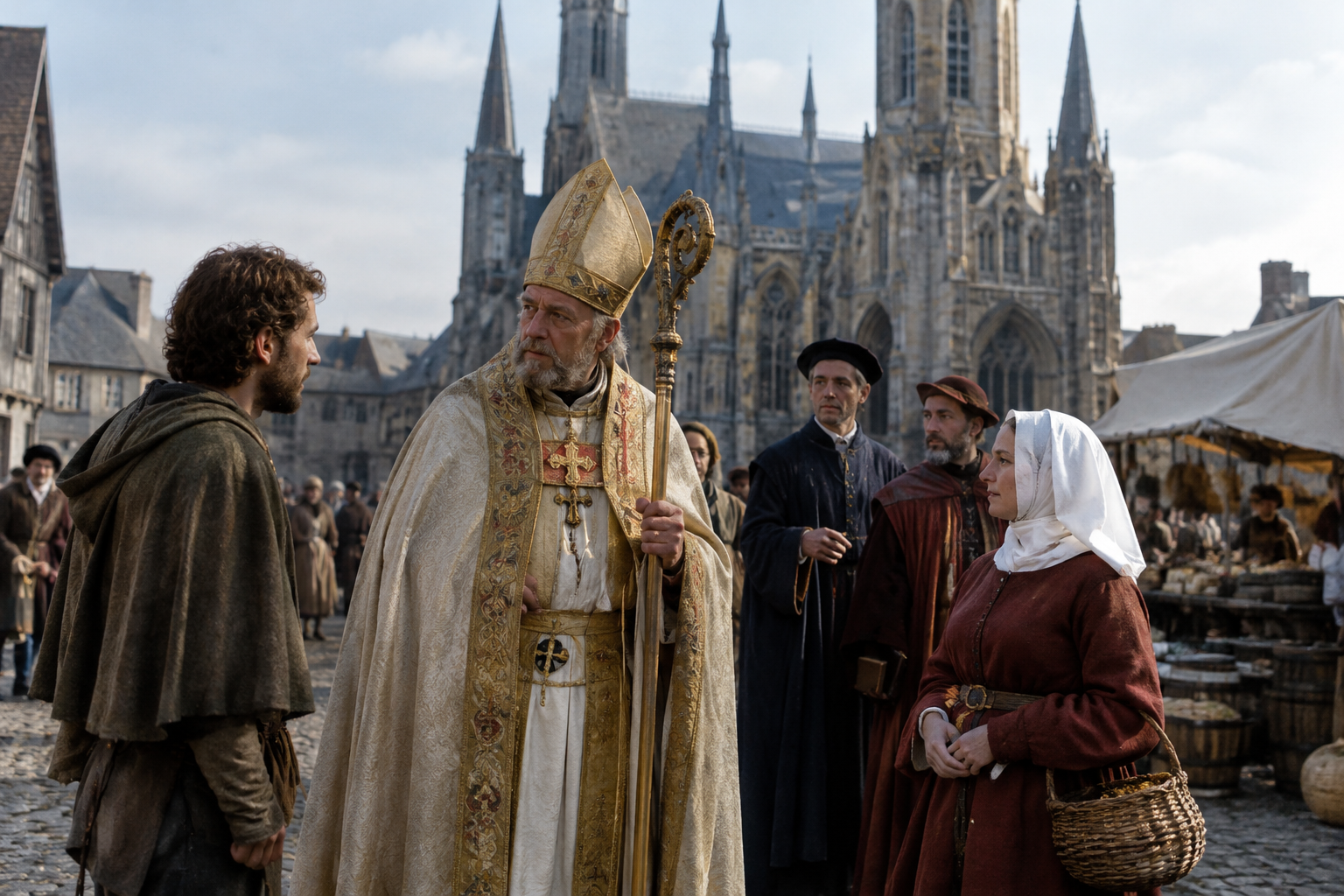
Some of the most evocative samples are early medieval. NCS200, identified as Bishop Teodomiro of Iria Flavia Santiago de Compostela, dated to 847 AD, brings the branch into the Christian north of Iberia. EV8, a Merovingian Period Frankish individual from Eltville in Germany dated to 660 AD, places it in the post-Roman Rhine world. CSK014 from Csokorgasse in the Vienna Basin dated to 650 AD, MS-45 from Early Avar Period Hungary dated to 645 AD, and GAT004 from the medieval riverine settlement of Gars-Thunau in Austria dated to 900 AD extend the map further east into central Europe.
Read about post-Roman Central Europe
What emerges is not a single grand migration story, but a pattern of continuity and reuse across regions that mattered deeply in medieval history: Iberia, northern France, the Low Countries, Britain, the Rhine, and the Danube frontier. That matters when we reach later burials such as the cluster from Late Medieval Belgium St. Rombouts - STR067, STR067d, STR067a, STR067c dated to 1652 AD, and STR091, STR091c, STR091d dated to 1558 AD. Here the lineage has not vanished into prehistory. It is still turning up in an urban Christian setting in the Spanish Netherlands era.
Then there is the Atlantic world. The branch appears among the Historic St. Mary City Chapel Field Cemetery Maryland burials - I35260, I35265, and I15301, all dated to 1634 AD. In other words, the same paternal line that once appeared in Iron Age Yorkshire and Bronze Age Iberia also crossed into the early English colonial world. That is not a noble pedigree; it is something more democratic and, in its way, more revealing: the movement of ordinary and extraordinary men alike through the machinery of European history.
Other finds add texture rather than a tidy plot. ATP_PSN_920 from medieval Cherry Hinton in England dated to 1055 AD, I15027 from medieval Morbihan Saint-Pierre Quiberon in France dated to 1256 AD, VK87 and VK365 from Viking Age Denmark, and even YYY095A, a soldier of Napoleon's Grande Armee from Vilnius dated to 1812 AD, show the branch surfacing repeatedly in new political worlds.
It is against that broad western European background that the supplied noble families make sense. Not as proven descendants of ancient samples, certainly not, but as later occupants of regions where this paternal branch is well attested.
The House of Montmorency belongs in northern France, a landscape already represented in the ancient record by Belgic and Gallic samples from Marne. The Chateau de Montmorency at Montigny-en-Ostrevent began as a fortified medieval residence in a region shaped by feudal rivalry and shifting noble authority. Over time it changed from stronghold to more comfortable seigneurial home, which is precisely the sort of transition that tells us how warrior aristocracies settled into landed power. A Y-DNA lineage like this one, found repeatedly in northern France and the Low Countries, forms part of the deeper regional backdrop to such houses.
The House Gray, associated here with Chillingham Castle in Northumberland, stands in another historically charged zone: the Anglo-Scottish border. Chillingham began as a monastery in the late 12th century, became a fortified manor around 1344, and lived through centuries of raids and war before later becoming a grander residence. One hardly needs ghosts to make that place interesting, though it has acquired those too. More to the point, the ancient evidence places this haplogroup branch in Britain from the Bronze Age onward, with heavy Iron Age representation in Yorkshire and later medieval presence in England. That does not prove a Gray paternal line from those burials, but it does root the story in a very old British landscape.
In the southwest, the House Chichester is linked to Arlington Court in north Devon, a much later house in its present form, built in the 1820s and preserved by the National Trust after the family line dwindled. Here the interest lies less in fortification than in continuity of estate memory. And in north Wales, the House of Salusbury and Lleweni Hall represent a different fate: a great house once central to local gentry life, later demolished in 1912 as fortunes changed. These are reminders that noble houses, like paternal lineages, survive unevenly. Some become museums, some ruins, some footnotes.
For readers interested in one of those families directly, the Salusbury connection opens onto the Welsh borderlands and their long entanglement with English and British history.
Explore the House of Salusbury
The real value of R1b1a1b1a1a2a1b is that it refuses to behave like a simple family legend. It appears in prehistoric caves, Bronze Age barrows, Iron Age chariot-country, Frankish and post-Roman burials, a bishop's grave, late medieval church contexts, and the colonial Atlantic. That is exactly why ancient DNA is so useful. Written genealogy usually begins late and favors the prominent. Y-DNA, cautiously handled, lets us see a paternal line long before surnames and long outside aristocratic record keeping.
It also teaches a useful lesson in restraint. Sharing a haplogroup does not make two men close relatives in any ordinary genealogical sense. It does not prove descent from Montmorency, Gray, Chichester, or Salusbury. What it does provide is historical context: a direct paternal branch with deep roots in western and central Europe, visible across many centuries and several major cultural worlds.
If you want to understand how archaeology and genetics work together on questions like this, there is also a broader guide worth reading.
Learn how archaeogenetics changed history
Upload your DNA to MyTrueAncestry to explore whether your results show connections to ancient individuals, archaeological cultures, and historical populations like those discussed here. Such matches can offer remarkable perspectives on your past, even though they do not by themselves prove direct descent from a specific ancient person or noble house.






Comments