Haplogroup R1b1a1b1a1a2a

– 6 min read


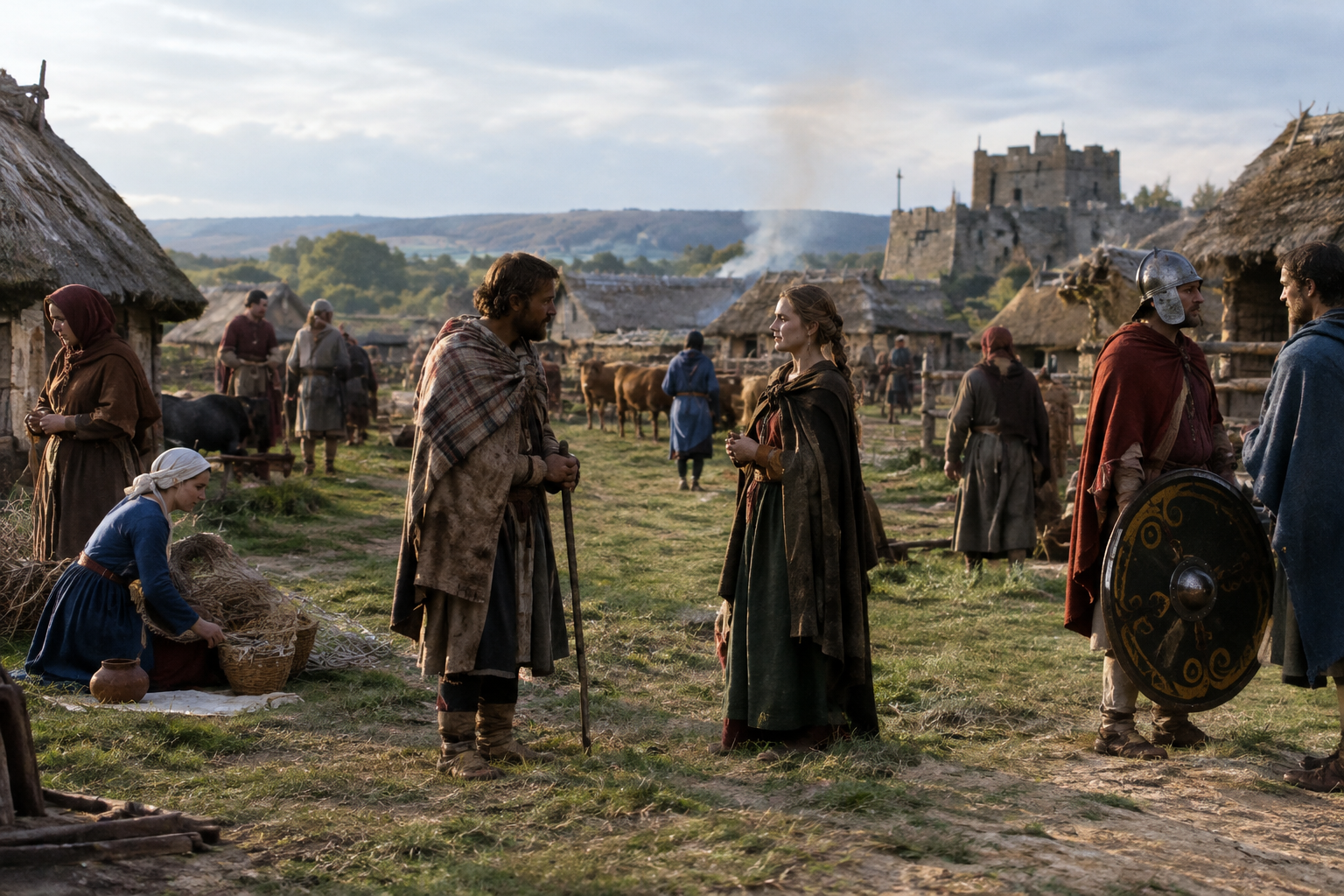
There is something wonderfully awkward, and therefore revealing, about a Y-DNA lineage as specific as R1b1a1b1a1a2a. It sounds less like history and more like an engineer's shelf label. But behind that tangle of letters and numbers lies a very human story: fathers and sons, settlements and warbands, farmers and nobles, all moving through Europe over thousands of years and leaving behind, if we are lucky, a few scraps of bone and a line on the Y chromosome.
It is worth saying at once what Y-DNA can and cannot do. A Y haplogroup traces one direct paternal line only. It does not represent a person's whole ancestry, still less their culture, language, or social identity. But as a narrow thread through the past, it can be extraordinarily useful. In the case of R1b1a1b1a1a2a, the ancient samples supplied here place related paternal lines across a wide swathe of western and central Europe, from Bronze Age France and Iberia to Iron Age Britain, Roman Belgica, medieval Spain, Ireland, and Scotland. That is historically interesting precisely because it suggests not a single people, but a long-lived paternal network repeatedly woven into different societies.
This subclade sits within the broader R1b family, one of the major Y-chromosome lineages found in western Europe today. For a branch as specific as R1b1a1b1a1a2a, caution matters. We should not lazily dump the whole history of broad R1b onto it. Still, the sample pattern here strongly places related paternal lines in Bronze Age and later western Europe, especially in regions that would become important in Celtic, Romano-provincial, and medieval Atlantic histories.
Some of the earliest anchors are in Bronze Age contexts: BRE445FK from les Pointes et les Grevottes, Greviandes, Aube, dated to 2339 BC; SMGB54 from Saint-Martin-la-Garenne in Yvelines, Ile-de-France, dated to 2139 BC; and Iberian cases such as MDP003 from Molinos del Papel, Murcia Caravaca, dated to 2090 BC, and PUC002 from Puntal de los Carniceros, Alicante Villena, dated to 1653 BC. These are not "the origin" in any simplistic sense, but they do show that paternal lines linked to this branch were already established in both Atlantic and inland western Europe deep in prehistory.
Explore Celtic origins through ancient DNA
That matters because later history in these same regions is full of mobility without complete replacement. Men bearing related Y lineages could turn up under very different cultural labels over time: Bronze Age villagers, Iron Age aristocrats, Roman provincials, early medieval settlers. The label changes; the paternal thread sometimes persists.
The Iron Age evidence is especially vivid. In southern Germany, the elite Celtic burials at Asperg-Grafenbuehl and Ludwigsburg Roemerhuegel produced samples such as APG001, APG003, and LWB001, all dated to around 450 BC. These are precisely the sorts of graves that remind us that paternal lineages were not confined to peasants in remote valleys. Men from socially prominent Celtic settings also carried related lines.
Britain then supplies a remarkable concentration. The Durotriges cemetery at Duropolis, Winterborne Kingston, includes WBK103, WBK106, WBK36, WBK105, and WBK23, all dated to 125 AD. Although this is already Roman-period Britain, the Durotrigan setting points to substantial local continuity under imperial rule. In Yorkshire, the Parisi and related Arras culture burials produce an even larger cluster: I36879, I37333, I36965, I36761, I21699, I21861, I5502, and others around 225 BC to 100 BC. When a haplogroup appears repeatedly in one regional archaeological tradition, it does not prove a dynasty, but it does suggest that some paternal lines were firmly embedded in local communities over generations.
There is also Roman and post-Roman mobility. I21059 from Gallia Belgica Tongeren, dated to 35 AD, places the lineage in one of the empire's great northern crossroads. FEN008 from Roman-era Fenstanton in Cambridgeshire, dated to 100 AD, adds another Romano-British point. Later still, the line appears in Gallo-Roman and migration-period contexts such as R2055 and its associated entries from Metz Lunette Sablon in 432 AD, DNA031 from an Alemanni grave at Basel-Waisenhaus in 376 AD, and COL_098b from Lombard-era Collegno in northern Italy in 580 AD.
Read more on Roman and early medieval Britain
None of this means all these men belonged to one coherent "tribe" in the modern imagination. Quite the opposite. What it shows is that related paternal lines could be carried into Celtic, Roman, Germanic, and mixed frontier settings alike.
One of the most intriguing regional clusters comes from northern Spain, especially Las Gobas. There we find ldo062 in 620 AD, then ldo066, ldo037, and ldo040 in 1000 AD, followed by ldo046 and ldo048 in 1025 AD. That sequence does not prove a single uninterrupted family line, but it does hint at notable local persistence in a landscape that experienced Visigothic rule, Islamic expansion elsewhere in Iberia, Christian frontier dynamics, and medieval resettlement.
Other Iberian samples widen the picture: I20382 from early Visigothic Girona in 611 AD, I19670 from early medieval Guadalajara in 601 AD, I30592 from Zaragoza Epila in 600 AD, and I19799 from imperial Roman Tarragona Reus La Canonja Antigons in 375 AD. Iberia, in other words, was not merely receiving outside paternal lines in the Roman and post-Roman periods; it also seems to preserve regional branches over long stretches of time.
Britain and Ireland tell a similar story of persistence mixed with change. The Pict-era Rosemarkie Cave samples in Scotland, including KD001 and related entries dated to 541 AD, place the lineage in the far north of Britain. Medieval Ireland adds Kilteasheen in Roscommon, with KIL047, KIL032, KIL035, KIL024, KIL002, and KIL004, all around 650 AD. Again, this is not a genetic proof of any later clan, but it gives useful context for why certain paternal lines could remain regionally important in Gaelic lands.
Discover Roman Hispania's genetic legacy
By the medieval and early modern periods, the story shifts from burials to buildings. Here one must be disciplined: an association between a haplogroup and a noble family in community tradition or project matching is not the same thing as a documented, proven paternal descent for every member of that family. Still, the supplied noble houses help place this haplogroup in the landscapes where its deeper history appears.
In northern Spain, the House Jimenez is tied not to a fortress but to Pamplona Cathedral, the great ecclesiastical heart of Navarre. That is rather fitting. Haplogroups do not only belong to castles and battlefields; they also belong to cathedral chapters, kingdoms, and urban lineages. In southeastern Spain, the House Pacheco brings us to Atalaya Castle in Villena, a hilltop fortress with Islamic beginnings and major Christian rebuilding under Juan Pacheco in the fifteenth century. Given the Bronze Age and medieval Iberian sample spread, that castle stands in a region where paternal continuity and political reinvention have long coexisted.
Across the Irish Sea and into Britain, the same pattern continues. Clan ODonovan is remembered through Castle Donovan in west Cork, a tower house from the turbulent late Gaelic world. Clan Dwyer is linked with Killenure Castle in County Tipperary, another fortified residence shaped by local rivalry and later decline. In Scotland, Clan Cathcart held Cathcart Castle above the White Cart Water near Glasgow; Clan Sutherland possessed Dunrobin Castle, later transformed into a grand chateau-like seat; and Clan Murray is associated with mighty Bothwell Castle, begun in the late thirteenth century and battered in the Wars of Scottish Independence.
These places do not prove a haplogroup. What they do provide is historical topography. If related paternal lines were present in Iron Age Britain, Pictish Scotland, and early medieval Ireland, then later clan territories in those same broad regions become meaningful settings in which such lineages might survive, divide, and be absorbed into new political identities.
Explore the history of Clan Cathcart
The great value of R1b1a1b1a1a2a is not that it hands us a neat ethnic label. It does not. Rather, it shows how one paternal branch can appear in Early Bronze Age France, Bronze Age Iberia, elite Celtic Germany, Iron Age Yorkshire, Roman Belgica, Pictish Scotland, medieval northern Spain, and Gaelic Ireland. That is a history of durability, spread, and adaptation.
It also shows why ancient DNA is so useful alongside written history. A castle tells us who claimed power in stone. A chronicle tells us who won, who lost, and who married whom. A Y-chromosome lineage tells us that beneath those visible dramas, some paternal lines had been moving through the same regions for centuries or even millennia. Not unchanged, of course; history changes everyone. But still present.
If you want one final image for this haplogroup, make it architectural. Not a single tower, but a long wall patched and rebuilt over generations: Bronze Age foundations, Iron Age additions, Roman repairs, medieval battlements, and modern ivy.
If your own Y-DNA belongs somewhere near this branch, MyTrueAncestry can help you explore whether your paternal line shows connections to ancient individuals such as ldo062 from Las Gobas, I21059 from Tongeren, or the Iron Age men of Yorkshire and Duropolis. These matches do not prove direct descent from a noble house or a named ancient person, but they can place your family line in the same deep historical world.
Upload your DNA and see whether your ancestry reaches toward the caves, cemeteries, cathedral towns, and castle lands where this lineage once appeared.






Comments