Haplogroup R1b1a1b1a1a1g1

– 6 min read


Some Y-DNA haplogroups arrive with great fanfare: they are broad, famous, and easy to place in the public imagination. R1b1a1b1a1a1g1 is not like that. It is a narrow branch, deep inside the wider R1b tree, and that is precisely what makes it interesting. Small branches can be historically revealing because they force us away from lazy labels and toward the real business of history: movement, mixture, local survival, and the odd persistence of male lines across many centuries.
Y-DNA traces one direct paternal line only: father to son to son. It does not describe a person's whole ancestry, culture, language, or identity. Still, when ancient DNA turns up related branches across Bronze Age Germany, Iron Age central Europe, Roman frontier zones, Anglo-Saxon England, Viking Age Scandinavia, and medieval Flanders, we begin to see not a single people marching through history, but a line that kept reappearing in some of the most contested and connected parts of Europe.
This haplogroup belongs within the vast R1b family, one of the major Y-chromosome lineages in western Eurasia and especially well known in much of Europe. But one must be careful here. The long and complicated history of R1b as a whole cannot simply be pasted onto the much narrower branch R1b1a1b1a1a1g1. What we can say more responsibly is that the ancient samples supplied here place related paternal lines in a striking arc from the North Sea and Scandinavia through central Europe and down into the Roman and post-Roman Balkans.
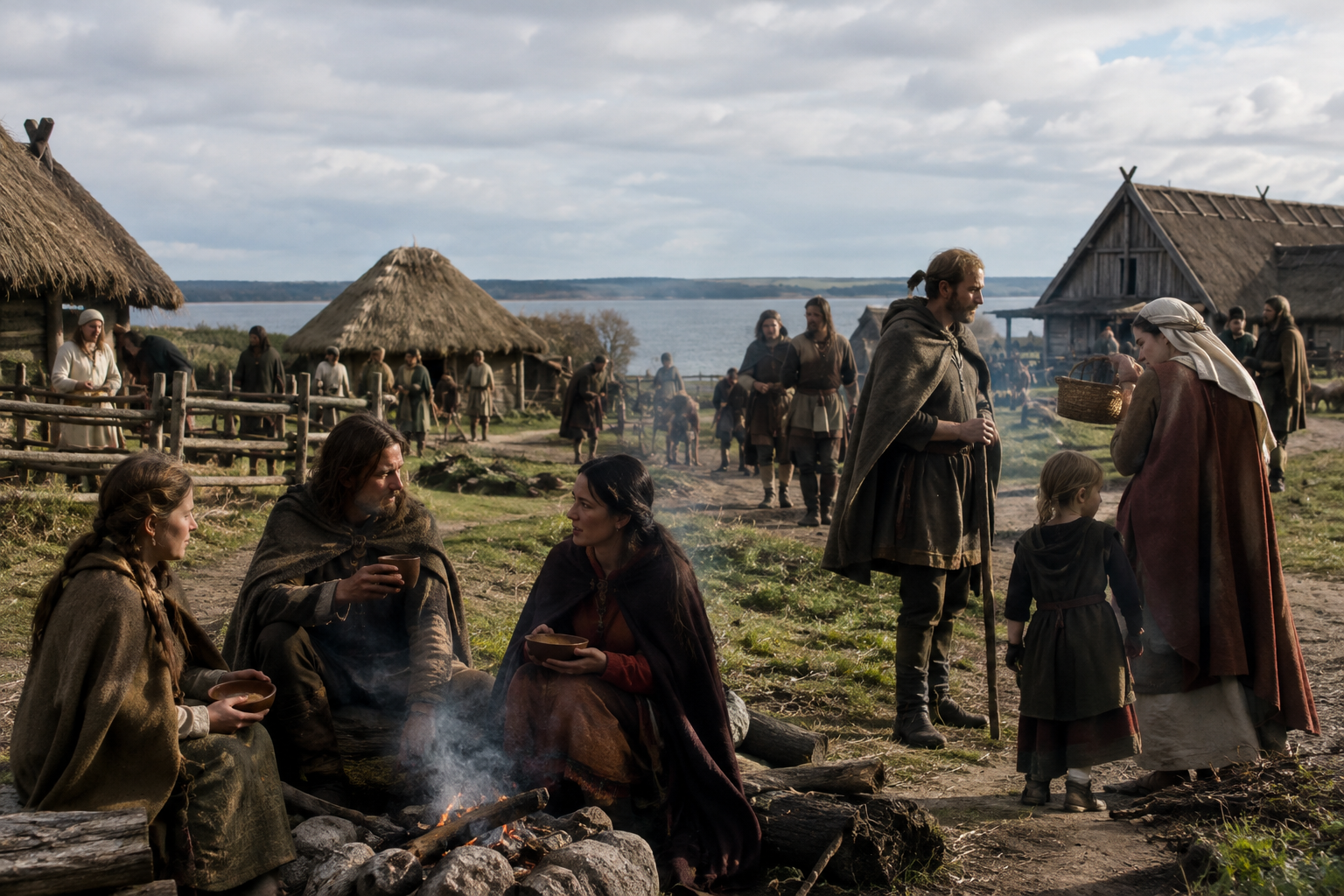
The pattern suggests that this branch, or very closely related branches above and beside it, belonged to populations active in central and northern Europe over a very long period. Some appearances fit prehistoric contexts linked to the spread of steppe-derived ancestry into Europe; others belong to Iron Age and Roman-era societies; and many cluster in early medieval settings associated with Germanic-speaking groups, North Sea networks, and the making of early England.
Explore Central European Celtic DNA
The earliest signpost in this dataset is impressively old: I12902, a Late Neolithic Vlaardingen/CordedWare individual from Mienakker in the Netherlands dated to 2682 BC. Another early appearance comes from Scandinavia in RISE98, a Battleaxe culture sample from L Beddinge 56 in Sweden dated to 2079 BC. Then there is LEU007, from Bronze Age Unetice Thuringia at Leubingen-Sommerda, Germany, dated to 1950 BC. Even without overclaiming exact branch continuity, these finds matter because they place related paternal lines in the world of late Neolithic and early Bronze Age northern and central Europe.
That is a world archaeologists know well: expanding exchange networks, new burial customs, mobile elites, and communities increasingly tied together across large distances. If you are looking for the deeper backdrop to this haplogroup, these are the kinds of societies that deserve attention.
By the Iron Age, the branch appears in several different settings. CGG101214, from Celtic Iron Age Hallstatt in Austria dated to 550 BC, hints at a place for related lineages in the central European zone often discussed in connection with early Celtic cultural development. Hung160, from Iron Age Hungary at Kesznyeten-Szeruskert dated to 150 BC, and CGG023274, an Iron Age Jutland Denmark bog skeleton from Nygaard_Mose dated to 218 BC, show that this was no tiny local curiosity. It had a footprint stretching from the Carpathian Basin to the Danish world.
The Roman period makes the picture more interesting rather than less. I15527 from Imperial Roman Viminacium in Serbia, Pecine Necropolis, dated to 100 AD, places the lineage in one of the great military and urban crossroads of the Danube frontier. OSIJ003, a Roman-period Germanic warrior from Mursa in Croatia during the Third Century Crisis, dated to 260 AD, reminds us that Roman frontiers were not clean lines on a map. They were zones of recruitment, settlement, trade, and violence. R11121 from Imperial Roman Era Isola Sacra dated to 200 AD and TAQ013 from Etruscan Tarquinii dated to 400 BC further show that related paternal lines could also appear in Italy, though that should not be mistaken for a single Italian origin story.
Read about Rome's frontier mixing
Where this dataset becomes especially dense is the Migration Period and early medieval north. There are multiple relevant samples from Pannonia and adjacent regions: GYS029 from Late Antique Arrabona in Hungary dated to 425 AD; SZL050, SZL051, and SZL076 from Longobard Period or Migration Period Savaria-Szeleste Barbaricum in Hungary dated to 525 AD; and I18184 from Early Medieval Hungary, Holt-Tisza-part, dated to 650 AD. Add STR393b and STR316b from Straubing-Bajuwarenstrasse in Bavaria dated to 410 AD, and the impression is of a paternal line quite at home in the shifting societies of post-Roman central Europe.
Then come the Anglo-Saxon and Saxon finds, and they are hard to ignore. In England alone the list includes BUK012, BUK060, BUK064, BUK070, and BUK007 from Buckland Dover around 400 AD; OAI006 and OAI013 from Oakington dated to 470 AD; EDI064c from Anglo-Saxon Edix Hill, Cambridgeshire dated to 545 AD; and I11583, I20652, and I11584 from West Heslerton in Yorkshire around 500-550 AD. Across the North Sea, there are matching points in Saxony-Anhalt and Lower Saxony: BRC006x, RTW012, HID003, HID004, plus DUN006, DUN009, and DUN011 from Dunum dated to 840 AD.
This is exactly the sort of evidence that helps explain how a paternal line could move from continental Europe into early medieval England. Not by a single invasion arrow in a schoolbook, but through repeated crossings, settlements, kin groups, and local integration over generations.
Scandinavia also remains in view: CGG106724 from the Danii tribe in Denmark dated to 175 AD, urm160x from Viking Age Sigtuna in Sweden dated to 935 AD, and SWG001 from post-Viking Age Hedeby in Southern Jutland dated to 1140 AD. These samples place related paternal lines in the maritime north long before and after the classic Viking Age.
Discover Anglo-Saxon migration DNA
What, then, do we do with a later noble family such as the House Vaughan? With care, in a word. The supplied material links the Vaughan family with Tretower Court in Powys, Wales, a site that began as part of a Norman frontier settlement beside Tretower Castle and developed into a distinguished medieval manor house in the fourteenth and fifteenth centuries. Over time it shifted from a defended residence into a more comfortable gentry home, with a great hall, private rooms, and Tudor-style alterations expressing changing ideas of status and domestic life.
This is the Welsh Marches at their most revealing: a region where Norman power, Welsh tradition, military architecture, and landed ambition all met. Tretower Court is valuable not because it proves a haplogroup, but because it preserves the social world in which paternal lineages mattered greatly to inheritance, lordship, and memory. Men cared very much about who their fathers were, who held the estate, and whose name attached to the hall. That does not mean the documentary family line and a genetic line always matched neatly, but it does explain why Y-DNA can sometimes speak so interestingly to medieval history.
The Vaughans therefore belong here as a historical association, not as proven carriers of this exact haplogroup in every branch. Their world was one in which old regional lineages, Marcher politics, and family identity were made visible in stone. Restored in the twentieth century, Tretower Court now offers one of the best surviving views of elite domestic life on that borderland between fortress and household.
Explore the Vaughan family story
The real lesson of R1b1a1b1a1a1g1 is not that it "belongs" to one people. The samples point instead to a paternal line with deep roots in the European north and center, turning up in Late Neolithic and Bronze Age contexts, surviving into Iron Age societies, appearing on Roman frontiers, and becoming especially visible in Migration Period, Anglo-Saxon, Saxon, Danish, and Viking Age settings.
There are also medieval appearances in the Low Countries, such as ST2969 from Carolingian Sint-Truiden dated to 795 AD, ST0323 and ST0786 dated to 900 AD, ST0024 dated to 1090 AD, and WPK005 from post-Carolingian Flanders at Wulpen dated to 1162 AD. That matters because it shows continuity into the high medieval North Sea world, the same broad zone that connected England, Flanders, Frisia, Saxony, Denmark, and beyond.
Ancient DNA and medieval history are useful together precisely because they do different jobs. Genetics can reveal long-term paternal patterns invisible in chronicles. Castles and manor houses preserve the social settings in which families remembered themselves. Neither one replaces the other. And neither can, on its own, prove that an ancient man from a cemetery in Hungary or Yorkshire was the direct ancestor of a later noble house in Wales.
If your Y-DNA falls within R1b1a1b1a1a1g1, or near it, you are looking at a paternal line with a long archaeological trail across northern and central Europe. MyTrueAncestry can help you compare your DNA with ancient individuals such as LEU007, EDI064c, urm160x, or the many Saxon and Migration Period burials discussed here. These matches can offer remarkable historical perspective, even though they do not by themselves prove direct descent from any one ancient person or noble family.
Upload your DNA and see where your own story meets the cemeteries, strongholds, and borderlands of the past.






Comments