Haplogroup R1b1a1b1a1a1g

– 6 min read


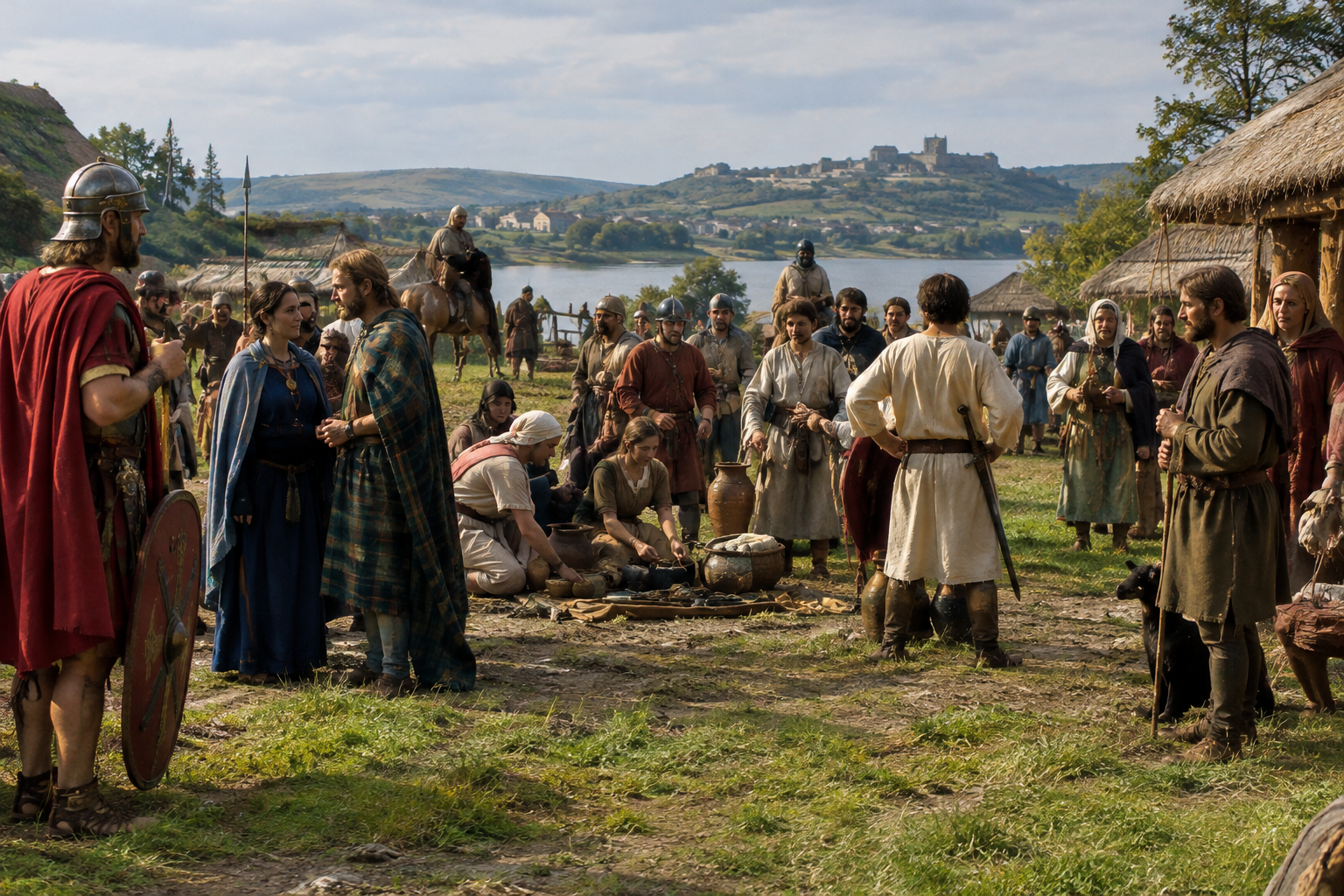
Some Y-chromosome lineages announce themselves in the historical record not through one kingdom or one people, but by cropping up again and again in the busy places of Europe: Bronze Age graves, Celtic burials, Roman frontiers, Pictish caves, Saxon cemeteries, medieval monasteries. Haplogroup R1b1a1b1a1a1g belongs to that kind of story. It is a very specific paternal branch within the wider R1b family, and that matters, because the broader fame of R1b in western Europe should not be lazily poured into every narrow subclade as if all its history were identical.
What Y-DNA gives us is a record of direct father-to-son descent across deep time. It is powerful, but also limited: a Y-haplogroup traces only one paternal line among the many ancestors any person has. Still, when a branch like R1b1a1b1a1a1g appears across so many archaeological settings, it becomes a useful thread for following long-term male-line continuity, mobility, and regional persistence. The result is not a fairy tale of pure bloodlines, but a much more interesting picture of Europe as a place of repeated movement, settlement, and local survival.
The safest place to begin is not with medieval surnames or modern identities, but with the deep archaeological horizon. Among the oldest supplied examples linked to this haplogroup are Early Bronze Age and late Copper Age individuals spread across western and central Europe: BRE445FK from les Pointes et les Grevottes, Greviandes, Aube in France, dated to 2339 BC; SMGB54 from Saint-Martin-la-Garenne, Yvelines, Ile-de-France, dated to 2139 BC; I7288 from Copper Age Radovesice in the Czech region, dated to 2350 BC; I4890 from Copper Age Prague Kobylisy, dated to 2220 BC; and I5661 from Copper Age Irlbach, Straubing-Bogen, Bavaria, dated to 2250 BC.
That distribution suggests a branch already established in parts of temperate Europe during the centuries when older Neolithic worlds were being transformed by new social systems, changing burial customs, and expanding networks of exchange. Other early finds reinforce that pattern: VLI092, VLI085, and STD002 from Bronze Age Corded Ware contexts in Bohemia around 2100 BC; I12902 from Late Neolithic Vlaardingen/CordedWare Netherlands Mienakker, dated to 2682 BC; and I13025 from Early Bronze Age Bell Beaker Molenaarsgraaf in the Netherlands, dated to 1892 BC. These do not prove a single simple migration route, but they do place closely related paternal lines in the archaeological world shaped by Bell Beaker and Corded Ware expansions and their aftermath.
If you want the wider archaeological background to that shifting landscape, MyTrueAncestry readers may enjoy this related piece on the Lower Rhine and the Beaker world.
By the time we reach the Bronze Age proper, the lineage is visible in societies often associated with growing hierarchy and long-distance connectivity. The Unetice samples from Leubingen, Sommerda in Thuringia, Germany - LEU040, LEU065, and LEU007, all dated to 1950 BC - are especially striking. So too are WEHR_1474 and WEHR_1564 from Bronze Age Wehringen, and AITI_50 from a North Alpine Bronze Age context. We are looking here not at one isolated family, but at a paternal branch turning up repeatedly in the communities that helped shape Bronze Age central Europe.
Then the story becomes even more vivid, because this haplogroup appears in recognizably Iron Age and Roman-period settings across a huge arc of Europe. There is LWB002_ss and LWB002_ss_b from the elite Celtic burial at Ludwigsburg Roemerhuegel in Germany, dated to 450 BC. There is CGG101214 from Celtic Iron Age Hallstatt in Austria, dated to 550 BC, and I11715 from Celtic La Tene Iron Age Bratislava, dated to 95 BC. In France we meet CHF106 from Champfleury, Marne, dated to 430 BC, BES1096B from Gallic Volcae Monderiere, Bessan, dated to 450 BC, and CGG022436 from the Belgic Suessiones at Bucy-le-Long, dated to 330 BC.
This is the sort of evidence that tempts people to call a lineage "Celtic" full stop. Better not. What it does show is that paternal lines of this branch were present in several populations archaeologists classify as Celtic or Gallic. That is important, but not the same as saying the haplogroup belongs to one ethnicity for all time.
Britain adds another layer. WBK106, a Celtic Durotriges individual from Duropolis, Winterborne Kingston in England, dated to 125 AD, and I7632 from Celtic Briton Slonk Hill, Sussex, dated to 295 BC, place the lineage firmly in pre- and Roman Britain. So do I19653 from Ham Hill Fort in Somerset and I20632 from Fin Cop in Derbyshire. Meanwhile, I21059 from Gallic Belgium, Gallia Belgica, Tongeren, dated to 35 AD, and I15527 from Imperial Roman Viminacium in Serbia, dated to 100 AD, remind us that Roman-era populations were never neatly local. Soldiers, traders, camp followers, and provincial families circulated along roads and rivers from the Rhine to the Balkans.
Readers interested in that western imperial setting may want to follow up with this broader look at Iberia under Rome.
Read Roman Hispania's DNA Story
If this lineage had vanished with the Iron Age, it would already be interesting. But it does not. Instead it continues appearing in the churn of late antiquity and the early medieval centuries. In Scotland, the Pict-era Rosemarkie Cave on the Black Isle offers a remarkable cluster: KD001, KD001_2, KD001_3, KD001_4, KD001_6a, and KD001_6b, all dated to 541 AD. That concentration matters. It places this paternal branch in northern Britain in a specifically Pictish-era context, centuries before later clan genealogies took written form.
In England and across the North Sea zone, the same branch appears in early Anglo-Saxon and Saxon contexts: EDI064c from Edix Hill, Cambridgeshire, dated to 545 AD; BUK064, BUK070, BUK060, BUK012, and BUK007 from Buckland, Dover, dated to 400 AD; OAI006 and OAI013 from Oakington, dated to 470 AD; I11583, I11584, and I20652 from West Heslerton; and the Dunum samples DUN002, DUN006, DUN009, and DUN011 in Lower Saxony, dated to 840 AD.
Elsewhere, the lineage turns up in Migration Period and post-Roman central Europe: DRH046, DRH017, and RTW012 in Saxony-Anhalt; Bur6 in Merovingian Bavaria; GYS029, SZL050, SZL051, SZL061, SZL073, SZL076, and MFC006 in Pannonia and adjacent Hungarian regions. That spread suggests not a single "tribal" signature, but a paternal lineage woven into several post-Roman populations.
For a wider look at how these centuries reshaped Britain, this article is particularly relevant.
The medieval record is equally revealing. We see samples in Belgium at Sint-Truiden - ST2969, ST2455, ST0323, ST0786, ST2335, ST3037, ST3076, ST0024, and ST2542 - in England at Cherry Hinton (ATP_PSN_944) and Cambridge St Johns Hospital (ATP_PSN_36), in Spain at Las Gobas (ldo040 and ldo046), in Portugal at Castro de Avelas and Santarem, and in Scandinavia at Sigtuna (urm160x), Frojel (VK57), Ljungbacka (VK217), and Vasterhus (wes004). One line, many regions, many historical settings.
This is where documentary history and genetic history begin to stand side by side. The supplied noble association is Clan Paisley, tied to Paisley Abbey in Renfrewshire, Scotland. The abbey began in 1163 as a Cluniac priory founded by Walter fitz Alan and became a wealthy medieval monastery before being raised to abbey status in the 1200s. It was closely linked with the Stewart family, and local tradition holds that Marjorie Bruce, daughter of Robert the Bruce, was buried there after her death near Paisley in 1316.
That makes Paisley Abbey an ideal historical anchor for this haplogroup's story, not because the building proves a Y-line, but because it sits in a region where ancient and medieval paternal histories overlap. The Pict-era finds from Rosemarkie show that related paternal branches were present in Scotland long before the abbey was founded. By the high Middle Ages, Renfrewshire had become part of a thoroughly documented political world of monasteries, landholding families, royal patronage, and wars of independence. Genetics cannot bridge that gap on its own, but it can show that some paternal lineages in Scotland were very old indeed.
The abbey itself lived several lives: damaged in the Wars of Scottish Independence, diminished after the Reformation of 1560, partially ruined, then restored in the 19th and 20th centuries. Excavation there uncovered important finds, including one of the oldest known examples of musical notation in Scotland. In other words, Paisley Abbey is not merely a backdrop. It is a storehouse of memory, where religion, dynasty, local identity, and archaeology all meet.
For readers who want to follow the Paisley connection further, and also the Stewart orbit around it, these community articles are a natural next step.
R1b1a1b1a1a1g is historically interesting not because it can be pinned to one banner, but because it resists that simplification. In the supplied evidence it appears in Bronze Age France, Bohemia, Bavaria, and the Low Countries; in Iron Age Celtic and Gallic settings; in Roman provincial worlds from Britain to the Balkans; in Pictish Scotland; in Anglo-Saxon England; and across medieval western and central Europe. That makes it a fine example of how a paternal lineage can endure through enormous cultural change.
But this is also where caution matters most. Sharing a haplogroup with an ancient individual does not make that person your direct ancestor. Nor does a haplogroup association with a clan or noble setting prove descent from a named family, king, or abbey founder. What it does offer is something subtler and, in some ways, more valuable: a way to place one paternal line within the long human history of settlement, mobility, and survival.
And if Scottish regional continuity and deep-time kinship interest you, this related article is well worth exploring too.
Explore Ancient Kinship in Scotland
MyTrueAncestry lets you compare your DNA with ancient individuals and historical populations from precisely these kinds of sites. You may find connections to Bronze Age Europe, Iron Age Britain, Pict-era Scotland, or medieval communities across the continent. Those matches do not prove direct descent from a noble house or a famous burial, but they can offer a vivid and evidence-based new perspective on your ancestry.






Comments